
Search Governance: The operating system between evidence, strategy and execution
8 min read
A search issue touches Marketing, Product, Technology and an external agency. Everyone can see part of it. Nobody owns the complete condition.
The agency can recommend. Technology can implement. Product can approve the promise. Marketing can fund the work. Leadership can resolve priority. But without a shared decision system, the finding moves between teams until the commercial moment has passed. Search Governance exists for that gap.
The model at a glance
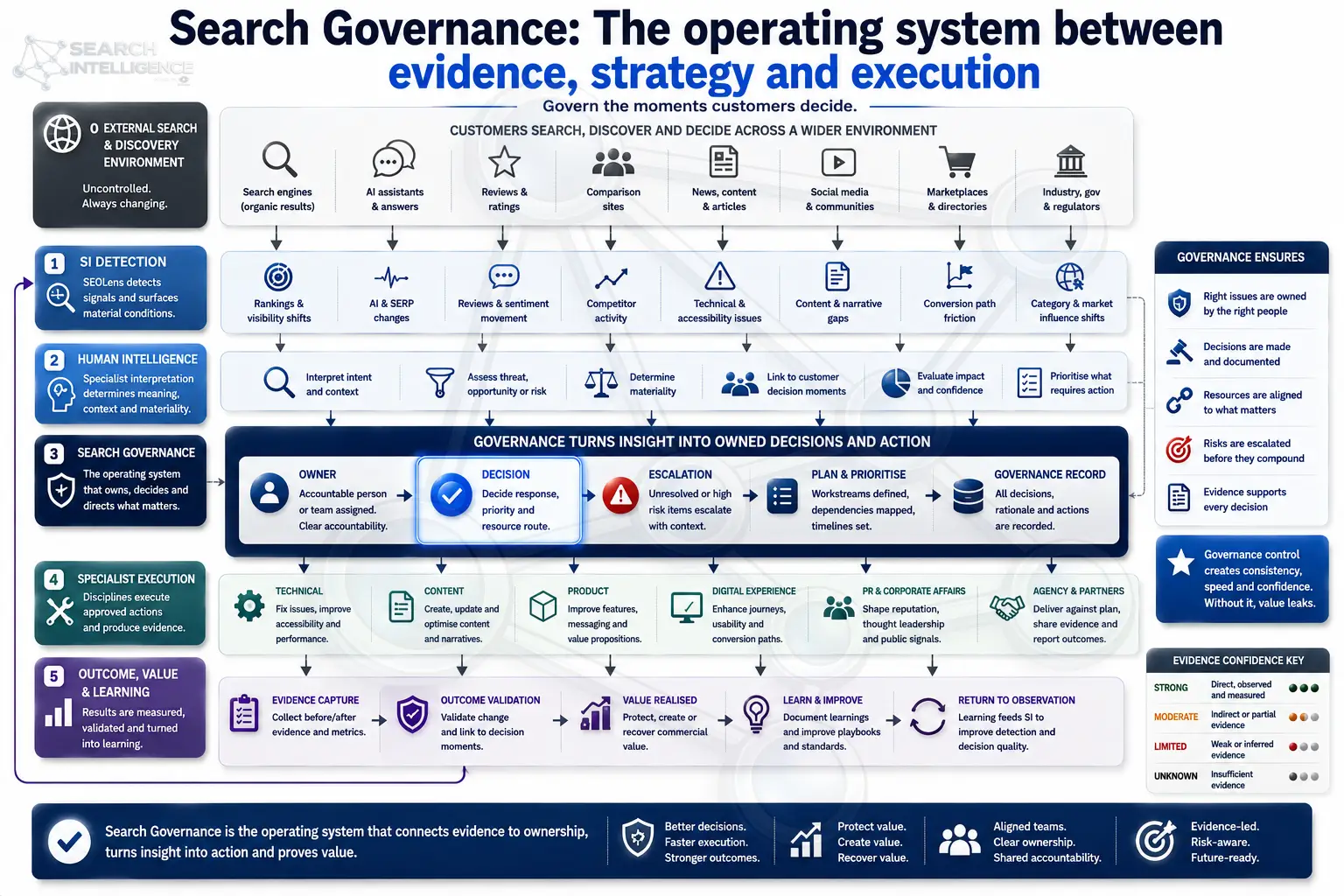
WHY: Search problems become organisational problems
Search is often managed as a channel. Customers experience it as a decision environment. The evidence may involve Organic Search and paid media; reviews and reputation; Product facts and claims; AI answers; technical systems; comparison platforms; Sales objections; Customer Experience; and agencies and partners. No single team controls all of these conditions. The organisation therefore needs a way to decide what matters, assign authority, mobilise the right specialists and review what changed. Without that layer, three failure patterns repeat:
Search Governance is not another execution service
SEO improves Search Eligibility, relevance, visibility and performance.
Search Intelligence establishes what is happening, why it matters and what is materially significant.
Search Governance governs how the organisation owns, decides, responds, escalates and learns.
Specialist teams implement the approved work.
SI does not replace internal teams or agencies. It improves the conditions in which their work is prioritised, approved and connected to the customer and business outcome.
HOW: The complete operating chain
Observation Evidence Interpretation Materiality Owner Decision Mobilisation Implementation Outcome Value Learning
Observation and evidence
SEOLens and other sources capture the relevant customer, competitive, technical and market condition.
Interpretation
Human Intelligence tests context, alternative explanations and evidence quality.
Materiality
Search Intelligence determines whether the condition is capable of changing a customer, commercial, reputational, technical or organisational outcome.
Ownership and decision
Search Governance assigns the accountable owner, decision rights, priority, accepted exposure and escalation route.
Mobilisation and execution
Approved work becomes a governed workstream. SEO, Content, Product, Brand, Technology, Customer Experience, agencies and assurance specialists execute according to authority.
Outcome, value and learning
The environment is re-observed. The Evidence Trail records what changed, what remained Unknown and what the organisation should learn.
A governance forum should not become a longer status meeting. Its purpose is to decide which material conditions require action, which need more evidence, who owns the response, which dependencies require escalation, which exposure is accepted or deferred, whether completed work changed the outcome, and what value was created, protected, recovered or clarified. Supply it with a short executive scoreboard, evidence links and clear decision requests, not a data dump.
Who can approve Product truth, commit Technology capacity, own customer and commercial consequence, validate financial claims, accept residual exposure, publish or disclose evidence, and escalate urgent conditions. A detailed RACI is helpful only when these real authority questions are answered.
Working with agencies and specialists
Agencies often know what should be done but cannot control client-side approval, capacity or prioritisation. Search Governance translates recommendations into business decisions, establishes materiality, identifies client-side owners, preserves dependencies and blockers, sets completion evidence, reviews outcomes and protects agencies from accountability for authority they do not possess.
Where the organisation chooses not to act, the decision should record the reason, residual exposure, owner and review trigger.
WHAT: What governance leaves behind
A Search Exposure Map, a material risk and opportunity register, evidence-status records, an ownership and decision matrix, a prioritised governance roadmap, implementation briefs, a decision log, an executive scoreboard, outcome and value records, and retained learning.
These artefacts make search less dependent on institutional memory, individual suppliers and repeated rediscovery.
Visible
Material exposure can be seen.
Accountable
Owners, decisions and priorities are assigned.
Governed
Cadence, escalation, evidence and value tracking operate consistently.
The objective is not more governance activity. It is fewer unowned conditions, faster responsible decisions and stronger organisational learning.
A worked operating example
A financial-services organisation identifies three connected conditions: a competitor is gaining first-page presence around retirement planning; customer searches reveal uncertainty about adviser fees; the approved fee explanation exists but is difficult to find and inconsistent across two public sources.
SEO can improve discovery. Content can clarify the explanation. Product and Compliance must approve the truth. Technology may need to correct templates. Corporate Affairs may need to address an external source. Finance may want to understand the value of the exposed segment. Search Governance turns this into one managed decision:
The decision record then names the business owner, authorised reviewers, specialist implementers, external dependencies, evidence status, review date and residual exposure.
What governance should feel like for the client
The client should experience fewer disconnected recommendations, clearer explanation of why the work matters, less blame between teams and suppliers, explicit trade-offs, decisions that survive beyond meetings, visible blockers, outcome review and retained learning.
Governance should not feel like an additional layer of bureaucracy. It should remove the repeated translation and uncertainty that already consume time.
What changes during the first 90 days
Establish
Define the business question, scope, baseline, evidence and stakeholders.
Decide
Interpret material conditions, challenge assumptions and record decisions.
Mobilise
Convert approved decisions into owned workstreams with completion evidence.
Re-observe
Review early outcomes, unresolved conditions and the next governance cycle.
The exact timing depends on scope. The operating logic remains consistent.
The customer remains the reference point
Search Governance is not governance for its own sake. Every material record should connect back to the customer's ability to find the organisation, understand the offer, trust the evidence, compare alternatives, complete a viable next step, and receive an experience consistent with the promise.
That reference point keeps the operating system commercially and ethically useful.
Govern the handoff between knowing and doing.
Explore how SI works, or see how organisations engage SI.