Grow
See where the organisation can strengthen its ability to be found, understood, trusted, preferred and chosen.
Search Intelligence measures your Organic Search Performance against the market, so leadership can see where the business is strengthening, where competitors are taking ground, where customers or commercial value may be slipping away, and where action matters.
SEOLens provides the evidence. Experienced people interpret what it means. Search Governance turns material findings into clear ownership, decisions, action and outcome review.
SEO improves performance. Search Intelligence explains what is changing across the market. Search Governance makes the response accountable.
Independent · Agency-agnostic · Evidence-led
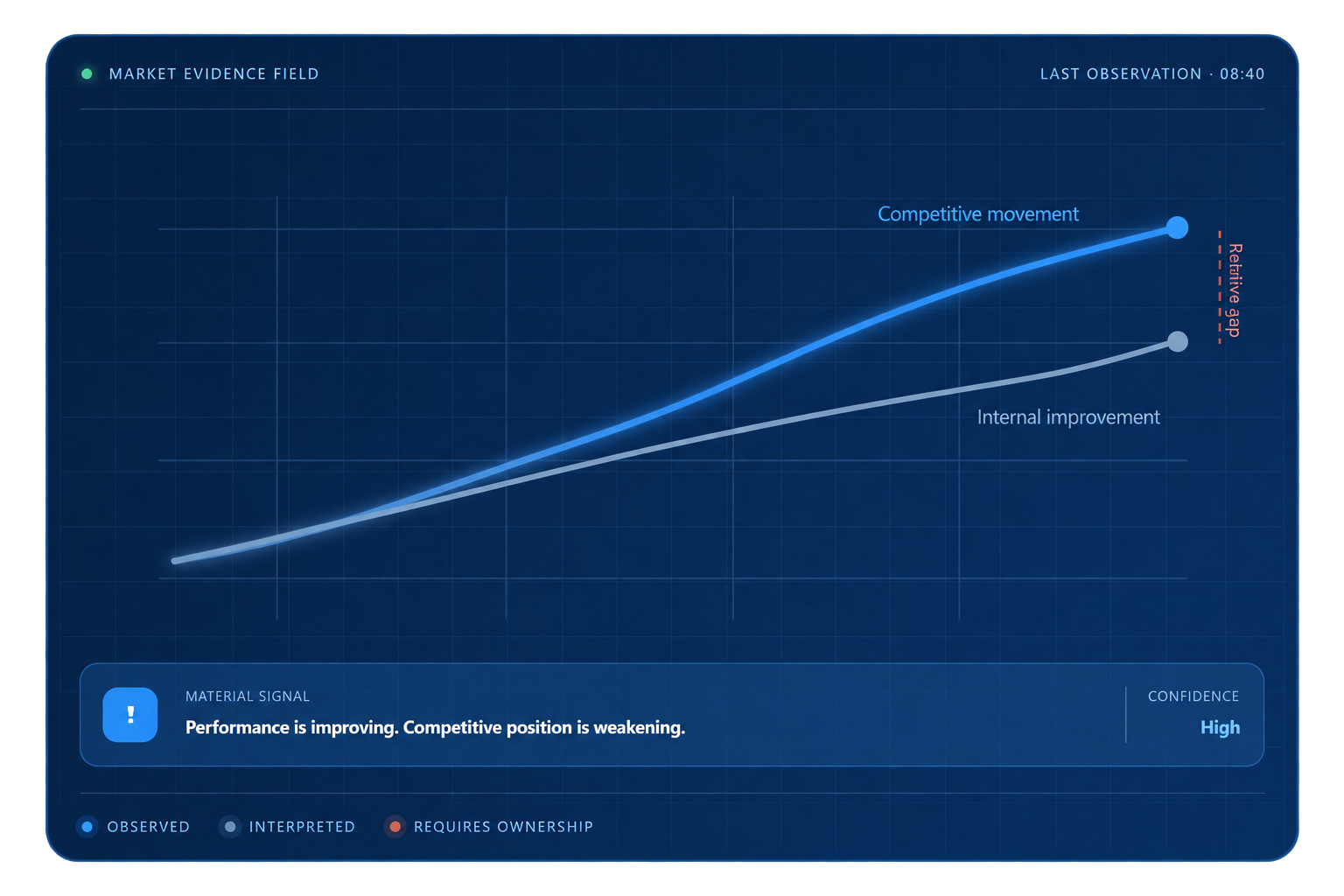
Most reporting compares the business with itself. Traffic this month versus last month. Rankings up or down. Conversions against target. Those numbers matter. They just do not show the whole market.
Your customers are not comparing you with last month. They are comparing you with everyone else they could choose.
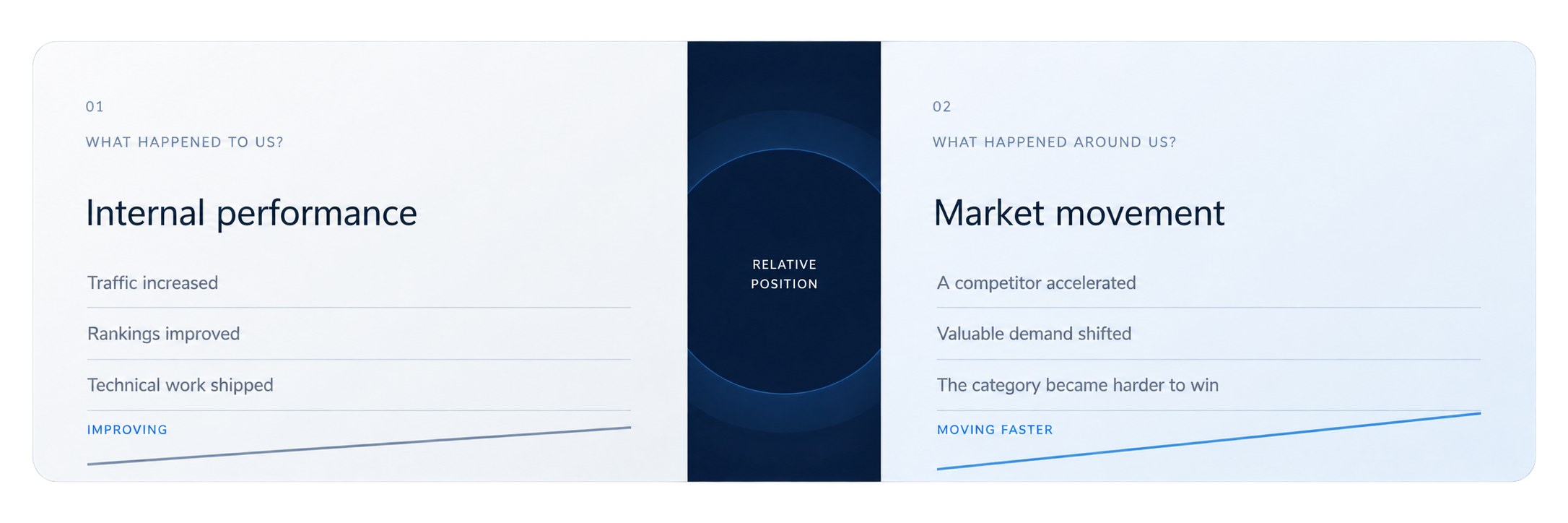
Your business can improve and still lose ground because a competitor is improving faster. Overall performance can look healthy while another organisation quietly becomes stronger around one valuable Product or service. A ranking can fall because something changed on your website. It can also fall because the market moved around you.
The difference changes what you do next. We help answer two connected questions:
What happened to us?
What happened around us?
Visibility gives the organisation an opportunity to enter the customer's consideration.
Trust and Influence help determine whether that customer keeps moving, who becomes the preferred choice and where the demand eventually goes.
Search Intelligence helps management see where those conditions are strengthening, where customers or commercially important demand may be moving elsewhere, and where competitive position or existing investment needs a closer look.
The same evidence supports four different jobs.
See where the organisation can strengthen its ability to be found, understood, trusted, preferred and chosen.
See where customers, commercially important demand, competitive position or existing value may face avoidable loss.
Direct attention, ownership and investment towards conditions important enough to deserve a response. Stop spending time on those that do not.
Return to the evidence and establish whether the response improved the condition.
Search Intelligence does not replace the specialists who do the work.
It gives leadership the wider view needed to decide what matters, who owns the response and what happened afterwards.
We built SEOLens to observe more than one website. It records the Organic Search environment around the organisation over time: performance, competitors, commercially important demand, Products and services, technical conditions, historical movement, and the search and AI evidence customers may encounter.
That history helps us distinguish between three very different situations:
A conventional report can make those situations look similar. They may need completely different responses.
SEOLens helps us see the difference. It does not decide what the business should do. That calls for judgement.
Then we look again:
Did the condition actually improve?
The answer becomes new evidence.
My route into Organic Search began in engineering, not marketing.
Engineering taught me to question an output that did not fit the system around it. When the result made no sense, I learned to look beyond the symptom.
I carried that habit into digital marketing and Organic Search. Years later, I kept finding the same problem.
The rankings could be accurate. The traffic numbers could be accurate. The work could appear complete. And the explanation could still be wrong.
I wanted to know why a competitor was getting stronger. Had our performance changed, or had the market moved? Was a technical weakness developing before the headline KPI showed it? What did the customer find after leaving our website?
So I stopped looking at one website in isolation. I began building tools that could observe the wider environment and keep that history over time. That work became SEOLens.
More data was never the goal. I wanted clearer answers to four practical questions:
What changed?
Why does it matter?
Who needs to act?
What happened afterwards?
Those questions shaped Search Intelligence. The need for an accountable response shaped Search Governance.
Read the Founder StoryA customer can find you first and still buy from someone else. They may see your campaign, search your Brand, visit your website and read the Product information. Then they keep looking.
A competitor may explain the choice more clearly. Their reviews may answer a concern yours leave unresolved. Their conditions may feel easier to understand. Their next step may feel simpler. An AI answer may represent their offer more completely.
The customer chooses them. Your analytics records a visit with no conversion. Your CRM records nothing. Sales never sees the opportunity. But the decision still moved.
You can lose a customer without ever seeing a lost customer.
Search Intelligence makes that part of the journey easier to examine.
They only need to become more convincing while the customer decides. The difference may look small. A clearer Product explanation. A stronger answer to an important concern. Better reviews. More useful evidence. A simpler journey. More accurate representation in search or AI.
Any one of those conditions can move preference. So we look beyond who ranks above whom. We ask:
Where is another source becoming more useful, believable or easier to act on than we are?
That source may be a direct competitor, publisher, retailer, aggregator, review platform or AI answer.
If it gives the customer more confidence at the point of choice, it can influence where the decision goes.
Organic Search reaches far beyond whether a page ranks. It is where people compare Products, test claims, check reputation, read reviews, look for reassurance, investigate alternatives and ask AI to explain the choice.
The environment never stands still. Competitors change. Products change. Technology changes. Search systems change. Public information changes. Customer expectations change.
Some shifts begin affecting the business before a headline KPI shows the problem. So the question can no longer stop at:
How did Organic Search perform?
Leadership also needs to ask:
What is changing around that performance, and does it matter enough for us to respond?
A competitor gains around an important Product. A technical weakness affects a high-value journey. Another provider answers a recurring customer concern more clearly. AI repeats outdated Product information. Someone else captures demand your organisation helped create. An important recommendation remains unresolved because nobody owns the decision.
None of these conditions automatically signals a crisis. And every ranking movement, review, AI answer or technical warning does not deserve executive attention. But some can affect:
At that point, the issue has moved beyond a search metric. The organisation needs to understand the business condition behind it.
A useful intelligence system should not create urgency every time something changes. Sometimes the right response is to:
What matters is making that decision deliberately. For a material finding, leadership should be able to answer four questions.
Does the condition deserve attention now?
Which person or team has the authority to respond?
Will we act, investigate, monitor, defer or accept the exposure?
What changed after the response?
That is where governance begins.
Search is too important to remain ungoverned.
An organisation can perform strongly overall while losing ground in an important part of the business. A bank may lead in transactional banking and struggle in business banking. An insurer may hold one Product category while a competitor builds a stronger position elsewhere. A retailer may dominate Brand searches and remain underrepresented around valuable non-Branded demand.
So we look at Products, services and customer needs rather than relying on the organisational average. We call this your Competitive Search Position. It helps management see where the business is:
Competitive Search Position does not equal economic market share unless independent market evidence supports that conclusion. It gives management a clearer view of the competitive search environment around the business.
SEO remains a core part of the system. Technical SEO, On-Page SEO, Off-Page SEO, Content and related specialist work improve the conditions that contribute to Organic Search Performance. The terms describe different responsibilities.
Put simply:
Specialists improve the condition.
Search Intelligence explains the environment.
Search Governance makes the response accountable.
Customers do not experience your organisational structure. They experience one decision. They ask:
When an organisation sustains those conditions, Authority can compound over time. Authority does not form a fifth customer stage. It develops when the organisation becomes a credible reference point in its category.
Search Intelligence does not take over those responsibilities. It gives each team a shared view of the same customer and competitive environment. The organisation can then move from:
Not only overall, but across the Products, services and demand that matter.
Where are competitors stronger, weaker or moving faster?
What deserves attention before it becomes a larger problem?
What matters, who owns it and what did we decide?
Did the response improve the condition?
Another report will not solve the problem if the reporting system cannot help management answer those questions.
Not every valuable outcome arrives as new revenue. Sometimes value lies in protecting a position that already exists, recovering lost ground, acting before a technical weakness becomes more expensive, preventing commercially important demand from moving elsewhere, stopping low-value work or redirecting investment towards a condition that matters more.
Sometimes the evidence points towards growth. Sometimes it reveals avoidable loss. Both matter.
Where revenue, cost, profitability or market share is involved, test the commercial consequence against the organisation's own evidence. Do not infer it from rankings, traffic or visibility alone.
This is why we look at growth and exposure together. They often give leadership two readings of the same evidence.
You do not need another dashboard before knowing whether there is a problem worth solving. The Decision Confidence Diagnostic offers a practical first step.
It helps establish where your Organic Search Performance, competitive position, customer-facing evidence and organisational controls deserve closer examination.
The Diagnostic does not manufacture urgency or assume that every weakness needs a programme of work. It helps separate what matters from what does not.
Know where the business is getting stronger.
Know where competitors are taking ground.
Know where customers or commercially important demand may be slipping away.
Know what deserves management attention.
Know who owns the response.
Know what changed afterwards.
Organic Search Performance understood in the context of the market around you.