
From Visibility to Authority: How organisations turn search presence into trust, preference, demand and category strength
22 min read
A customer sees the campaign.
They search the Product, read two reviews, ask an AI assistant about the risk they are most worried about, compare a competitor and leave without becoming a lead.
The media created awareness. The Brand was visible. The website received a visit. The organisation still lost the decision.
That is the gap the Search Intelligence customer and commercial progression is designed to make visible.
Four connected layers describe what happens as the customer moves from discovery towards commercially relevant action:
These conditions are not owned by one executive, one Marketing team or one SEO supplier. They are created across the organisation, through Brand, Product, Content, Media, Search, Technology, Customer Experience, Sales, reputation, public evidence and the quality of the journey itself.
The value of the model is not that it gives every team another set of metrics. It gives the organisation a shared way to understand where customer confidence is strengthening, where commercially valuable demand is being lost and whether repeated strength across the system is beginning to compound into a more durable market position.
The model at a glance
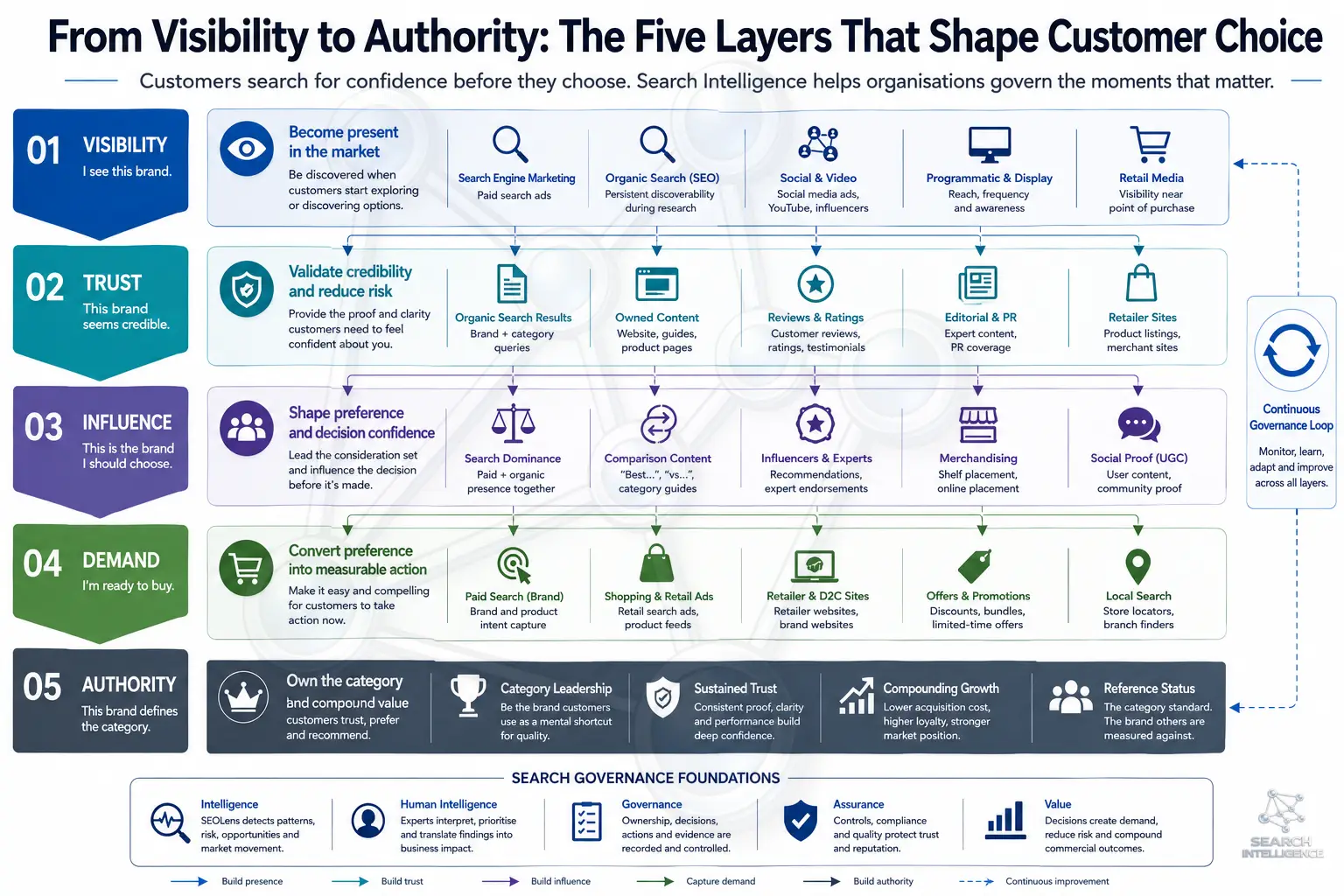
Discovery is the beginning of the decision, not proof that the decision is going well.
Visibility matters. A customer cannot consider an organisation they do not encounter. SEO, paid media, social, public relations, retailer environments, publishers, comparison platforms and AI answers can all help a Brand or Product become discoverable.
A visible organisation can still be difficult to understand, weakly evidenced, distrusted because of reviews or public narratives, indistinguishable from competitors, technically unreliable at the point of action, represented inaccurately by AI systems, absent from the customer's final shortlist, or unable to turn interest into a viable next step.
This explains a familiar business frustration. Marketing reports reach. SEO reports improved rankings. Digital reports traffic. Sales reports that lead quality is uneven. Product sees recurring questions. Customer Experience sees avoidable confusion. Technology has an expanding backlog. Leadership sees many activities but no single explanation of where the decision is being won or lost. The individual reports may all be accurate. The picture can still be incomplete.
A visible organisation can still be
The customer progression
Four layers shape the movement towards action. Authority compounds above them.
Each layer is a condition the customer clears before the next one matters. Authority is not a fifth step — it is what compounds when the four hold repeatedly.
Can I find a relevant option?
The organisation is present for the right need, audience and environment.
Is there enough evidence to believe the promise?
Important uncertainty is reduced through credible, consistent evidence.
Which option feels more suitable or preferable?
The organisation earns a meaningful place in the customer's evaluation.
Can I take a viable next step?
Commercial intent reaches and progresses through the organisation.
Has the organisation become a credible reference?
Authority is the sustained market condition created when repeated Visibility, Trust, Influence and Demand cause an organisation to be treated as a credible reference point. It may become visible through persistent category presence, trusted evidence, credible citations, recommendations, branded demand, resilience and repeated reference behaviour.
Authority is not: one high ranking; high reach; a backlink score; a temporary campaign result; or a leadership position the organisation can simply declare for itself. The market must repeatedly behave as though the organisation is a credible reference.
That is why Authority sits above the Four-Layer Decision Progression while completing the wider Five-Layer Strategic Stack.
This is not a conventional funnel
Customers do not move through the four layers in a clean funnel.
A referral may create influence before the customer searches. A review may weaken trust after the customer has already requested a quote. An AI answer may create initial visibility and shape the comparison in the same encounter. A customer may trust the Brand but abandon the journey. Existing Authority may make future discovery and trust easier.
The model is a connected system with feedback
↑ Authority strengthens future Visibility, the loop feeds back to the start
Authority can strengthen future visibility. It can shorten the trust journey, improve preference and make demand less dependent on constant promotion. The organisation's job is not to force every customer through a fixed sequence. It is to ensure that the evidence, Product, service and journey conditions needed for a confident decision are present, and to recognise where they are failing.
Customers search to become confident enough to choose.
A search is rarely just a request for information. Behind it is often a form of uncertainty. The customer may use a search engine, an AI assistant, a review platform, a publisher, a retailer page, a comparison tool or the organisation's own website to reduce that uncertainty.
Internally, those encounters are often divided across teams and channels. The customer does not experience the division. They experience one decision. That is why the customer progression is organisation-wide. No single function owns the complete outcome.
Behind the search is often a question like
Marketing may introduce the Brand. SEO may help the customer discover a relevant page. Product may determine whether the offer is understandable. Customer Experience may determine whether the promise feels credible. Technology may determine whether the journey works. Sales may determine whether qualified demand progresses. Corporate Affairs and reputation evidence may shape trust long before the organisation knows the customer exists.
Materiality, not just scale
A small problem can create a large commercial loss.
The most expensive failure is not always the largest visible metric decline. A confusing fee on one high-value Product page may stop more valuable demand than a traffic decline across several low-intent articles. A technical release affecting one quote journey may matter more than hundreds of minor crawl warnings. A competitor answering one decisive trust question may capture customers even while the organisation's overall visibility remains stable.
Search Intelligence considers
This prevents every ranking fluctuation, review, AI answer or technical issue from being treated as a crisis. It also prevents an apparently small signal from being dismissed when it sits close to an important customer decision.
HOW: Different functions strengthen different layers
The four customer-progression layers describe what must become true as confidence develops towards commercially relevant action. Authority describes what may compound in the market when those conditions are sustained. Search Governance connects the organisational response when no single team owns the complete condition:
This chain matters because insight without ownership becomes another report. Ownership without authority becomes a stalled recommendation. Implementation without outcome review becomes completed activity with no evidence of value. The organisation therefore needs two connected groups.
The people responsible for the work
Marketing, Media, SEO, Content, Brand, Product, Digital, Technology, Data, AI, Sales, Customer Experience, Corporate Affairs, agencies and specialist partners.
The people responsible for governing the work
Executives, functional leaders, Finance, Risk, Compliance and the owners authorised to prioritise, fund, accept, defer or escalate the response.
Leadership does not perform every function's work. It ensures that material conditions crossing several functions do not remain invisible, unowned or repeatedly rediscovered.
WHAT: The four layers and the compounding outcome in practice
The four layers, and Authority, in practice.
Can the right customer find us?
Visibility is the organisation's presence across the environments where customers discover and investigate choices. It may include Organic Search, paid search and media, AI answers, maps and local search, reviews, comparison platforms, publishers, retailer and marketplace pages, video and social environments, and Product and service pages.
SEO improves the organisation's ability to be crawled, indexed, understood, presented and selected. It helps create technical eligibility, relevant Content, useful internal pathways, strong search presentation and more consistent Organic Search performance. Those foundations remain essential in AI-mediated search.
Hidden loss at the Visibility layer
Is there enough evidence to believe the promise?
Trust is the point at which the customer decides whether the organisation is credible enough to keep considering. A page can be well written and still fail to create trust if the Product is unclear, the service promise is contradicted by reviews or the journey feels unreliable.
Is this a communication problem, an evidence problem, a Product problem, a service problem or an operational problem?
That distinction prevents the organisation from trying to solve every trust failure with more Content.
Hidden loss at the Trust layer
The customer may leave before submitting a form. The organisation never receives a rejected opportunity, a lost-deal reason or a complaint. The loss is real, but absent from normal reporting.
Which option is becoming preferable?
Influence is where customers begin to form a preference. Visibility can create a Search Exposure. Attention creates a Search Encounter. A meaningful Search Moment occurs when the evidence changes confidence, preference or intended action.
Influence is shaped through repeated credible presence, useful comparison support, Product clarity, differentiation, social proof, expert reference and coherent representation across sources.
Hidden loss at the Influence layer
Can preference become viable action?
Demand is not one event. It has at least three conditions. Marketing may create interest. Organic Search may support validation. Product information may build confidence. A technical defect, unclear next step, weak availability or stronger competitor may still capture the action.
Demand Creation
Interest or need is generated.
Demand Capture
The organisation becomes the route through which that need progresses.
Demand Leakage
Commercially relevant intent exists but fails to reach or move through the organisation.
The CRM records the customers who survived long enough to enter the pipeline. It does not fully explain the customers who never arrived.
Hidden loss at the Demand layer
A cross-layer control
AI Narrative Integrity operates across the complete strategic stack.
AI Narrative Integrity is not another progression layer. It is a cross-system condition affecting the four customer-progression layers and the longer-term Authority outcome.
| Part of the model | AI Narrative Integrity question |
|---|---|
| Visibility | Is the organisation included for the right questions? |
| Trust | Are the facts, claims and limitations accurate and supportable? |
| Influence | Does the answer frame the organisation fairly and in context? |
| Demand | Is a viable next step represented clearly? |
| Authority | Is the organisation repeatedly represented as a credible reference where the evidence supports that treatment? |
Traditional search largely rewarded page-level visibility. AI-mediated search raises a second requirement: accurate, consistent and supportable representation across the source environment. Visibility remains necessary. Narrative integrity determines what that visibility means.
1. Accuracy
Is the representation factually correct?
2. Consistency
Do important sources agree?
3. Provenance
Can claims be traced to credible evidence?
4. Currency
Is the information current?
5. Context
Are conditions, qualifications and limitations preserved?
6. Entity coherence
Are Brands, Products, organisations and people correctly distinguished?
7. Technical accessibility
Can search and AI systems reliably reach the approved source?
The organisation cannot control an external search engine or AI model. It can govern source accuracy, Product consistency, technical accessibility, ownership, correction and re-observation.
How this differs from conventional SEO frameworks
The customer progression does not replace SEO. It prevents SEO from being asked to explain or solve every business condition around search.
| SEO operating question | Wider SI question |
|---|---|
| Can the page be crawled and indexed? | Is the organisation present for the right commercial need? |
| Is the Content relevant and useful? | Does the wider evidence reduce uncertainty and build confidence? |
| Does the page rank? | Does the organisation earn preference across the decision environment? |
| Did Organic Search traffic or conversion improve? | Was valuable demand created, captured or lost? |
| Does the domain appear strong? | Is the organisation becoming a credible category reference? |
| Which page should be optimised? | Which customer, commercial or organisational condition requires a decision? |
| What should the SEO team implement? | Who owns the decision, which specialist implements it and what proves the outcome? |
SEO improves search performance. Search Intelligence creates understanding. Search Governance creates organisational control.
How each function contributes
No department owns the complete progression.
| Model component | Primary contributors | Supporting contributors | Governing question |
|---|---|---|---|
| Visibility | SEO, Media, Content, Digital | Technology, Product, agencies | Are we present for commercially important needs? |
| Trust | Brand, Product, Customer Experience, reputation | SEO, Content, Technology, Risk, Compliance | Is there enough consistent evidence to believe the promise? |
| Influence | Brand, Product, Content, PR, category strategy | Agencies, reviews, publishers, experts | Who is shaping preference and the comparison criteria? |
| Demand | Sales, Ecommerce, Digital, Product, Operations | Marketing, SEO, Technology, Customer Experience | Does qualified intent reach and complete a viable next step? |
| Authority — compounding outcome | Executive leadership, Brand, Product, Corporate Affairs | Every contributing function | Is repeated strength across the system causing the organisation to become a credible reference? |
The first four rows describe conditions within the customer decision progression. Authority describes the wider market outcome that may compound when those conditions are repeatedly sustained. Different functions contribute to different parts of the system. Search Governance connects them when no single team owns the complete response.
What changes for teams on Monday morning
The framework should alter decisions, not merely language.
Marketing and Media
Ask what customers find when they investigate the campaign promise, not only whether the campaign generated reach.
SEO, Content and agencies
Measure commercially important portfolio consistency, customer-question coverage and contribution without accepting accountability for Product, service and client-side decisions outside the specialist mandate.
Brand, Product and Customer Experience
Use search, review, AI and Sales evidence to understand where the promise is unclear, unsupported or contradicted by the delivered experience.
Sales and Business Development
Feed recurring objections, competitor references and customer questions back into Product, Trust and Influence decisions.
Digital, Technology, Data and AI
Protect technical eligibility, source consistency, entity clarity, journey reliability and Measurement Confidence across the complete decision environment.
Reputation, Risk, Compliance and Corporate Affairs
Identify when claims, public evidence, customer experience and external narratives no longer agree, and ensure specialist judgement remains with authorised owners.
Leadership and Finance
Decide which conditions are material, who owns the response, what value may be created or protected and which residual exposure the organisation knowingly accepts.
Questions every organisation should be able to answer
If the answer to any of these is unclear, the condition is being managed by assumption rather than evidence.
Visibility makes the organisation available. Authority makes it consequential.
The distance between the two is not a single funnel. It is the repeated interaction of Visibility, Trust, Influence and Demand across the places where customers investigate, compare, hesitate, choose and sometimes disappear.
When those conditions are repeatedly sustained, the organisation may begin to earn something more durable: recognition as a credible reference within a particular decision space. That is Authority.
Search Intelligence makes the environment observable. Human Intelligence interprets what matters. Search Governance connects material evidence to ownership, decisions, specialist implementation, outcome review and learning.
The goal is not to make every team responsible for everything. It is to help the organisation understand how the customer progression connects — and whether repeated strength or weakness across those conditions is compounding into the market position the organisation is building over time.
Explore the functional application pages
Marketing and Media
From attention to demand
SEO, Content and Agencies
From search performance to business contribution
Brand, Product and Customer Experience
From promise to proof
Sales, Business Development and Ecommerce
Demand before the pipeline
Digital, Technology, Data and AI
The infrastructure behind customer confidence
Reputation, Risk, Compliance and Corporate Affairs
Governing public evidence
Executive Governance, Finance and Organisational Value
Governing the complete system
Explore the sector, scale and collaboration applications
Pharmaceutical
Approved information, public confidence and source integrity
Insurance
Claims confidence, preference and quote demand
Banking
Institutional trust, Product adoption and financial control
FMCG
Product truth, retailer discovery and repeated choice
Financial Services and Wealth
Confidence in judgement before the first conversation
Telecommunications
Coverage truth, service confidence and connectivity demand
Automotive & Motoring
Model discovery, ownership trust and purchase demand
Sports
Fan discovery, participation and official information
Hospitality
Booking confidence, direct demand and intermediary capture
Healthcare & Medical
Provider discovery, patient information integrity and appropriate action
Beauty & Cosmetics
Product truth, claim confidence and repeat demand
Enterprise
Governing customer confidence across complexity
Corporate
Turning activity into clearer commercial priorities
SME
Becoming easier to find, trust and choose
Next step.
Take the Decision Confidence Diagnostic to explore where value may be weakening across Visibility, Trust, Influence and Demand — and where wider market conditions may be strengthening or eroding Authority.