From Visibility to Authority for SMEs: Become easier to find, easier to trust and easier to choose
7 min read
An SME owner opens the monthly Marketing report.
The website received visits. The adverts generated clicks. A few keywords improved. Enquiries are still inconsistent. The owner does not need another lecture about channels.
They need to know why competitors look more credible, why paid leads cost so much, what customers find before making contact and which improvement deserves the next rand of investment. For an SME, the From Visibility to Authority framework should make growth simpler, not introduce Enterprise language and paperwork. This article applies the From Visibility to Authority framework to smaller and owner-led organisations.
The model at a glance
The practical question
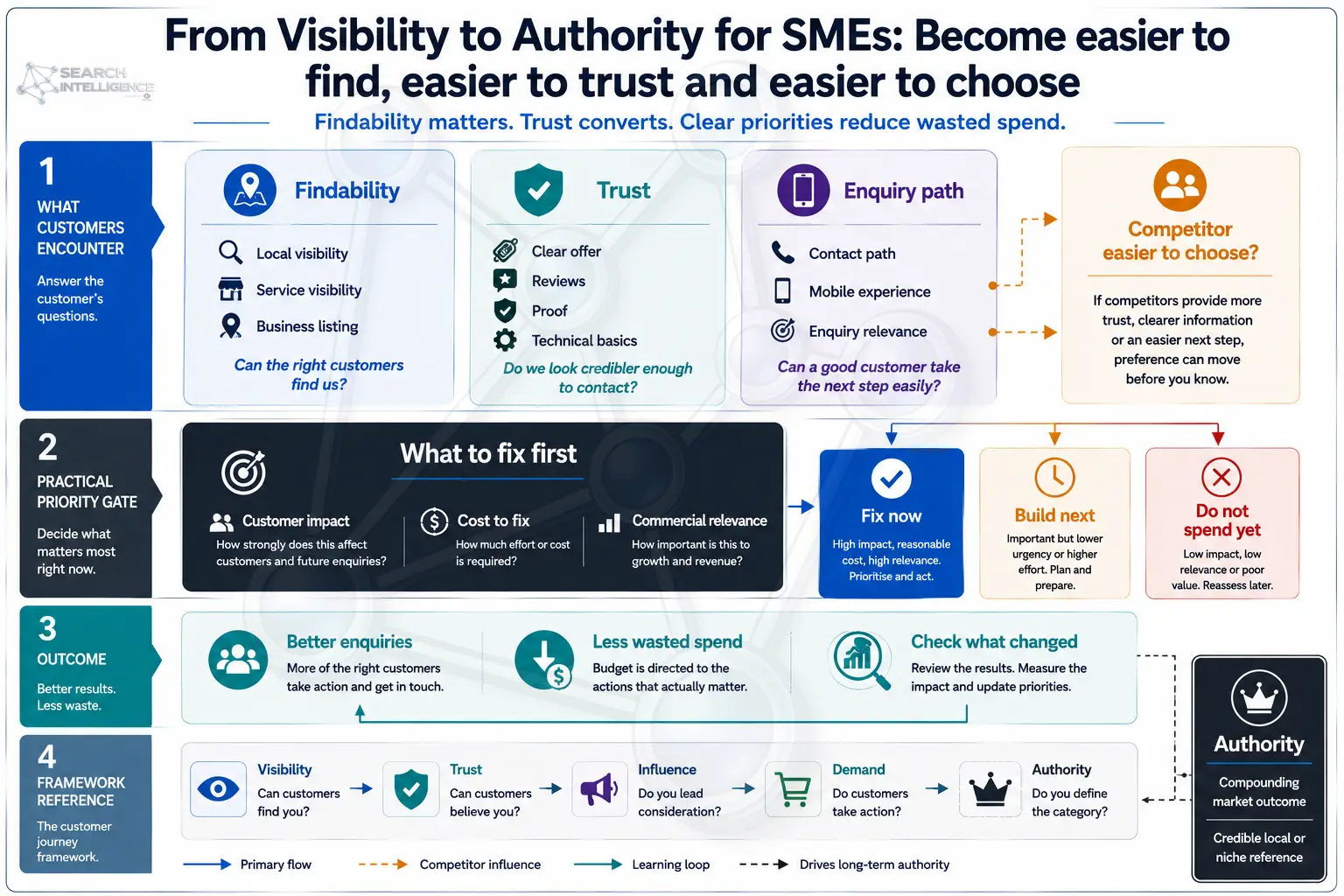
Most SME customers are trying to answer four things quickly: Can I find this business? Does it look credible? Is it right for my need? Is it easy to contact, visit or buy from? Authority grows later, when the business becomes a familiar and trusted local, niche or specialist reference.
Findability confidence preference enquiry reputation that compounds
How the four customer-progression layers and the Authority outcome apply
| Condition | SME question | A stronger condition may look like |
|---|---|---|
| Visibility | Can local or relevant customers find the business? | Core services, locations and customer needs are easy to discover. |
| Trust | Does the business look real, capable and safe to approach? | Reviews, proof, contact information, service explanations and website quality support confidence. |
| Influence | Why should the customer choose this business rather than another? | The difference is clear, believable and relevant to the customer's problem. |
| Demand | Can the customer call, message, visit, book or buy without friction? | The next step is simple and enquiries are more relevant. |
| Authority | Is the business becoming a recognised local or specialist reference? | Customers remember, recommend and search for the business by name. |
Where SME value appears
Value created
Improving local discovery, clarifying core services, answering questions that stop enquiries and becoming visible for a profitable niche rather than trying to compete everywhere.
Value protected
Existing Google Business Profile and local visibility, customer reviews, Brand reputation, the owner's time, paid campaign value, important service and location pages, and enquiry pathways.
Value recovered
Where a competitor has taken local visibility, where old contact information creates mistrust, where weak reviews deter customers, where a broken form loses enquiries, or where the business is known offline but difficult to validate online.
Waste avoided
Often the most immediate benefit: stop paying for broad traffic with little commercial value, Content that nobody needs, redesigns that don't improve the decision, ads that send customers into a weak trust environment, technical work with no meaningful customer consequence, or several suppliers solving the same symptom.
What progress may look like over time
Short term (30–90 days), fix obvious confidence leaks
Core service and location visibility; Google Business Profile consistency; contact and enquiry paths; reviews and trust proof; technical basics; service clarity; the strongest competitors; and what should not be prioritised yet.
Medium term, build a reliable enquiry system
Improve core service pages, publish useful answers, strengthen local and niche visibility, collect reviews responsibly, improve enquiry quality, reduce dependence on paid media for every lead, and make the Brand difference easier to understand.
Long term, become the remembered choice
Stronger branded search, repeat and referral confidence, better local or specialist Authority, lower acquisition waste, a more resilient digital presence and greater clarity about where to invest next.
The business still needs to deliver, search cannot turn a poor service into trusted Authority.
AI changes how customers shortlist small businesses
Customers can now ask an AI assistant for local or specialist recommendations and receive a shortlist before visiting a website. The SME may be excluded because its location or service information is inconsistent, reviews are weak or unclear, the website does not explain what it does, directories use old information, the entity is difficult to distinguish, or no credible source connects the business to the customer's need.
The solution is not an expensive AI programme. It is clearer public information, stronger local sources, consistent details, useful proof and regular observation of the decisions that matter.
For an SME, Brand is often the owner, the people, the work and the experience customers talk about. The website should not make a small business sound like a large anonymous corporation. Trust grows when the business is specific about what it does, clear about where it works, honest about the next step, supported by real proof, easy to contact, consistent across the website, maps, directories and reviews, and recognisably human.
In many SMEs, one person wears several hats. The operating model should stay practical: identify the condition, decide whether it matters, choose the smallest sensible action, assign the person or supplier, check whether it changed, and keep the learning. Formal governance artefacts should be proportionate, the owner needs clarity and control, not a board process designed for a multinational.
Evidence that helps the owner decide
Useful evidence may include local and service visibility; competitor comparison; Google Business Profile condition; review themes; call, form, booking or message paths; high-value customer questions; AI and directory representation; paid and Organic Search interaction; enquiry relevance; and before-and-after observations.
Questions an SME owner should answer
Where to begin.
Start with the core commercial problem, not the full digital estate. One service, location, enquiry pathway or competitor gap is often enough to reveal what should happen next.