
From Reporting to Decision Confidence: Why accurate metrics are not enough
9 min read
A monthly report arrives on time. The figures are checked. Rankings are stable. Traffic is up. The agency has completed the agreed work. Nothing appears to require urgent attention.
A few weeks later, Sales raises a concern about the quality of enquiries. Product notices the same customer question appearing repeatedly. A competitor begins appearing more consistently across one profitable segment. Technology confirms that an intermittent journey failure has existed for longer than anyone realised. None of the earlier reporting was necessarily wrong. It was answering a narrower question.
That is the difference between reporting confidence and Decision Confidence. Reporting confidence asks whether the metric is accurate. Decision Confidence asks whether the organisation has enough reliable, relevant and sufficiently complete evidence to choose responsibly.
The model at a glance
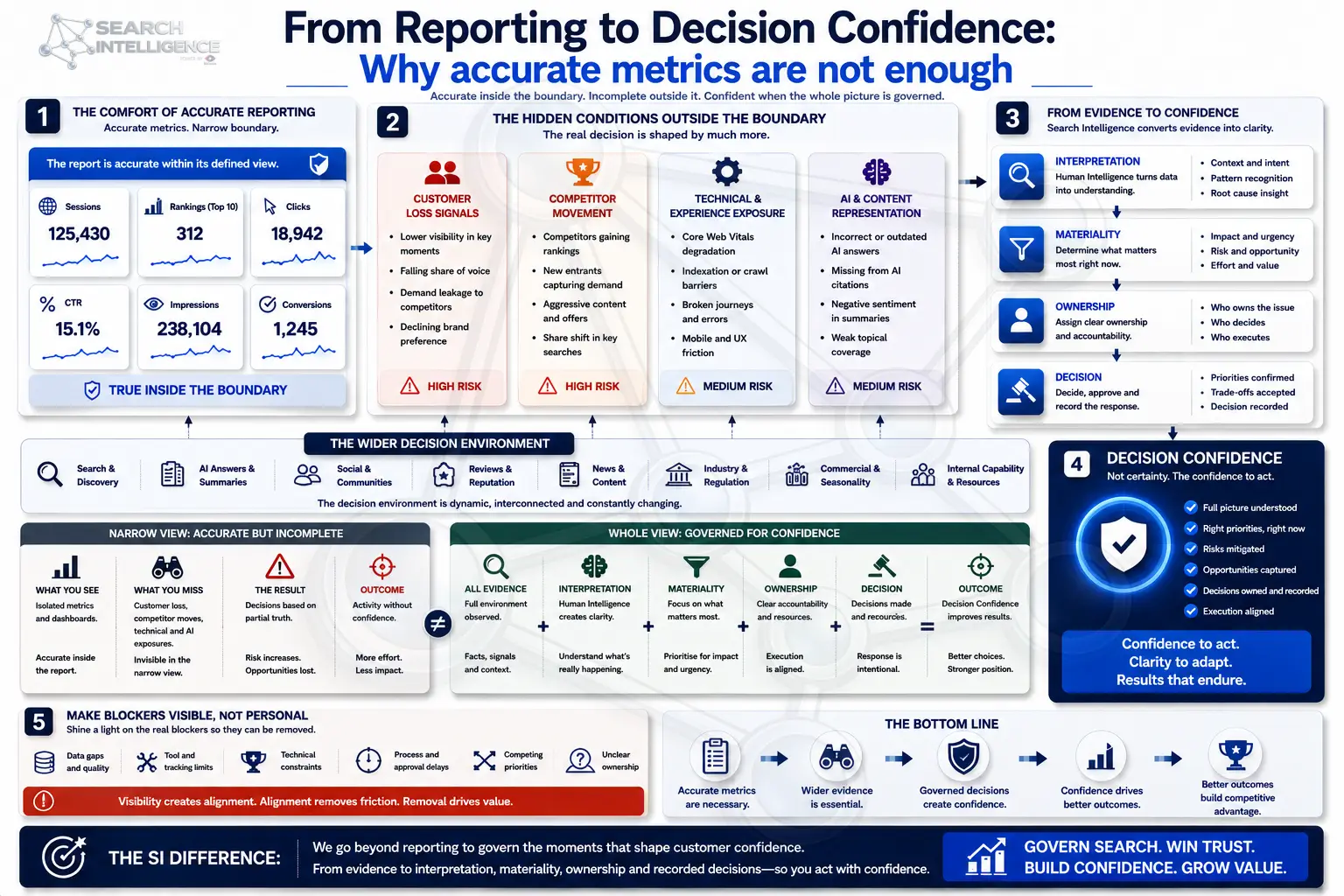
Every report has a frame, shaped by the KPIs selected, the systems available, the supplier's scope, the known competitor set and the events the organisation can measure. That frame is useful, without it, reporting becomes inconsistent. But the frame also decides what remains outside the picture.
The problem is not reporting. The problem is asking reporting to carry a decision it was never designed to support.
A dashboard may show
Tracked keywords, website traffic, CRM leads, crawler-found technical issues, completed agency tasks and the competitors already in the report.
It may not show
The customer who researched again and chose someone else, the question that weakened confidence before the form was opened, the competitor outside the expected set quietly gaining ground, the Product condition Content cannot solve, the technical weakness that has not yet become a visible ranking decline, the blocked recommendation, the outcome that did not improve, or the evidence that remains Unknown.
The customer who disappears before becoming a metric
Consider a customer researching an insurer, bank, adviser, Product or service. The organisation appears prominently. The customer visits, reads, then searches again, for reviews, fees, exclusions, reputation evidence or a clearer comparison. They may ask an AI assistant to summarise the main concern. A competitor provides the stronger answer.
The organisation may record an impression, a visit and no conversion. What it may not record is where confidence moved, which source shaped the decision or what commercially valuable demand was lost. This is why customer and commercial evidence must be considered beyond the boundary of the website and beyond the point where attribution begins.
HOW: Build a decision-ready evidence system
Search Intelligence begins with a business question, not with the ambition to collect every available metric. A responsible decision process asks:
Evidence Interpretation Materiality Owner Decision Implementation Outcome Value Learning
SEOLens and other sources create breadth and consistency. Human Intelligence interprets context and competing explanations. Search Intelligence establishes what is materially significant. Search Governance controls ownership, decision, escalation and review. Specialist teams implement the approved work.
Evidence must keep its status
Good governance does not make every claim sound equally certain. SI preserves five evidence states, and the status should travel with the claim.
That discipline protects the organisation from two common errors: acting with false certainty and delaying every decision until perfect certainty exists.
Search environments produce constant movement. Not every ranking change, review, technical issue or AI answer deserves executive attention. Materiality depends on consequence, not novelty.
A small recurring defect in a quote journey may matter more than hundreds of low-impact technical warnings. A modest movement across one profitable Product segment may matter more than a large traffic increase across informational pages.
A responsible answer may be "do not act"
Decision Confidence does not mean creating urgency around every finding. Sometimes the best decision is to monitor the condition, gather more evidence, accept the exposure, defer the work because another priority is more material, stop an intervention that is not changing the outcome, or conclude that no further SI engagement is justified.
WHAT changes for the organisation
Instead of asking only "What moved?", teams can ask why it could matter, which customer decision is involved, what value may be created, protected or lost, how strong the evidence is, who owns the decision, what happens if nothing changes, what evidence would prove completion, and whether the condition actually improved.
Marketing gains
A clearer view of demand and confidence.
SEO and agencies gain
A better route for getting material work prioritised.
Product and CX receive
Evidence about customer uncertainty.
Technology sees
Business consequence rather than an undifferentiated backlog.
Finance sees
The boundary between contribution and attribution.
Leadership sees
Decisions rather than a longer report.
The five questions every decision should answer
That is the move from information to organisational judgement.
A worked decision example
A national service organisation sees stable overall Organic Search traffic. One high-value service line, however, is receiving fewer completed enquiries. The existing reports show several true facts, the domain remains visible, total traffic is stable, the main service page still ranks, the agency completed the planned Content work, and the enquiry form is available. Search Intelligence widens the question.
The commercially important comparison portfolio has become less consistent. A competitor now answers the customer's main service concern more directly. Sales hears the same concern in calls. On mobile, one step in the enquiry journey fails intermittently. The page's core promise also requires Product approval before it can be strengthened. The issue is no longer "improve the ranking". It becomes:
That decision has several owners: Product owns the approved service promise, Digital owns the journey, SEO and Content improve discovery, Sales contributes objection evidence, Technology implements the correction, and the business sponsor decides priority and accepted exposure.
The original reports remain useful. Decision Confidence comes from seeing how they fit together.
What this means for different teams
Marketing and Digital
Performance should be reviewed against the customer's complete decision path, not only the channel's immediate output.
SEO and agencies
A material recommendation needs a route into client-side decision-making. The agency should not carry accountability for Product approval or Technology capacity.
Product and Customer Experience
Search evidence may reveal uncertainty that the Product, service or operational model must resolve.
Technology
Technical priority should reflect customer and commercial consequence, not only severity scores.
Finance
The business case should distinguish expected value, observed contribution, modelled value and validated outcome.
Leadership
The question is not whether every detail is visible. It is whether material uncertainty, ownership and trade-offs are visible enough to decide responsibly.
Decision Confidence is a capability, not a score alone.
A diagnostic score can help the organisation locate a weakness. The enduring capability is the organisation's ability to repeat the complete discipline: ask the right question, assemble relevant evidence, tolerate uncertainty, distinguish materiality from noise, assign real authority, review what changed and retain the learning.
That capability becomes more valuable as search, AI, competitors and customer behaviour continue to change.
Begin with the decision, not the dashboard.
Take the Decision Confidence Diagnostic or explore the Reporting Blind Spot that leaves material conditions invisible.