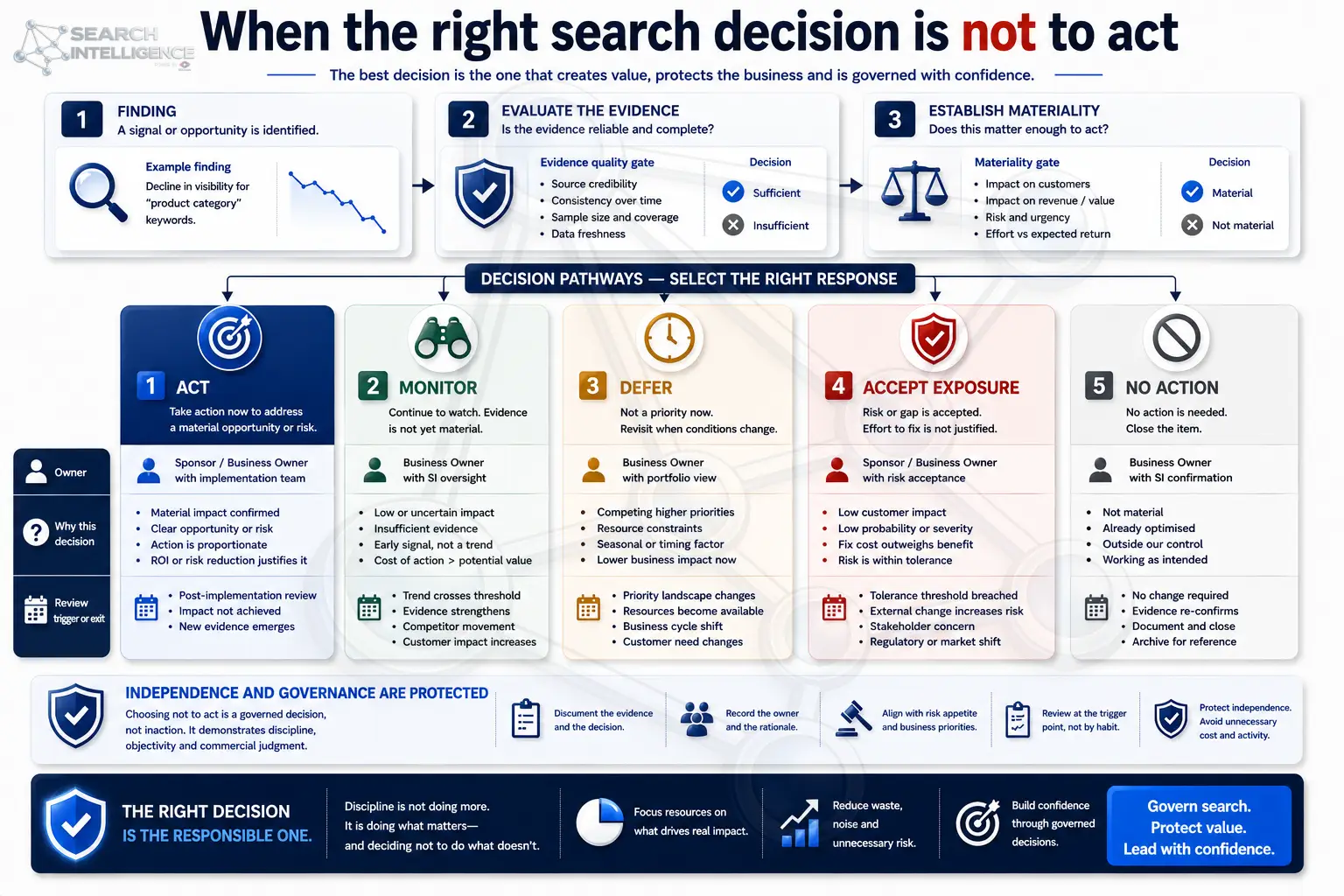
Action is not the only proof of good judgement.

When the right search decision is not to act

A finding has been raised. The evidence looks plausible. Someone expects a recommendation. The easiest response is to create work.

The more responsible response may be to wait.

Explore Results and Proof See the Evidence Trail
Why organisations overreact

Search creates urgency because movement is visible and competitors are active. Teams may feel pressure to respond before the evidence is strong enough, particularly when a senior stakeholder has noticed the issue. Overreaction can produce unnecessary Content, technical work with little business consequence, constant changes that make measurement harder, distraction from more material priorities, defensive agency behaviour, and false certainty about cause and effect.

Five valid reasons not to act immediately
The signal is too early — more observation is needed.
The consequence is low — the issue is real but not material.
The cause is uncertain — several explanations remain equally plausible.
The response is disproportionate — cost or disruption exceeds the likely value.
Another condition is more important — capacity should be used elsewhere.
Deferral is a decision, not a disappearance

A deferred finding should retain its evidence, status and confidence, reason for deferral, owner, residual exposure, review trigger and next observation date.

Without that record, "not now" quietly becomes "forgotten".
Independence is tested here

SI should not depend on every Assessment producing a Mobilisation project or annual agreement. A valid conclusion may be that the existing team already has the condition under control, the evidence does not support further intervention, the problem is outside SI's appropriate scope, the organisation should use a different specialist, or the issue is not material enough to justify the cost.

That outcome protects the client's Decision Confidence and SI's independence.

The ranking movement that should be watched

A priority page drops two positions for several days. The competitor set remains unstable, no meaningful traffic change appears, and there has been no technical release. Historical evidence shows similar short-term movement around the same period. An immediate rewrite, technical change and link campaign may create more noise than value. The governed response: classify as Observed, record Low/Medium confidence, monitor for two more observation cycles, define the trigger that would increase materiality, keep the Product and technical teams informed without creating work, and review if the movement persists or spreads — a controlled observation plan, not passivity.

The issue outside SI's remit

Search evidence may reveal customer dissatisfaction caused by a service-delivery problem. SI can evidence the public condition and its likely decision consequence — it should not pretend a Content intervention will solve the operational failure. The responsible recommendation is to route the evidence to Customer Experience or Operations and close the workstream once ownership is established.

What the customer gains

Clients often fear that a diagnostic provider will always discover a reason for a larger engagement. The willingness to recommend monitoring, referral to another specialist or no further work directly answers that concern. It shows that the purpose of the Assessment is a better decision—not the manufacture of scope.

The discipline of a review trigger

A "no action" decision should define what would change the conclusion: persistence beyond an agreed period, movement into a high-value segment, stronger customer or Sales evidence, material competitor reinforcement, technical validation, or a Product launch or campaign that increases exposure.

That trigger protects the organisation from both neglect and unnecessary intervention.

Make fewer, better decisions.

Explore Results and Proof, or return to the cornerstone framework.

Explore Results and Proof Return to the cornerstone
Related guidance and implementation pathways
Decision Confidence

Understand customer, evidence and organisational Decision Confidence—and why more data does…

Explore →
Buyer Intelligence

Get direct answers about SI scope, agencies, client effort, fees, independence, data…

Explore →
How Organisations Engage SI

Understand what organisations buy at Assess, Mobilise and Govern stages, what SI requires,…

Explore →