Organic Search Optimisation Is a System, Not a Task
14 min read
A familiar question appears in almost every long-running SEO programme:
It sounds reasonable. Work was recommended. A team implemented it. Time and money were spent. Leadership expects a result.
The problem is not the expectation of accountability. The problem is the mental model behind the question.
"We did the SEO" treats SEO as a discrete intervention: diagnose the problem, apply the fix and receive the outcome. That model works well for some kinds of work. A broken component is replaced. A calculation is corrected. A campaign is launched.
Organic Search does not behave that neatly.
A page must be accessible before it can be processed. It must be understood before it can be considered relevant. It must answer a real need before it can be useful. It must provide enough evidence to feel credible. The experience must work when a customer arrives. Competitors are improving at the same time. Search systems continue to change. The organisation itself keeps releasing code, publishing content, changing products and reorganising journeys.
The work is real. The outcome is not mechanically guaranteed.
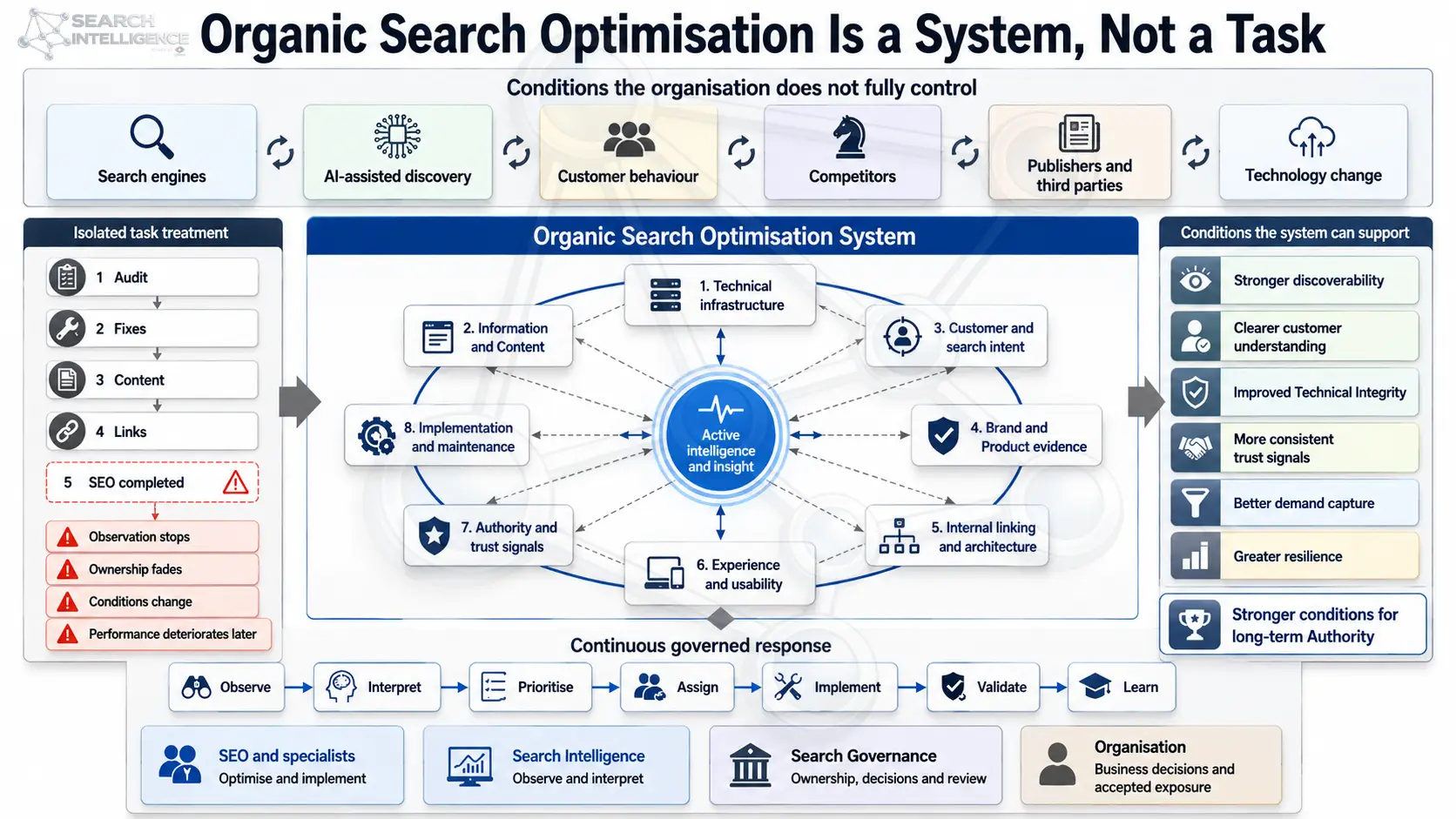
That is why Organic Search Optimisation should be managed as a system, not purchased as a task.
Organic Search Optimisation Is a System, Not a Task
A necessary correction before we go further
Organic Search Optimisation is not a new name for SEO.
Within the Search Intelligence framework:
The distinction matters because words shape accountability.
If SEO is described only as an outcome, the specialists doing the work can be left without a clear discipline to own. If Organic Search Optimisation is treated as a replacement category, the market loses a familiar and useful term. If Search Governance is confused with execution, leadership may expect the governance layer to perform work that belongs to Product, Technology, Content, SEO or an agency.
The better formulation is simple:
Why SEO keeps becoming a checkbox
Organisations simplify complex work so it can be budgeted, assigned and reported. That is not a character flaw. It is how management creates order.
A complex subject receives one label: SEO.
That label then becomes one line in a plan:
Once those items are marked complete, the organisation assumes the system has been dealt with.
But the label contains several different kinds of work. They do not share the same owner, time horizon, risk or evidence.
A rendering issue may need Engineering. A weak product explanation may need Product and Compliance. A category gap may need research, editorial resources and commercial approval. A poor application journey may need UX, Technology and Sales. A review pattern may expose a service problem that no amount of on-page optimisation can solve.
The customer sees one decision environment. The organisation sees separate departments and suppliers.
This is the first reason the system breaks.
The five operating conditions behind performance
Organic Search Optimisation can be understood through five connected operating conditions.
1. Eligibility and access
Can search systems find, retrieve, render and process the asset?
This includes crawl access, response status, rendering, indexability, canonicalisation, duplication, sitemaps, internal links, platform constraints and release integrity.
Eligibility does not create a ranking. It creates the possibility of being considered.
A technically blocked page cannot compensate with stronger copy. A broken canonical cannot be repaired through media spend. A JavaScript failure may remove content that looks perfectly visible to the internal team.
2. Understanding and relevance
Can a search system and a customer understand what the asset is, which need it serves and how it relates to the rest of the site?
This includes information architecture, headings, page purpose, metadata, internal linking, entity relationships, structured information and alignment with the customer's language and intent.
A page can be technically available and still be poorly understood. It may compete with another page, answer several needs badly or use internal terminology that customers do not use.
3. Helpfulness and content quality
Does the asset provide useful, reliable and sufficiently complete information for the intended need?
This includes accuracy, subject depth, editorial quality, source support, customer questions, content maintenance and the removal of thin, duplicated or outdated material.
Publishing is an activity. Helpfulness is a condition that must be tested.
A long article is not automatically complete. A product page is not useful because every field is populated. A frequently asked questions section is not helpful if it avoids the concern that brought the customer there.
4. Trust, reputation and policy safety
Can the asset and the organisation be treated as credible, reliable and safe to present?
This includes claims, sourcing, authorship, reputation evidence, reviews, policy compliance, product truth, transparency and the avoidance of manipulative practices.
This domain is often mishandled because trust is treated as a soft brand outcome. In reality, trust is tested through specific evidence. Customers notice contradictions. Search systems encounter policy violations. Regulators and risk teams care about unsupported claims. Reviews can expose a gap between the promise and the experience.
5. Experience and action alignment
Can the customer use the experience effectively after discovery?
This includes mobile usability, accessibility, responsiveness, page stability, journey continuity, clear next steps, form integrity, reassurance and alignment between the search promise and the destination.
A page may rank and still fail the customer. The result may promise clarity and deliver confusion. The page may load but the form may break. The content may answer the question and then force the customer through an unrelated conversion path.
Organic Search performance is produced across these conditions, not by one lever.
Why implementation and outcome must be separated
One of the most damaging reporting habits is to move directly from task completion to claimed impact.
Each step can fail.
A recommendation may be correct but never approved. It may be approved and implemented incorrectly. The implementation may be correct but not change the intended condition. The condition may improve while a competitor improves faster. Search presence may increase without producing a qualified visit. A visit may increase without creating a sale.
None of this removes accountability. It makes accountability more precise.
The right questions are:
This is the difference between reporting activity and managing a system.
Rankings matter, but they arrive late
Rankings are useful. They show where a page or domain is being surfaced for a particular query, market, device and moment.
But they are usually a lagging indicator.
By the time a material decline appears in a ranking report, the underlying condition may have been developing for weeks or months:
A managed system monitors the conditions that precede the outcome.
That does not mean every technical metric deserves executive attention. It means the organisation needs a clear distinction between:
The organisation depends on more than the SEO team
SEO specialists can diagnose, recommend and implement within their authority. They cannot independently control the whole system.
They may not control:
This is why many SEO programmes repeat the same recommendations for months. The issue is visible, but it has no effective route through the organisation.
The agency may be blamed for a fix the client never implemented. The internal SEO team may be accountable for a template owned by another function. Technology may be asked to prioritise work without a clear statement of commercial consequence. Leadership may receive a report but no decision.
Organic Search Optimisation gives the work a managed operating structure. Search Governance gives material conditions an organisational response.
The closed operating loop
A mature Organic Search Optimisation system does not finish with implementation.
It operates as a loop:
Recalibrate feeds back into Observe — the loop repeats rather than ending.
Search Intelligence is essential because the organisation needs to understand more than its own website. It needs competitive context, external evidence, market movement and a disciplined way to separate signal from noise.
Search Governance is essential because important findings need owners, decisions, resources, escalation, accepted exposure and outcome review.
Specialists remain essential because decisions do not improve websites. People implementing the right work do.
What leadership should change
Leadership does not need to become expert in crawling, canonicalisation or structured data.
It does need to stop asking one discipline to carry responsibility for a system the organisation has fragmented across several functions.
A practical shift begins with five questions:
The answer should not be another dashboard.
It should be a managed operating model.
SEO is not a task to complete and forget.
It is a discipline operating inside a changing system.
Organic Search Optimisation is the managed practice that keeps that system visible, prioritised and capable of improvement.
Search Intelligence creates the understanding required to decide what matters.
Search Governance creates the organisational control required to act and learn.
Continue with Search Intelligence, SEO Is Not a Task to Complete, SEO as Intervention, Organic Search as Infrastructure, Business Outcomes and Unmanaged Systems, Why “We Did the SEO” Is the Wrong Question, The Five Operating Conditions, Why Rankings Are Lagging Indicators, Organic Search Is an Environment, Not a Metric, What AI Search Changes — and What It Does Not, Two Connected Systems: OSO and Visibility to Authority, How OSO Supports Trust and Influence, Governance Evidence Trail, and Decision Confidence Diagnostic.