
Organic Search Is an Environment, Not a Website Metric
6 min read
Inside most reporting platforms, Organic Search appears as a channel.
It is a row in a table. A source of sessions. A collection of keywords. A line on a chart.
That is useful for measurement.
It is not a complete description of the environment in which the organisation is competing.
Organic Search is the unpaid search environment in which search systems discover, process, assess and surface information in response to customer needs.
The organisation participates in that environment. It does not own it.
Organic Search Is an Environment, Not a Metric
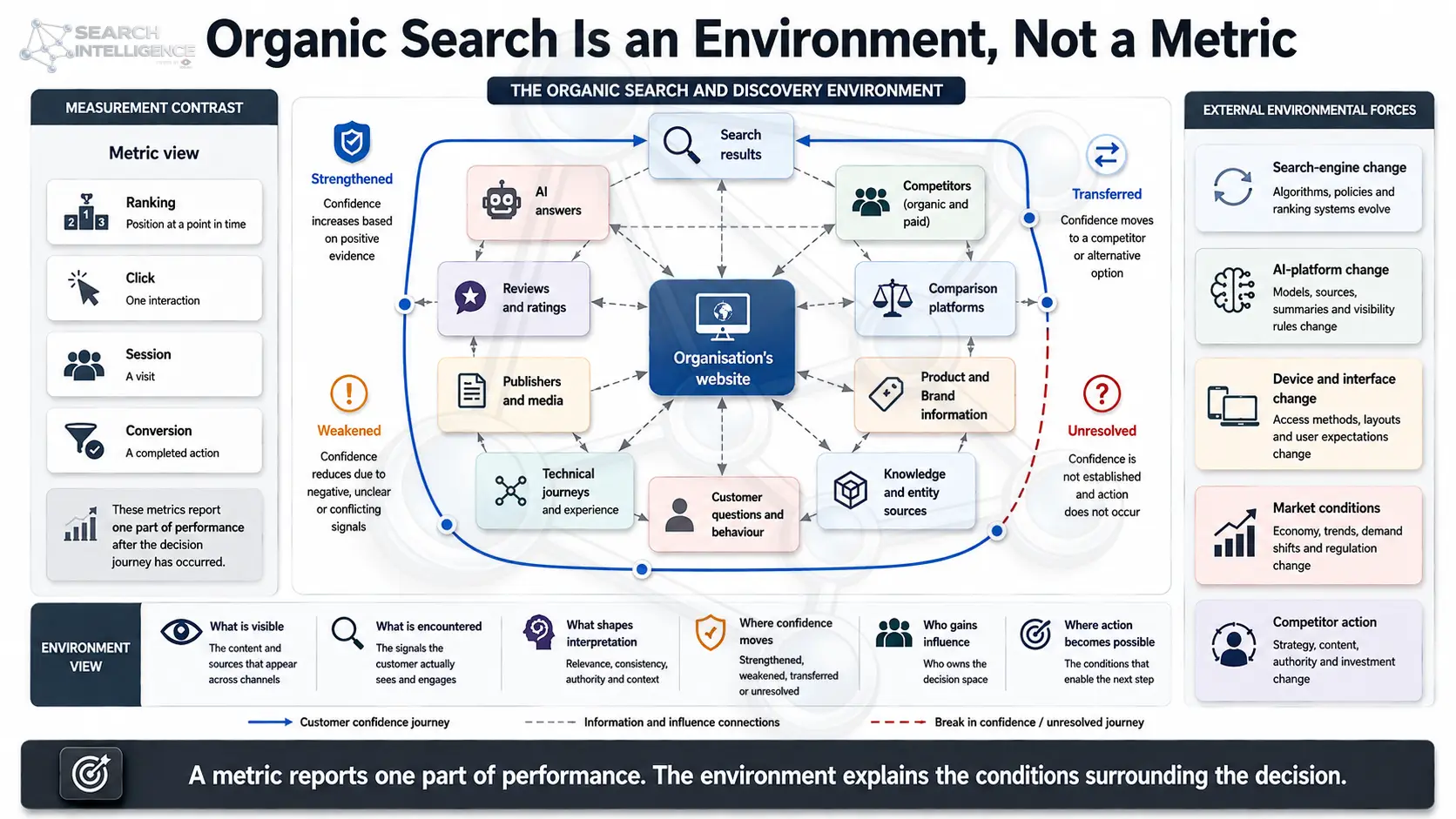
Why the metric view is attractive
Metrics give the organisation a manageable frame.
It can track rankings, impressions, clicks, visits, conversions and revenue attribution.
These measures help teams understand selected outcomes.
The problem begins when the measurable frame is mistaken for the full market reality.
A traffic report usually shows people who reached the site. It says less about people who saw a competitor first, trusted an external comparison, accepted an AI summary, changed their mind after reading reviews, found the organisation but did not consider it credible, or completed their decision without visiting the site.
The environment is larger than the owned analytics trail.
The website is one participant
A customer searching for a product or provider may encounter the organisation's pages, competitors, comparison sites, publishers, review platforms, maps and local results, forums, video, retailer listings, and AI-generated answers.
Some of these surfaces belong to the wider Organic Search and Discovery Environment rather than conventional Organic Search alone. The distinction still matters.
The practical point is that the customer does not experience the company website in isolation.
They experience a field of evidence.
Relative performance changes the meaning of your data
A website can improve and lose ground.
That sounds contradictory until the competitive environment is considered.
Suppose the organisation improves a product page. Its content is clearer, the page is faster and the internal links are stronger.
At the same time, a competitor publishes a complete comparison centre, earns stronger references and improves its product journey.
The organisation's page may be better than it was. It may still become less competitive.
Website-only reporting can miss that distinction.
Search Intelligence adds the wider context required to determine whether movement is specific to the organisation, common to the category, driven by a competitor, connected to a platform change, temporary noise, or materially important.
Organic Search is not controlled by optimisation
The phrase "optimising Organic Search" can be misleading if it suggests the organisation controls the environment.
It does not control search engines, AI platforms, competitors, customer behaviour, publishers, reviews or market events.
It can improve its own assets and operating conditions for performance within that environment.
That boundary is central to the SI framework.
The difference between exposure and encounter
Being present in the environment does not prove that a customer noticed or evaluated the organisation.
Search Exposure means the evidence was available to be seen.
Search Encounter means the customer paid enough attention to evaluate it.
A Search Moment occurs when interpretation changes confidence, preference or intended action.
This distinction protects the organisation from overstating what a ranking or impression proves.
Visibility is the opportunity to influence. It is not proof that influence occurred.
Why this changes strategy
Once Organic Search is understood as an environment, strategy changes in five ways.
1. Competitors become evidence
Competitor performance shows where the market is moving, which customer needs are being answered and where structural advantage is developing.
2. Customer questions become market signals
Queries reveal uncertainty, demand, comparison behaviour and changing language.
3. Owned content is judged in context
A page is strong when it remains useful and credible within the available field of alternatives, not because it meets an internal standard.
4. Measurement extends beyond traffic
The organisation considers presence, result composition, customer evidence, competitive movement and downstream contribution.
5. Governance becomes necessary
Material findings may involve Product, Technology, Brand, Risk, Compliance, Customer Experience or an agency. The response cannot remain inside an SEO report.
The management correction
Organic Search is not simply a metric produced by the website.
It is a changing external environment in which the organisation's assets are found, interpreted and compared.
SEO improves the organisation's ability to perform within it.
Search Intelligence establishes what is happening across it.
Search Governance controls how the organisation responds to material evidence.