
SEO Is Not a Task to Complete. It Is a Discipline Operating Inside a Changing System.
7 min read
There is a sentence that tells you how an organisation thinks about SEO:
The statement may be factually correct. A project was completed. An audit was closed. A migration was supported. A set of pages was optimised.
What it does not prove is that the Organic Search system is now complete.
A task can be finished because its boundary is fixed. A discipline continues because the conditions around it keep moving.
SEO belongs in the second category.
SEO Is Not a Task to Complete
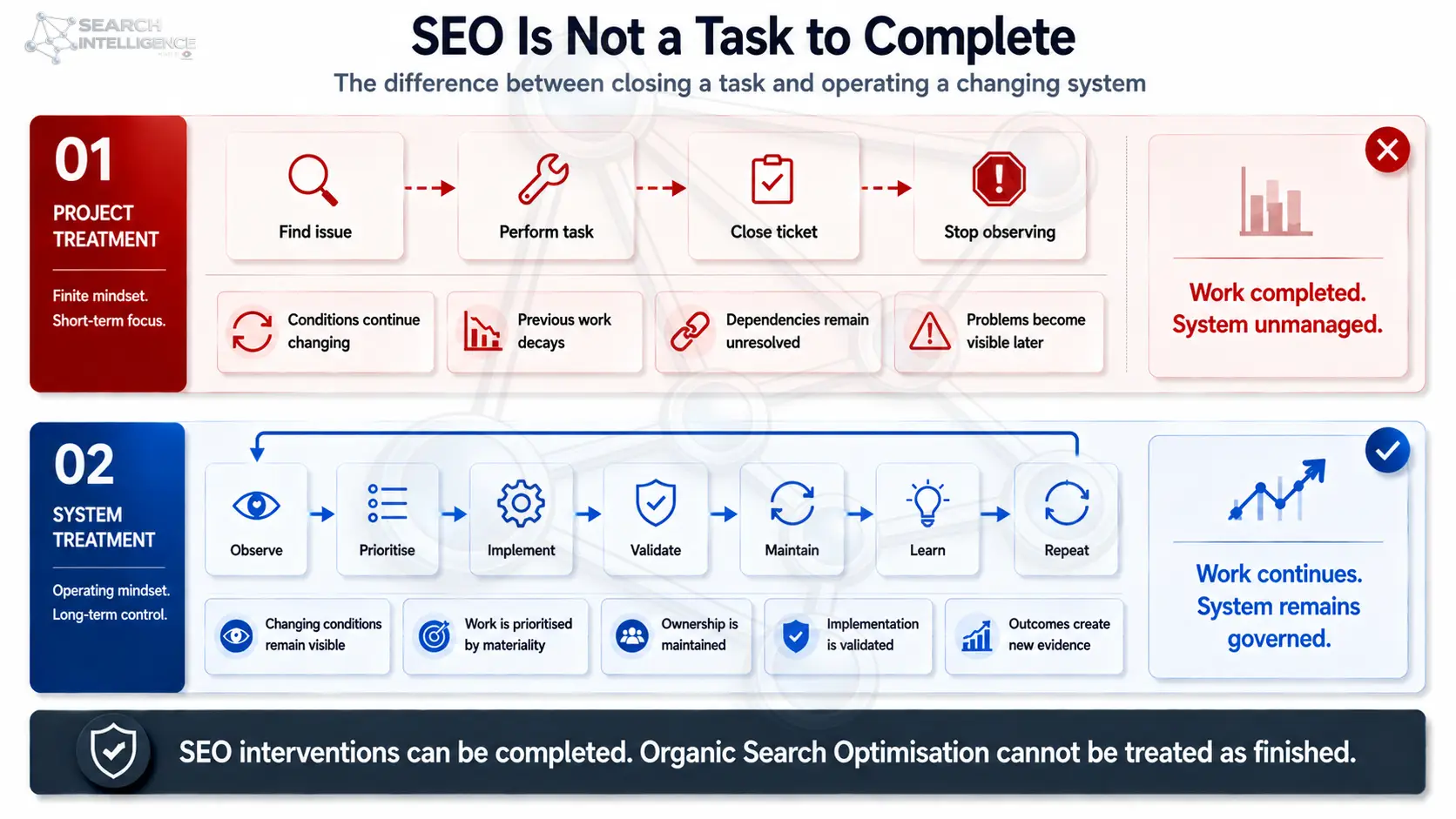
A task has a completion state
A well-defined task has a beginning, an output and a point at which it can be signed off.
Examples include:
Each can be completed and verified.
SEO, however, is not the sum of one completed list. It is the discipline that keeps assessing whether the website and its content remain accessible, understandable, relevant, useful and competitive as the surrounding system changes. That system includes the organisation, its customers, its competitors and the search platforms through which discovery occurs.
The website does not stand still
Even when an organisation stops doing SEO, the website keeps changing.
Teams release new templates. Product names change. Old pages remain live. Navigation is redesigned. JavaScript is introduced. Campaign pages are published and abandoned. Tracking scripts accumulate. Content ages. Internal links disappear. New domains or subdomains are added.
Many of these decisions are reasonable in isolation. Together, they can change how search systems access and interpret the site.
The organisation does not need to "do SEO" again because SEO expired. It needs an active discipline because the environment that SEO works within never stopped moving.
Competitors do not wait for your project to end
A ranking is a relative position.
Your page can remain unchanged and still lose ground because another organisation:
This is one reason task-based thinking fails. The project plan is internal. The outcome is competitive.
A page that was strong eighteen months ago may now be ordinary. A category that looked secure may become contested. A query that once produced a conventional list may now surface comparisons, video, local results or AI-generated answers.
Completion inside the business does not freeze the outside world.
Customer questions change
Customer language is not fixed.
New products create new questions. Economic pressure changes what people compare. A service failure changes what they fear. Regulation changes what they need explained. New technology changes the words they use and the places they look for answers.
A content set can remain technically accurate and become less useful.
The discipline of SEO includes noticing that change, understanding the gap and helping the organisation respond through the right owner.
That is not endless activity for its own sake. It is maintenance of relevance.
Search systems change too
Search platforms continually reassess how information is crawled, indexed, understood and presented. Broad ranking updates occur because the web and the systems evaluating it continue to change.
The practical lesson is not to chase every fluctuation.
It is to avoid treating a previous position as a permanent asset.
A disciplined programme watches underlying conditions, not only the visible ranking. It knows which changes are material, which are noise and which require patience rather than intervention.
Discipline does not mean perpetual busyness
Some organisations hear "continuous SEO" and imagine a supplier inventing work to protect a retainer.
That concern is legitimate.
A discipline should not be measured by the number of recommendations it produces. It should be measured by the quality of its judgement.
Sometimes the correct decision is to act.
Sometimes it is to wait, gather more evidence or protect a stable system from unnecessary change.
A mature SEO discipline can say:
That is very different from a task factory.
What the organisation should complete
SEO itself is not completed, but individual work must be.
The organisation should complete:
The discipline continues. The work should not remain permanently open.
This distinction matters because "SEO is ongoing" is sometimes used to excuse weak accountability. A functioning system must still show what was identified, what was decided, what changed and what happened afterwards.
The better management question
Instead of asking whether SEO is finished, ask:
That question opens a more useful conversation:
SEO is not a task to complete.
It is a discipline that helps the organisation remain eligible, relevant and useful inside a system that changes whether the organisation is paying attention or not.