
When a search problem becomes an ownership problem
4 min read
A Product page needs clearer evidence. The mobile journey needs work. Reviews reveal a recurring service concern. The agency has raised all three. Who owns the problem?
The answer is rarely "the SEO team".
The model at a glance
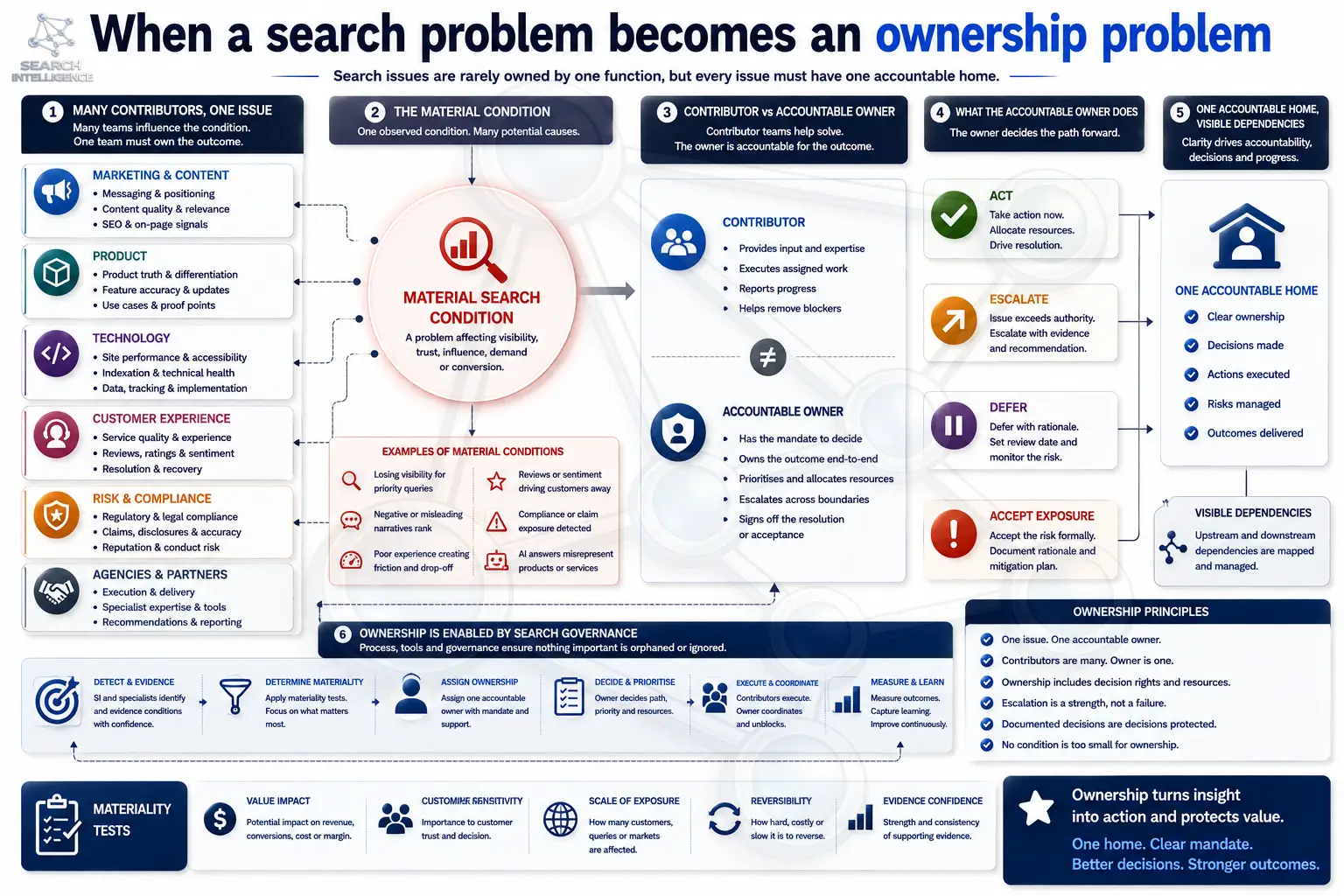
Marketing investment, Product truth, Content and SEO execution, Technology systems, Customer Experience, reputation, Sales evidence, Legal, Compliance or assurance, agency delivery. A task may have an executor while the business condition remains ownerless.
The accountable owner should be the person authorised to decide what the organisation will do, not simply the person able to complete a task. Product owns the approved promise; Digital owns the journey; Technology owns platform change; Marketing owns investment and campaign implications; Corporate Affairs owns public response; Finance validates financial claims; the sponsor resolves cross-functional priority.
The governance test
Who can decide? Who can implement? Who can approve the evidence or Product truth? Who carries the customer or commercial consequence? Who accepts the exposure if no action is taken? When those answers differ, governance is required.
A real owner can approve action, defer it, accept the residual exposure or escalate it. Naming an owner without decision authority creates the appearance of accountability without the ability to change anything.
A common ownership trap
A bank's switching page explains the process, but customers repeatedly search for what happens to debit orders and salary payments. Marketing sees a Content gap. Product sees a process question. Digital sees a journey question. Operations sees service responsibility. Compliance sees a disclosure concern. The agency can create the page but cannot define the process. Calling this "an SEO issue" places ownership with the team least able to resolve it.
Customer-focused ownership language
Instead of asking "Who owns this page?" ask:
That question often reveals that page ownership and business ownership are not the same thing. Clear ownership shortens delay, improves supplier relationships, reduces the chance that the same issue returns in every report, and gives leadership a more honest picture of why the condition remains unresolved.
The accountable owner should usually sit closest to the business condition: Product for Product truth and suitability, Customer Experience or Operations for service delivery, Digital for journey progression, Technology for platform integrity, Corporate Affairs for material public narrative, Marketing for demand investment and campaign implication, and executive sponsors for cross-functional priority. SEO, Content and agencies remain essential specialist contributors.
Search Governance should not simply assign a name. It should document why the condition crosses functions, which authority is required, the consequence of delay, what each party owns, who can accept the residual exposure, and where escalation occurs if agreement fails.
Give the condition an accountable home.
Explore Search Governance, or return to the cornerstone framework.