
The Search Governance forum: Decisions, escalation and operating cadence
6 min read
The forum has failed when every participant arrives with a separate deck and leaves with the same unresolved actions.
A good governance forum is a decision surface.
The model at a glance
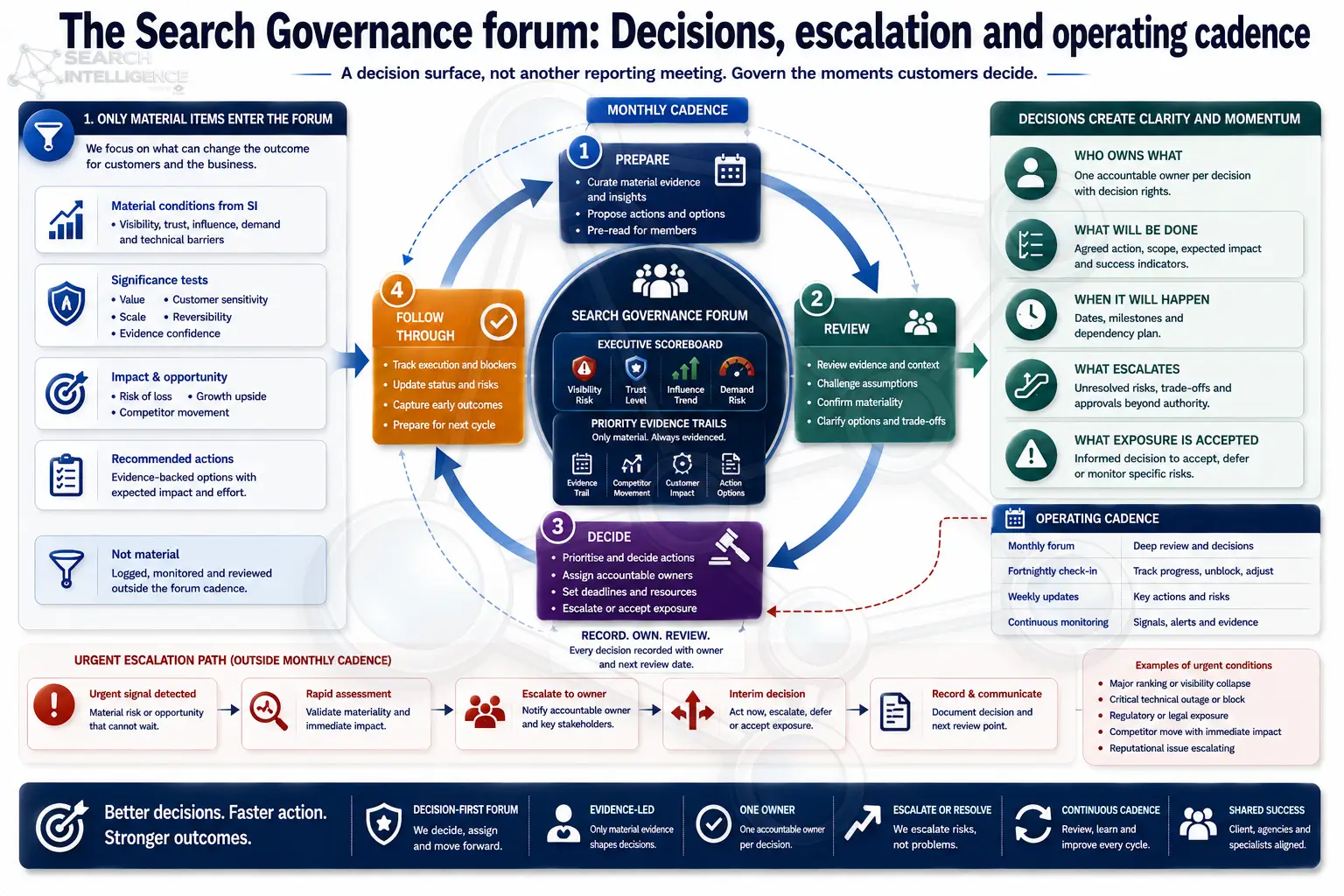
Newly identified material conditions, evidence changes and Unknowns, decisions required, blocked implementation, urgent escalation, accepted or deferred exposure, outcome review, value and learning.
Detailed operational updates, long keyword lists, routine task reporting and unprioritised technical inventories should remain in specialist forums unless they create a material decision.
Urgent triggers should bypass the monthly cycle when waiting would increase exposure.
The scoreboard should show current condition and movement, material issues, evidence confidence, owner, decision required, escalation status, next review date, and value link. It is a decision aid, not a decorative dashboard.
A sample 60-minute governance forum
Material movement, 10 min
What changed since the last cycle? Only material or potentially material items.
Evidence challenge, 10 min
Observed, Inferred, Modelled, Validated or Unknown? Which alternative explanations remain?
Decisions required, 20 min
Approve, defer, monitor, reject, accept exposure or escalate.
Implementation blockers, 10 min
Which approved work is blocked and why?
Outcomes and learning, 10 min
What changed after implementation?
Not every function needs to attend every meeting. Core roles may include the governance sponsor, SI lead, Marketing or Digital owner and relevant programme owner. Product, Technology, Sales, Risk, Compliance, Finance or agencies join when their decision or expertise is required, this protects senior time and keeps the forum decision-focused.
Urgent conditions need defined triggers, channels and response times: what qualifies as urgent, who receives the alert, who may decide interim control, how evidence is retained, and when the full decision is reviewed.
The governance owner should circulate the material evidence, decision request and known dependencies in advance. Participants can then challenge the evidence before the meeting rather than using executive time to discover the problem together.
Every material item should leave with one clear state: approved action, further evidence, monitoring, deferral, accepted exposure, escalation or closure. The owner and next review date should be visible before the agenda moves on. A forum that ends with "the teams will discuss it" has usually postponed the decision rather than governed it.
Make the meeting earn its place.
Explore Annual Search Governance, or return to the cornerstone framework.