
Follow the system from customer choice to organisational control.
4 min read
Before a lead, quote, application, booking or sale appears, a customer has already encountered information, compared alternatives, interpreted evidence and formed some degree of confidence.
Those decisions are shaped across a wider environment: Organic Search, AI answers, reviews, competitors, publishers, Product information, Brand evidence, reputation, technical journeys and the organisation's own customer experience.
Understanding that environment requires more than one framework.
Search Intelligence brings together six connected systems that explain how customers choose, what must keep working, where commercial value can disappear, how AI changes representation, how evidence should support decisions and how the organisation responds when something materially matters.
Start with the question closest to the problem you are trying to understand.
Six connected questions
Begin with the question closest to your problem.
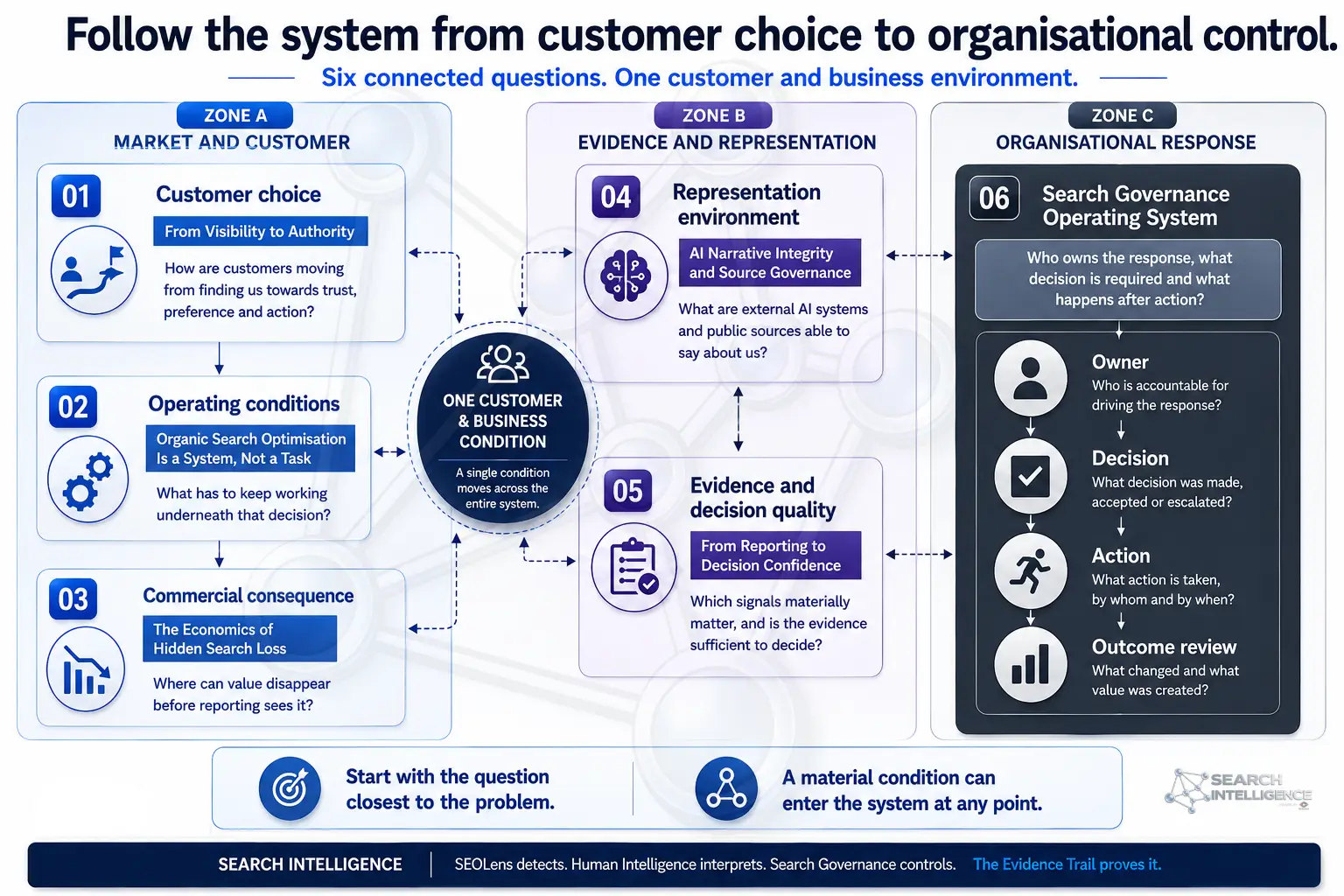
01 — How do customers move from finding you to choosing you?
Visibility → Trust → Influence → Demand, compounding over time into Authority.
02 — What has to keep working underneath that decision?
Why Organic Search performance depends on conditions that never stop needing attention.
03 — Where can commercial value disappear before reporting sees it?
Demand leakage, competitor capture and implementation loss before it reaches the P&L.
04 — What changes when AI increasingly interprets you for the customer?
The difference between AI visibility, AI representation and AI Narrative Integrity.
05 — How do we know which signals matter enough to act on?
Evidence → Interpretation → Materiality → Decision Confidence.
06 — What happens after the organisation knows something materially matters?
Evidence → Interpretation → Materiality → Owner → Decision → Action → Outcome → Value → Learning.
One connected system
These six frameworks are not separate theories competing for attention. They describe different parts of the same environment.
Choice → Operation → Value → Representation → Intelligence → Control
A problem may enter the system at any point. A technical condition can affect Visibility. A Product inconsistency can weaken Trust. A stronger competitor can shift Influence. A broken journey can leak Demand. Poor source integrity can distort AI representation. Incomplete evidence can weaken Decision Confidence. Unclear ownership can prevent action.
Search Intelligence helps connect those conditions so the organisation can understand the whole problem rather than only the part visible to one team.
Sector applications
From Visibility to Authority, applied by sector.
Each application uses the same governing architecture — Visibility → Trust → Influence → Demand, with Authority as the compounding market outcome. None of them creates a sector-specific version of SI.
Apply the thinking to your organisation
The cornerstone systems explain the underlying principles.
The rest of the SI knowledge architecture applies those principles to particular responsibilities and contexts.
By Sector
By Organisational Responsibility
By Organisational Scale
By Terminology
By Practical Artefact
Browse Everything
Start with your own evidence.
Understanding the system is useful. Understanding where your own organisation sits inside it is more useful.
The Decision Confidence Diagnostic provides a structured first view of where customer confidence, demand, representation, technical integrity, competitive position or organisational ownership may need closer investigation. It is not a ranking promise, assurance opinion or automated diagnosis — it is a starting point for determining what deserves a deeper evidence-led assessment.
This connects to Search Intelligence, Knowledge Library, Search Intelligence by Role, Formal Definitions, Resources, Manifesto, From Visibility to Authority, Organic Search Optimisation, The Economics of Hidden Search Loss, AI Narrative Integrity and Source Governance, From Reporting to Decision Confidence and Search Governance as an Organisational Operating System.