
Implementation loss: When the right recommendation never changes the condition
The issue is known. The recommendation is accepted. The work still does not happen. Or it happens, the ticket closes and nobody checks whether the customer or commercial condition improved.
Both situations create implementation loss.
The model at a glance
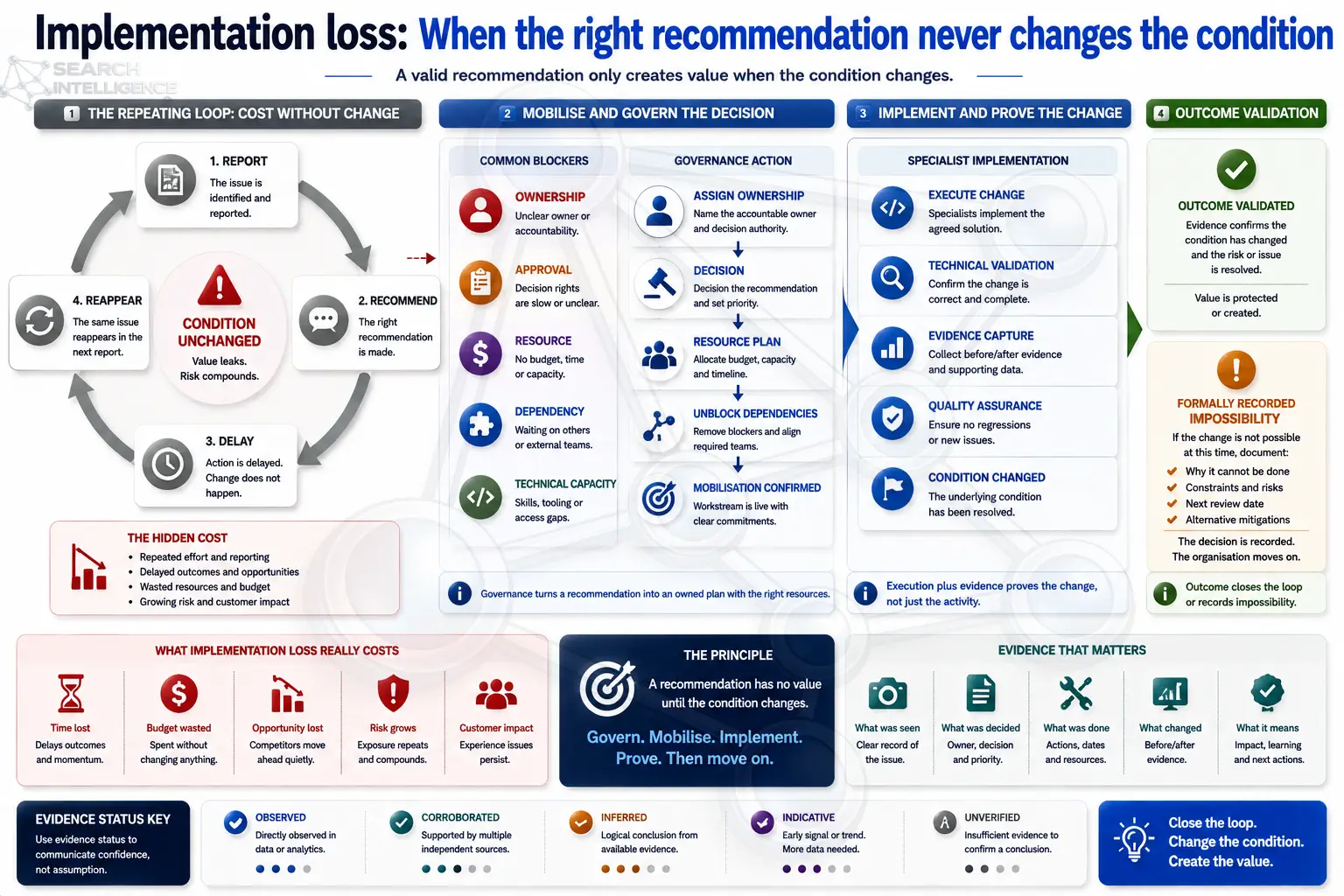
The hidden cost of repeated recommendations
The waste is not only the delayed outcome. It is the repeated effort around a decision system that never closes the loop.
Why good work gets trapped
The implementation-loss cycle
Over time, the organisation may normalise the open issue. The recommendation remains visible, but the exposure becomes part of the background.
A Mobilisation record should define
Implementation must be followed by re-observation
The cost categories
Implementation loss is paid in eight places at once.
None of them appear as a line item, which is why the cost is rarely challenged.
A practical mobilisation sequence
The organisation may face legal constraints, platform limitations, vendor dependency or insufficient capacity.
The client-facing advantage
Transparency about what did not move is worth more than a roadmap.
This approach does not promise that every recommendation will be implemented. It gives the client a clear account of what moved, what did not, why and what exposure remains — more valuable than a plan that assumes unlimited authority and capacity.
Questions to test implementation readiness
These questions should be answered before the organisation treats the recommendation as an active implementation commitment.
Turn approved work into changed conditions.
Explore Mobilisation, or return to the cornerstone framework.