
An appearance can be measured. A trustworthy representation must be examined. · 4 min read
AI visibility, representation and integrity are not the same thing
A monitoring tool records that the Brand was mentioned. The team celebrates an AI-visibility win.
Nobody checks whether the answer described the right Product, preserved the qualification or directed the customer to a current next step.
The model at a glance
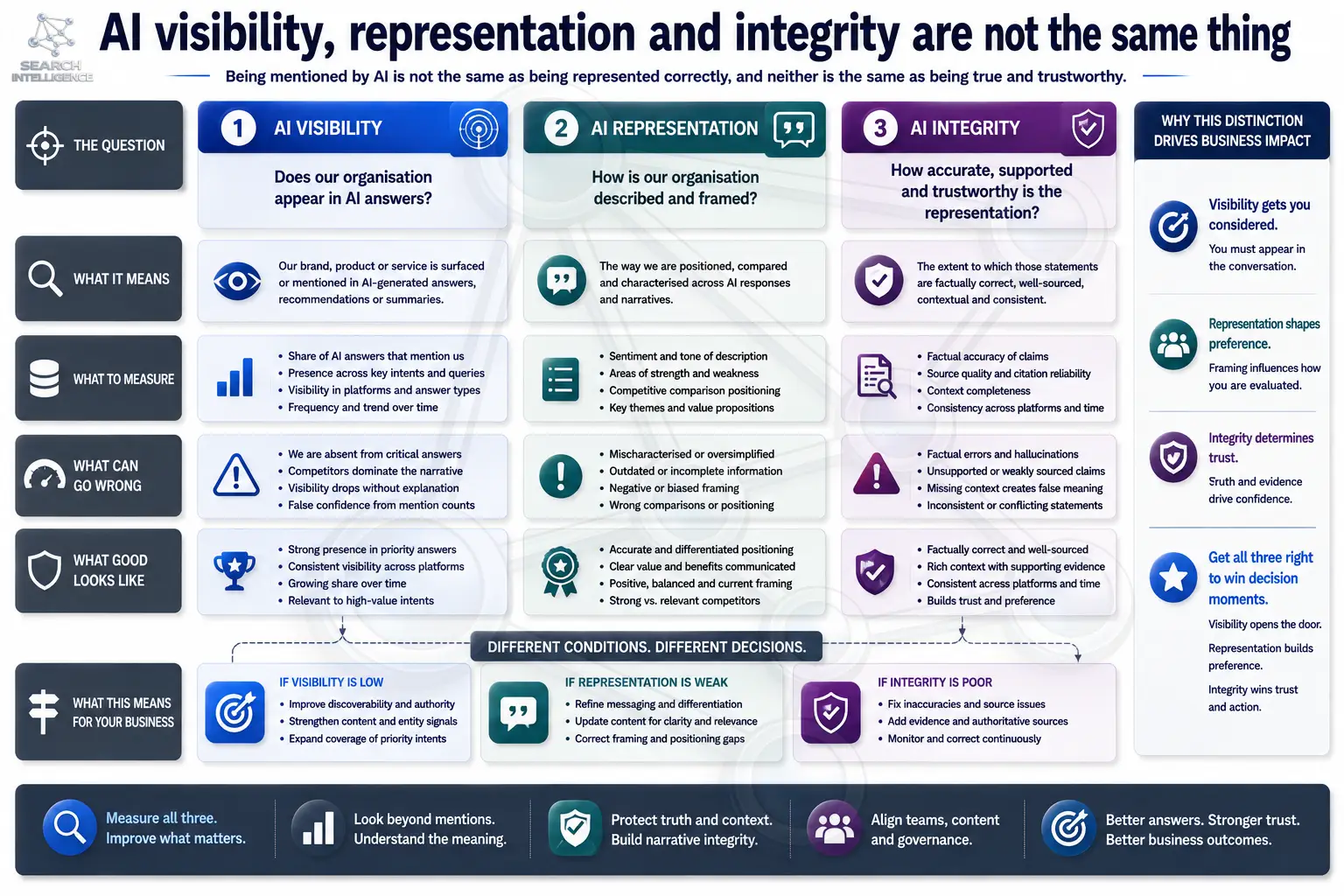
Three measures, three questions
Appearing is the easiest of the three to measure and the least useful.
Visibility may coexist with
Outdated Product Facts
Missing Conditions
Source Confusion
Unsupported Comparison Claims
Wrong Locations Or People
Obsolete Next Steps
Incomplete Context
Overreliance On Third-Party Sources
How to assess an answer
Every observation carries the same ten fields.
Customer Question And Prompt
Platform And Date
Answer And Cited Sources
Material Claims
Accuracy And Omissions
Product And Entity Identity
Qualifications And Context
Likely Decision Consequence
Evidence Status
Owner And Next Observation
A single answer is an observation. Repeated, comparable observations may support a pattern. One favourable or unfavourable output is never a universal claim.
A simple measurement framework
Three measure groups, kept separate.
01
Visibility measures
Mention Or Inclusion Rate
Product And Entity Inclusion
Cited Source Frequency
Share Of Relevant Answer Environments
02
Representation measures
Material Facts Included And Omitted
Product And Entity Accuracy
Comparison Framing
Next-Step Accuracy
Source Type Used
03
Integrity measures
Accuracy
Consistency
Provenance
Currency
Context Preservation
Entity Coherence
Technical Accessibility
The three groups should never be collapsed into one vanity score.
A customer-focused interpretation
A favourable mention can still fail the customer.
Six ordinary ways a positive answer still leaves the customer worse off.
01
The Product is not suitable for the stated need
02
The fee excludes an important condition
03
The answer links to the wrong region
04
The next step has changed
05
The source is outdated
06
A regulated qualification is omitted
How to compare observations
Use a controlled observation set
Defined Customer Questions
Consistent Platform Conditions
Dated Captures
Comparable Locations
Repeated Observation Over Time
Variation is part of the result, not something removed from the record.
The business decision
Materiality decides the response
A finding is material when the representation can plausibly affect an important customer decision, Product truth, reputation or commercial path.
A low-impact wording difference may require no action.
An inaccurate eligibility condition close to application may require urgent ownership.
Questions for the reporting team
01
Are mentions being counted without reviewing meaning?
02
Are cited and uncited answers separated?
03
Are Product-level and Brand-level observations being confused?
04
Is answer variation preserved?
05
Are negative and positive outputs reviewed with the same discipline?
06
Does the measurement connect to a customer question and decision consequence?
These controls stop AI reporting from becoming another visibility dashboard that leaves the interpretation to the reader.
Measure what the answer means, not only whether it exists.
Explore AI Narrative Integrity, or return to the cornerstone framework.