
Search Intelligence for the Sports Industry
7 min read
A fan should not need detective skills to work out when the match starts, where to buy the legitimate ticket or which service is carrying the broadcast. Yet sport increasingly lives across a fragmented digital environment: search results, social feeds, team pages, streaming platforms, ticketing systems, sponsors, publishers, live-score services and AI answers.
That fragmentation is not merely inconvenient. It affects attendance, viewing, membership, merchandise, sponsor exposure and the credibility of the sporting property itself.
Search Intelligence for Sports makes the official decision environment easier to observe: what fans find, which sources they trust, where third parties become the dominant explanation and whether participation can progress without unnecessary friction.
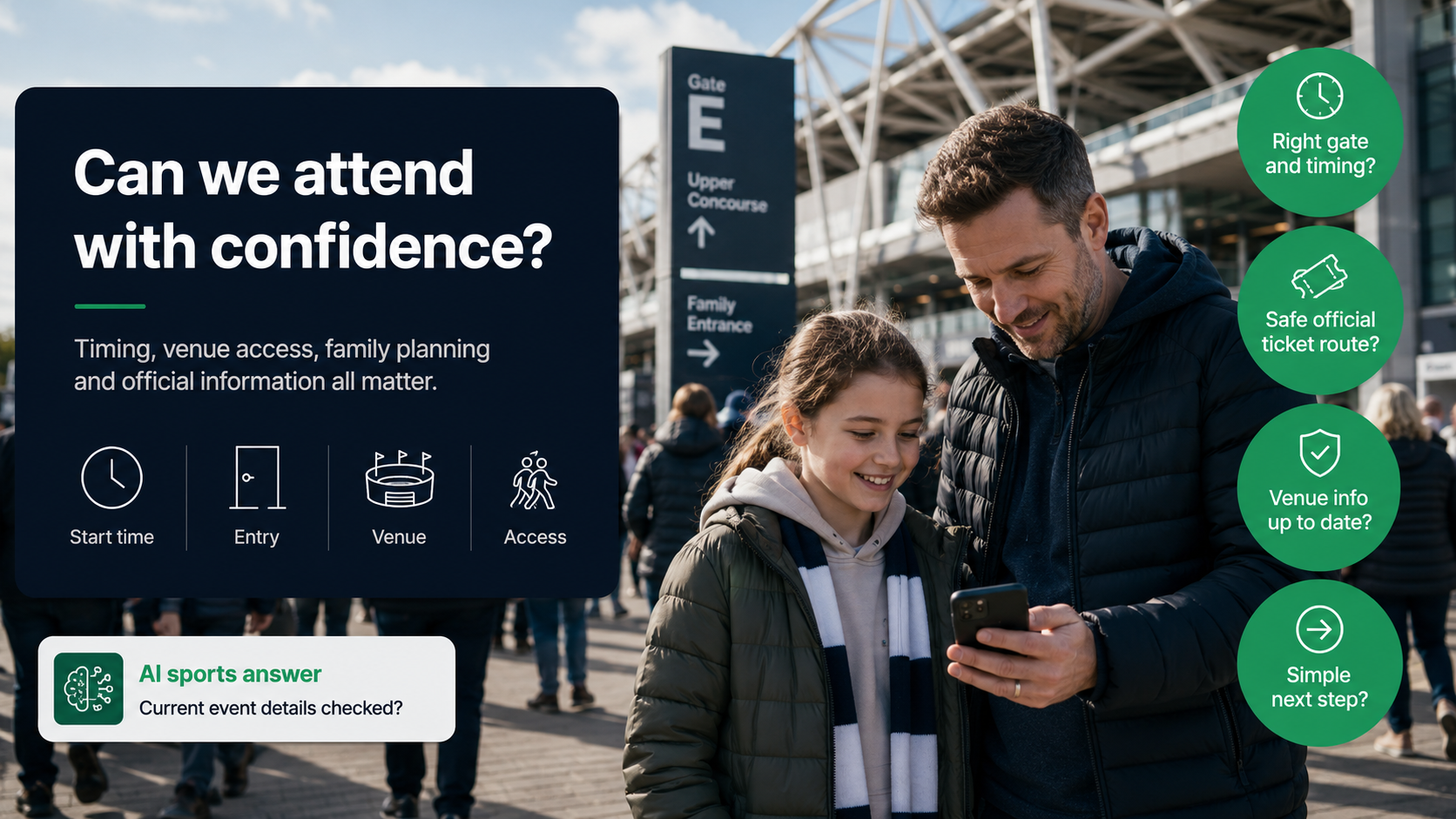
The sector truth
For a fan, the question is usually practical before it becomes commercial:
Search Intelligence follows the fan across the places where that answer is assembled: official sites, search results, AI answers, broadcasters, ticketing platforms, publishers, venue information, social evidence and commercial partners.
SEO helps official sports information remain discoverable and technically available. SI looks at the larger question of which source the fan actually trusts and what happens when fixture, ticket, broadcast or venue information fragments across several systems. Governance creates ownership when the answer spans Competition, Digital, Ticketing, Broadcast, Commercial and Venue teams.
What conventional reporting may not show
A sporting property may have strong social engagement while search surfaces old fixtures. A sold-out event may still have confusing ticket routes. A sponsor may be prominent in-stadium but barely associated with the relevant sporting property in research environments. A league may depend on third-party score and fixture sources because its own information is slow, fragmented or technically inaccessible.
These are different failures, but they share one characteristic: the organisation may see the eventual attendance or viewership number without seeing the friction that shaped it.
What Search Intelligence should focus on
Eight governance priorities specific to sports decisions.
Team, league, athlete and event entity integrity
Ensure official names, relationships, venues, competitions and season information are coherent across owned and search-connected sources.
Fixture, result and venue accuracy
Identify stale, conflicting or inaccessible official information that may undermine fan confidence.
Ticketing and attendance demand
Map event, venue, pricing, availability and access questions before the ticket transaction.
Streaming and broadcast discovery
Assess whether fans can reliably find where and when to watch across platforms and regions.
Membership, merchandise and fan demand
Understand the search questions that precede joining, buying, travelling or supporting.
Sponsor discoverability and commercial influence
See whether sponsor relationships become visible and meaningful in the relevant fan and category environment.
Reputation, community and fan trust
Observe recurring public evidence that strengthens or weakens attachment to the sporting property.
AI and real-time representation
Test how AI systems answer fixture, team, event and participation questions and whether official sources remain authoritative enough to support those answers.
How the From Visibility to Authority framework applies
The customer progression remains:
Authority is the compounding market outcome that may emerge when those conditions are repeatedly sustained. It is not an equivalent fifth customer-progression stage.
Where value can be created, protected or recovered
Value created
More discoverable events, improved fan participation, stronger membership and merchandise demand, better sponsor visibility and clearer broadcast discovery.
Value protected
Official information integrity, ticket demand, fan trust, sponsor value, digital rights visibility and the organisation's relationship with its community.
Value recovered
Lost event or ticket discovery, stale official information, weak entity understanding and search spaces dominated by unofficial or low-quality sources.
Waste avoided or investment redirected
Paid promotion for events whose official information is difficult to find, duplicate fixture publishing, disconnected digital platforms and recurring fan-support questions caused by unclear information.
The evidence status must travel with any value conclusion: Observed, Inferred, Modelled, Validated or Unknown. Contribution can be stated where the evidence supports it. Attribution requires a disclosed causal method.
AI systems can combine fixtures, results, ticketing, broadcast information and commentary in one response. That creates convenience, but it raises a source-governance question: is the official information accessible, current and clear enough to anchor the answer?
AI Narrative Integrity therefore operates across the complete strategic stack. The organisation cannot control external AI systems. It can govern approved source accuracy, currency, provenance, entity coherence, technical accessibility, ownership, correction and re-observation.
A sports Brand is experienced as a relationship, not simply a logo. Official information, fan treatment, event organisation, community relevance and the way uncertainty is handled all shape that relationship. Search evidence can make those moments visible without reducing supporter behaviour to a marketing funnel.
What an SI assessment could produce
A useful first scope might be one competition, one event series, one ticketing journey, one membership programme or one sponsor property. It should be small enough to trace the fan's path from discovery to participation and commercial action.
Boundaries and authorised judgement
The initial SI sports scope is clubs, leagues, federations, events and commercial sporting properties. It does not cover gambling optimisation, athlete medical decisions or rights that the organisation is not authorised to control.
Questions leadership and functional teams should be able to answer
Start with the customer uncertainty closest to commercial or reputational consequence.
Establish what the customer can currently find, what evidence enters consideration, which condition appears material, who can change it and what would count as improvement.