
From Visibility to Authority in Financial Services and Wealth: Building confidence in judgement before the first conversation
8 min read
A business owner is referred to a wealth adviser.
They do not call immediately. They search the adviser's name, the firm, its investment philosophy, fees, qualifications and recent commentary. They read a profile, scan a few articles, look for complaints and ask an AI assistant how the firm compares with alternatives.
The referral created initial influence. Search now decides whether that influence survives.
This is common in Financial Services and Wealth. The prospective client may arrive through a trusted introduction, a life event, a liquidity decision, retirement planning, estate complexity or concern about an existing portfolio. Before making contact, the prospective client quietly tests whether the firm appears credible enough to handle a consequential and personal decision. This article applies the From Visibility to Authority framework to Financial Services and Wealth.
The model at a glance
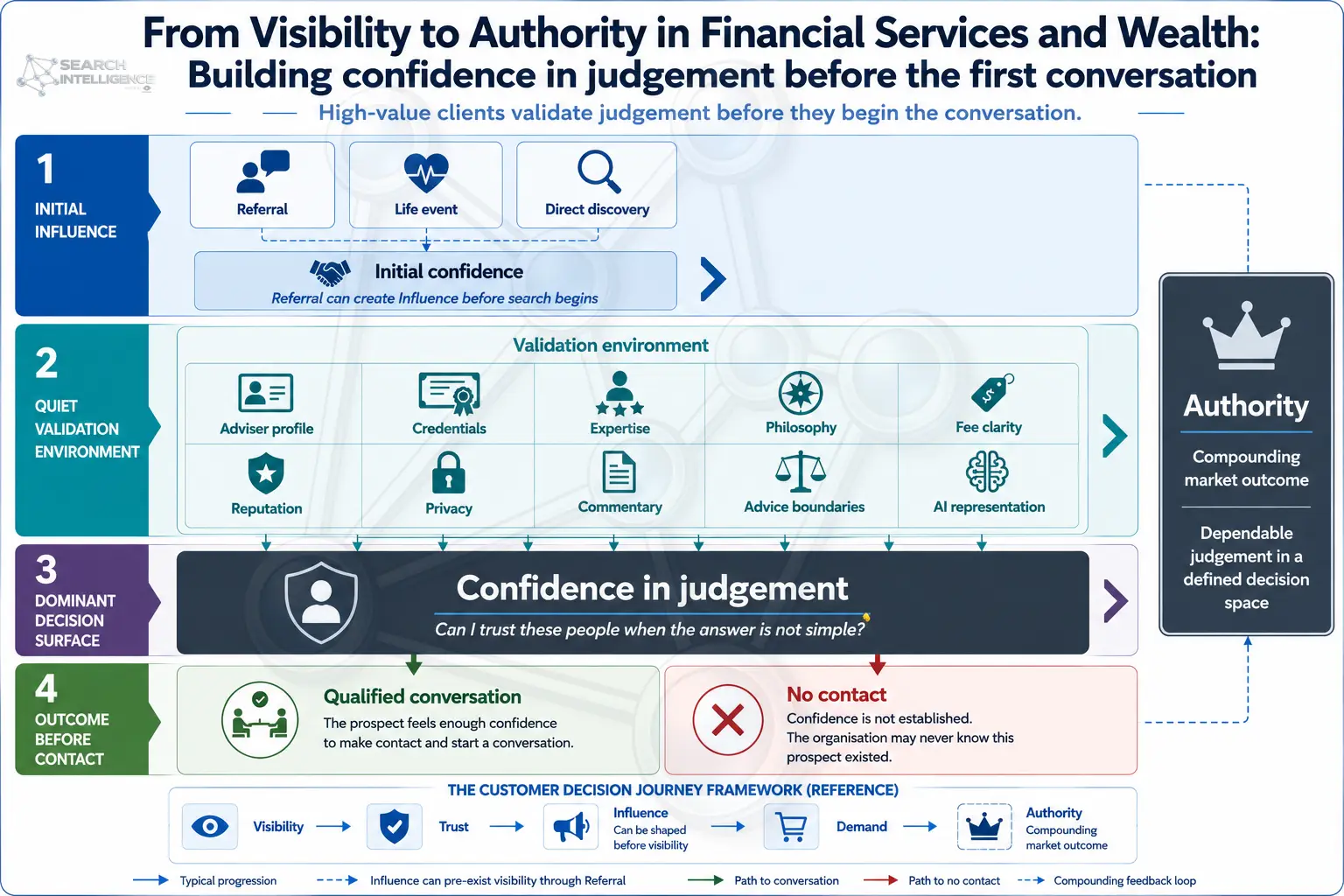
The client is buying confidence in judgement
The visible search may be for wealth management, financial planning, retirement advice or an adviser's name. The deeper question is:
That confidence may depend on expertise and credentials, clarity of philosophy, fee and incentive transparency, the ability to explain risk, professional reputation, discretion and institutional stability, evidence of understanding complex client circumstances, and the line between education, promotion and regulated advice.
How the four customer-progression layers and the Authority outcome apply
| Condition | Wealth question | A stronger condition may look like |
|---|---|---|
| Visibility | Can the prospective client find the firm or adviser for the relevant financial concern? | Expertise is discoverable across selected high-value needs and referral-validation searches. |
| Trust | Is there enough evidence to believe the firm is credible, transparent and suitable to approach? | Credentials, philosophy, fees, boundaries and reputation reduce perceived risk. |
| Influence | Does the firm earn a serious place on the shortlist? | The organisation's judgement and point of view feel more relevant and dependable than alternatives. |
| Demand | Can confidence become a qualified consultation or enquiry? | The prospective client can take an appropriate next step without confusion or pressure. |
| Authority | Is the firm becoming a trusted reference in a defined area of judgement? | Clients, referrers, publishers and the market repeatedly recognise credible expertise in selected decision spaces. |
Where value may be created or protected
Value created
Becoming more visible for material client concerns, making expertise easier to validate, clarifying the path to consultation and supporting qualified high-value enquiries.
Value protected
Firm and adviser reputation, referral value, trust in expertise, clarity around fees and advice boundaries, high-value subject-matter positions and confidence during market uncertainty.
Value recovered
Where an adviser's outdated profile dominates, where the firm has lost visibility for a strategically important area, where weak third-party information shapes referral validation, or where Product and service explanations no longer reflect the current offer.
Waste avoided
Avoid generic thought leadership, duplicated adviser profiles and Content activity that attracts interest without establishing credibility or suitability. Reduce the effort Sales or advisers spend correcting public misunderstandings during the first meeting.
What progress may look like over time
Short term, understand how confidence is tested
High-value client concerns and search behaviour; referral-validation journeys; adviser and firm entity consistency; fee, philosophy and service clarity; reputation and review evidence; AI summaries and cited sources; competitor and publisher influence; and gaps between public Content and the current advisory proposition.
Medium term, strengthen expertise and qualified demand
Improve selected expertise and client-question coverage; align adviser and institutional profiles; make fees, philosophy and process easier to understand; clarify the boundary between education and advice; strengthen referral-validation evidence; improve consultation pathways; build a more disciplined publication and review process; and protect or establish selected areas of Authority.
Long term, compound confidence in judgement
Sustained progress may contribute to stronger qualified enquiry and referral conversion; increased trust in the firm's expertise; more durable Brand and adviser reputation; stronger category association in selected areas; greater resilience during market volatility; and Authority grounded in credible judgement rather than promotional volume.
Long-term value depends on real advisory quality, client experience, compliance discipline and market performance. Search cannot manufacture trust that the underlying service does not support.
AI introduces a new layer of adviser and firm interpretation
AI may summarise an adviser's background, compare firms, explain fees or infer an investment philosophy from public sources. The answer can feel confident even when its source set is weak.
AI Narrative Integrity is not a licence to influence regulated advice. It is a way to govern the accuracy and coherence of approved public information.
In Wealth and Financial Services, Brand is inseparable from judgement. A polished identity may create initial confidence. The public evidence must carry the rest.
Authority is weakened by overclaiming. A firm becomes more credible when it can show what it knows, what it does not claim and where authorised advice begins.
Marketing and Brand, advisers and subject-matter experts, Product and proposition owners, Compliance, Legal and Risk, Corporate Affairs, Digital, SEO and Content, Technology, Data and AI, Business Development and referral partners. SI identifies and interprets the public decision condition. Authorised advisers and governance functions retain suitability, advice, legal and compliance judgement.
Evidence and value discipline
Useful evidence may include selected expertise and client-need visibility; adviser and firm source consistency; AI answer captures; fee and process clarity; referral-validation behaviour; reputation themes; qualified enquiry progression; competitor and publisher occupation; and implementation and outcome records.
The firm should distinguish between an Observed improvement in public representation and a Validated commercial outcome.
Questions Financial Services and Wealth teams should answer
Each question describes a condition that can be observed in public evidence before a first conversation takes place.
Where to begin.
A focused assessment can start with one firm, adviser group, expertise area or high-value client journey. It should define what evidence is public, what is material and which authorised owners would need to participate.