
From Visibility to Authority at Enterprise scale: Governing customer confidence across complexity
8 min read
An Enterprise group may have several Brands, hundreds of Products, multiple countries, separate websites, different Technology stacks and more than one agency. Each team may report progress.
One Brand is gaining traffic. Another is losing a profitable Product segment. A technical migration is affecting indexation in one market. Product information differs across domains. An AI system confuses the parent company with a subsidiary. Paid media is compensating for weak Organic Search in a high-value area. None of these conditions looks decisive in isolation, together, they may describe a material shift in customer confidence, demand or group reputation.
The Enterprise problem is not a lack of data. It is the absence of one governed way to determine what matters across the portfolio. This article applies the From Visibility to Authority framework at Enterprise scale.
The model at a glance
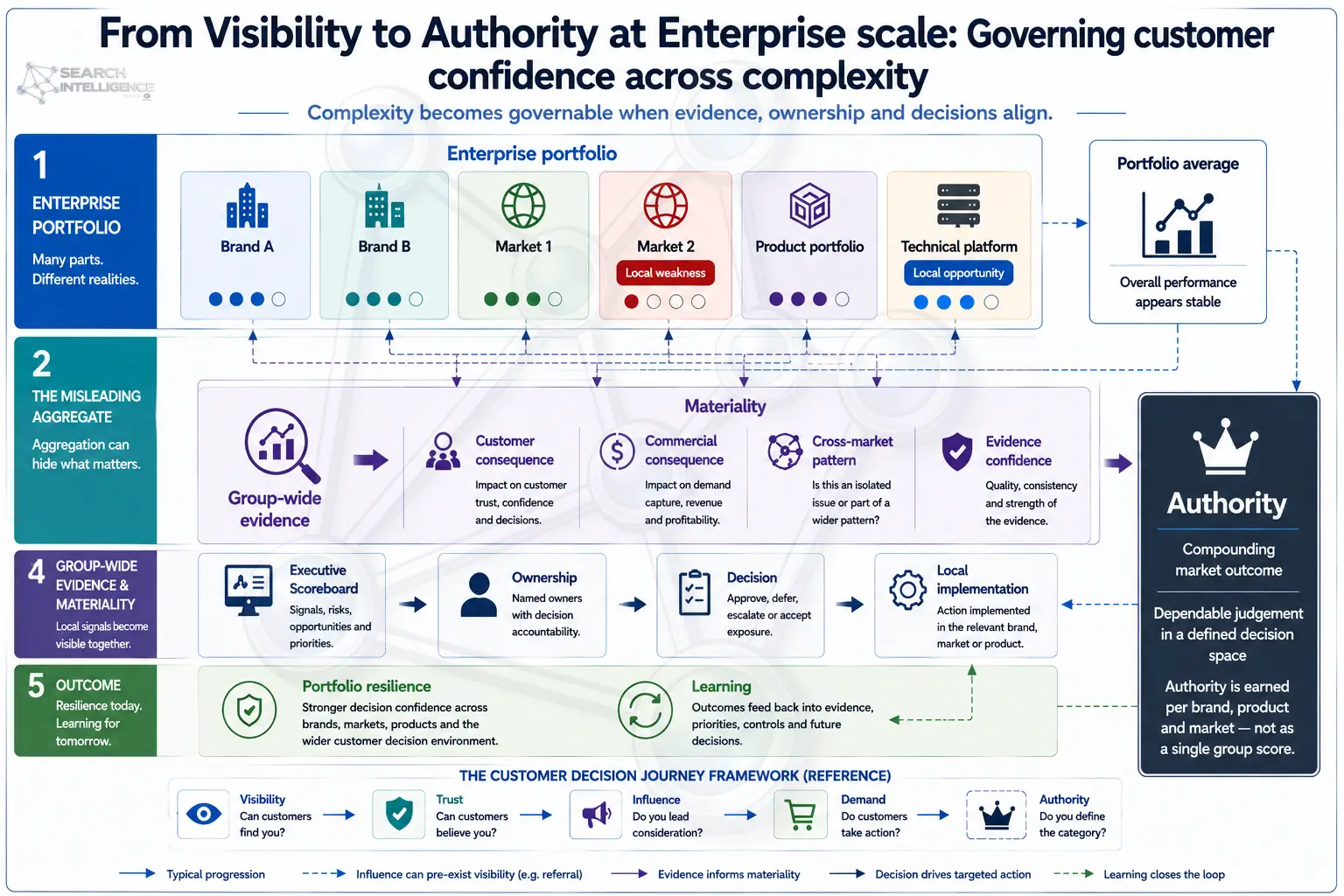
A smaller organisation may be able to resolve a search condition in one meeting. An Enterprise may need to coordinate many more people. The four customer-progression layers and the Authority outcome remain the same. The evidence, ownership and decision routes become more complex.
How the four customer-progression layers and the Authority outcome apply at Enterprise scale
| Condition | Enterprise question | A stronger condition may look like |
|---|---|---|
| Visibility | Does the group understand presence across Brands, Products, markets and devices? | Material portfolio coverage is visible without hiding local weakness inside global averages. |
| Trust | Do Product, Brand and corporate sources agree across the group? | Customers encounter coherent, current evidence despite organisational complexity. |
| Influence | Which Brands and competitors are defining the category in each market? | The group can protect local relevance while strengthening strategic positions. |
| Demand | Does valuable intent reach the correct Brand, market and journey? | Demand is routed into viable local or group pathways with leakage made visible. |
| Authority | Where does the group hold credible category strength, and where is it eroding? | Authority is evidenced by Brand, Product and market rather than asserted at group level. |
Enterprise value creation
Value created
Enterprise SI can reveal whitespace across markets, Product portfolios and customer needs. It can help leadership identify where a group capability, trusted Brand or existing evidence base can be used more effectively.
Value protected
Portfolio demand, Brand and institutional trust, technical resilience, Product source consistency, strategic market positions, major migrations and platform changes, and investment in agencies and internal capability.
Value recovered
Where one market or Brand has lost a profitable decision space, where legacy architecture weakens performance, where fragmented ownership prevents action, or where group Authority fails to transfer appropriately to a local Product or subsidiary.
Waste avoided
Reduce duplicated Content, conflicting agency work, repeated audits, unprioritised technical backlogs and global programmes that do not account for local customer behaviour or market consequence.
What progress may look like over time
Short term, create the portfolio view
The initial stage may establish material Brands, Products and markets; decision-critical customer journeys; group and local source architecture; competitor and category benchmarks; AI and entity exposure; technical and platform dependencies; existing reports, agencies and controls; and ownership and escalation gaps.
The first value is not more activity. It is a clearer view of where the group is exposed and which conditions deserve executive attention.
Medium term, create a common operating system
The organisation may introduce shared evidence and materiality standards; a group Search Risk Register; Brand and market scoreboards; common source and entity controls; clearer RACI and decision rights; implementation workstreams; agency collaboration rules; governance cadence and escalation; and outcome and value tracking.
Long term, compound portfolio resilience
Mature Enterprise Search Governance may contribute to more consistent portfolio strength; faster recognition of material change; reduced duplication and repeated failure; stronger technical and source resilience; better use of group and local expertise; clearer capital and resource allocation; defensible Authority across selected categories and markets; and retained organisational learning when people, agencies or platforms change.
AI increases the cost of fragmented sources
Enterprise organisations have more entities for AI systems to confuse: parent and subsidiary, Brand and legal entity, Product families, regional versions, executives and subject-matter experts, and current versus legacy names. A single inaccurate source may be less important than a pattern of inconsistency across dozens of sources.
The Enterprise AI task is structural: define the entity relationships, identify approved sources, make regional differences explicit, govern current and retired information, monitor material representations, assign correction and escalation routes, and re-observe after action.
At Enterprise scale, Brand coherence does not mean making every Brand sound the same. It means each Brand remains recognisable, group relationships are accurate, Product truth is consistent, local relevance is preserved, public claims do not conflict, and the customer reaches the correct entity and next step. The strongest portfolio may include different Brands holding Authority in different decision spaces, a group-level average should not hide that distinction.
Enterprise value depends on the handoffs. Search Intelligence may identify a material condition. Search Governance determines whether it is a group or local responsibility, which function owns the decision, who funds and implements the response, whether the risk is accepted, deferred or escalated, what evidence will be reviewed, and how learning is retained. Agencies and specialist teams execute within this system, they should not be expected to resolve client-side ownership, funding or risk acceptance.
Evidence for Enterprise decisions
The Evidence Trail may include Brand, Product and market visibility; customer decision maps; competitor and category movement; AI and source captures; technical integrity signals; recommendation and implementation status; decision owners and dates; outcome and value records; and accepted residual exposure.
Confidence and materiality must remain explicit. The largest dataset is not automatically the most important evidence.
Questions Enterprise teams should answer
Where to begin.
Enterprise work should start narrow enough to produce a defensible baseline. One Product portfolio, market cluster, Brand family or material customer journey can establish the model before broader rollout.