
Brand, Product and Customer Experience: When the promise must survive investigation
10 min read
The Product team approved one version of the truth.
The customer may find five.
The website explains the benefit one way. A retailer uses older information. Reviews describe a different service experience. A comparison platform simplifies the conditions. An AI answer combines several sources and removes an important qualification.
The Brand may be visible. The customer may still be unsure what is true, what the Product is for and whether the organisation will deliver the promise. For Brand, Product and Customer Experience teams, the From Visibility to Authority framework is a way to connect public evidence with the actual choice customers are trying to make:
The strongest contribution of these functions is not merely better messaging. It is improving the relationship between the promise, the evidence and the delivered experience.
The model at a glance
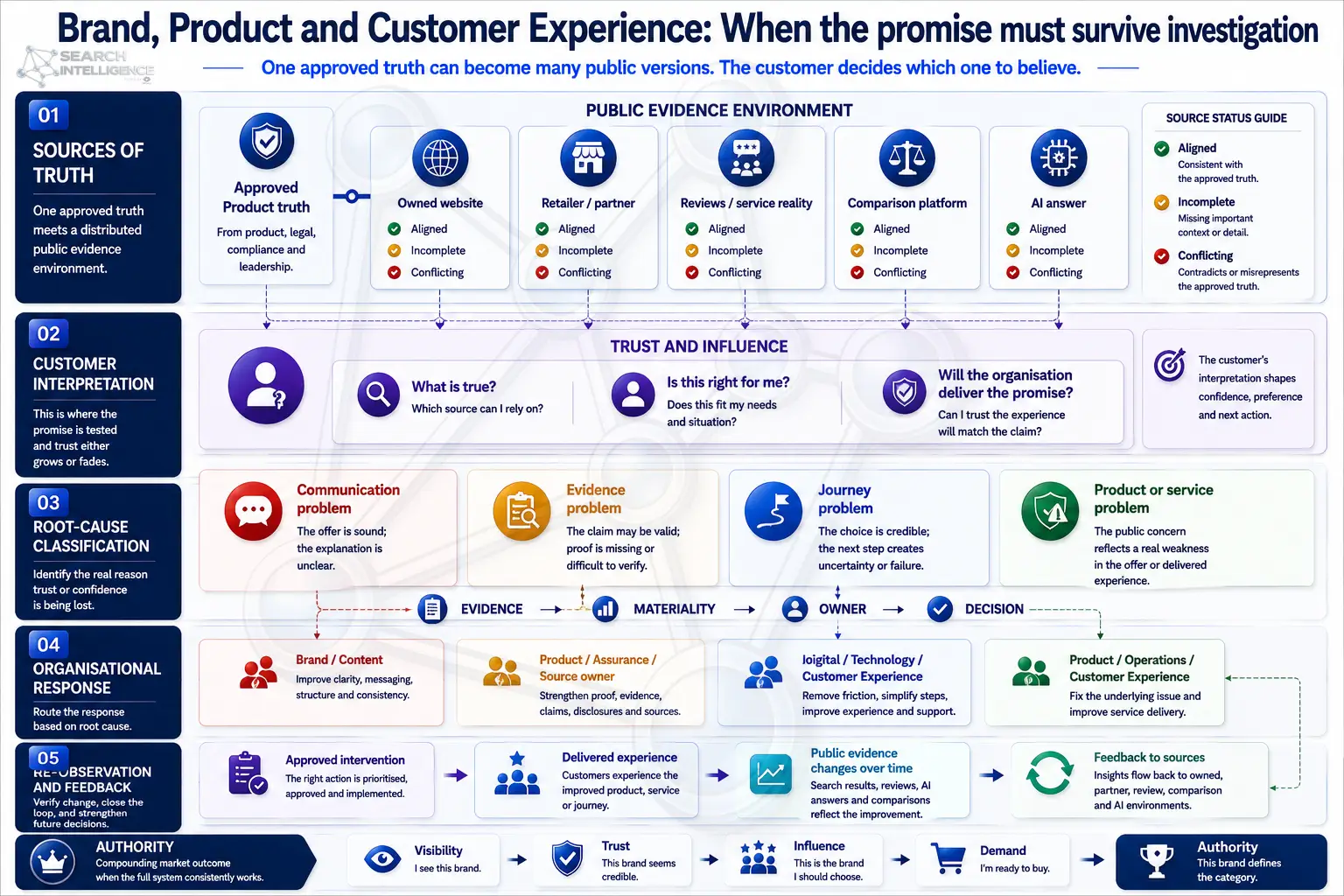
Search evidence is Product and service intelligence.
Customers reveal uncertainty through what they search, compare, ask, review and abandon. These are not always Content questions. They may reveal a Product that is difficult to distinguish, a fee or condition customers cannot understand, a service process that creates anxiety, a public promise stronger than operational reality, inconsistent retailer or partner information, a technical journey that weakens trust, an unresolved reputation concern, or a Product gap a competitor has explained more clearly.
The customer experiences one decision. The organisation may divide the evidence across Brand, Product, Content, Customer Experience, Sales, Technology and assurance teams. The From Visibility to Authority framework gives those teams a shared language for the condition.
HOW
Brand, Product and Customer Experience shape the middle of the model.
Visibility. Make the right Product understandable at first contact
Visibility is not useful when the wrong entity, outdated Product or vague category page appears. Brand and Product teams support visibility by ensuring naming is clear, Product relationships are understandable, important variants are distinguished, approved information is current, category language reflects customer need, retailer and partner sources are aligned, and search and AI systems can identify the correct entity.
Trust. Give the customer enough evidence to continue
Trust is where Brand promise meets Product truth and service reality. It may depend on clear benefits and limitations, fees and exclusions, proof and certifications, reviews and recurring concerns, technical and journey reliability, understandable support processes, source consistency and realistic expectations.
When trust is weak, the correct response may be one of four different things:
Influence. Help customers understand why the choice is right for them
Influence is not louder persuasion. It is the point at which customers can see meaningful difference and decide which option fits their need. Brand and Product teams shape influence through clear positioning, relevant comparison criteria, evidence-backed differentiation, credible claims, understandable Product fit, category education, consistent experience across channels and reassurance around the customer's real risk.
A competitor may become more influential because it explains a familiar Product more clearly, not because the underlying offer is objectively better.
Demand. Remove Product and experience barriers to action
Customers may be ready to act but still hesitate because the next step is unclear, availability is uncertain, the fee structure is difficult to understand, the form requests information before enough trust exists, the switching or onboarding process feels risky, retailer Product data is wrong, service expectations are vague, or support information is difficult to find.
Demand leakage may be a signal that the offer, explanation and journey are not working together.
Authority. Become the source customers and the market rely on
Authority grows when the organisation repeatedly provides accurate Product truth, useful category explanation, credible evidence, consistent service delivery, distinctive expertise, dependable customer support and current, accessible source information. Authority weakens when the owned source becomes less useful than a retailer, publisher, reviewer or competitor.
WHAT
How search evidence becomes a Product or service decision.
A responsible progression: customer uncertainty observed evidence pattern and materiality Product or service owner decision approved intervention implementation re-observation outcome and learning.
Communication problem
Customers repeatedly search for whether a service includes a particular feature. The Product includes it, but the explanation is buried and inconsistent. The response may involve clearer Product information, improved internal pathways and aligned partner sources.
Journey problem
Customers understand the Product but abandon an application because the next steps, documents and waiting periods are not clear. The response belongs across Product, Digital, Operations and Customer Experience, not only Content.
Operational problem
The Brand promises simplicity, but reviews consistently describe a difficult support process. The correct response may require service improvement before stronger promotional claims are made.
Source problem
The current approved page is technically inaccessible, while an older third-party source ranks and is used in AI answers. The response requires Technology, source ownership, Product verification and re-observation.
A Product and customer-confidence evidence map
| Evidence source | What it may reveal |
|---|---|
| Search queries | Customer uncertainty, comparison needs and Product language. |
| Reviews | Delivered experience, trust barriers and recurring service concerns. |
| AI answers | Public-source inconsistency, entity confusion and missing context. |
| Sales questions | Pre-pipeline misunderstanding and proof requirements. |
| Customer service | Post-purchase expectation gaps and operational friction. |
| Site journeys | Where understanding or confidence fails before action. |
| Competitor content | Comparison criteria and differentiation gaps. |
| Retailer or partner pages | Availability, Product truth and source-control problems. |
No single source proves the full condition. Patterns should be evaluated with their evidence status, period, scope and limitations.
Common objections
"Why should search evidence influence Product decisions?"
Because search, reviews and comparison behaviour show what customers are trying to resolve before they choose. The evidence does not dictate the Product decision. It helps Product teams see uncertainty that may otherwise remain fragmented across channels.
"Does SI decide that the Product is wrong?"
No. SI establishes the observable condition, evidence confidence and possible customer consequence. Product and authorised specialists retain decision authority.
"Can better Content solve most of this?"
Sometimes. When the underlying Product, service or process is sound, clearer explanation may be the right response. When the promise and delivered experience disagree, Content alone cannot repair trust.
"Is Authority just a Brand outcome?"
No. Authority depends on whether Product truth, evidence and experience are strong enough for customers and third parties to rely on repeatedly.
What teams should do on Monday morning
Choose one priority Product or service. Bring together the approved Product information, the top customer questions, recurring Sales and service objections, reviews, the main competitor explanations, current AI representations, the next-step journey and retailer or partner sources.
Ask where the evidence agrees, where it conflicts and what the customer is expected to believe. That conversation often reveals a more valuable improvement than publishing another generic piece of Content.
The promise must remain credible after the customer investigates it.
Brand creates expectation. Product defines the offer. Customer Experience delivers the reality.
The From Visibility to Authority framework connects those responsibilities to the search and evidence environment where customers decide whether the promise deserves their confidence.
Next step.
Explore Trust Architecture, or return to the full From Visibility to Authority framework.