
From Visibility to Authority in Banking: Helping customers move from financial uncertainty to confident action
8 min read
A customer is considering a new bank account.
They may be frustrated by fees. Their current app may feel unreliable. A life change may have made an old Product unsuitable. They may want credit, a business account or a safer way to manage everyday money.
They search before they switch, comparing account fees, rewards, qualification rules, digital banking reviews, fraud concerns and the practical steps involved in moving debit orders or salary payments.
A bank can appear for all the right terms and still make the customer feel that changing is too difficult, too risky or too unclear. Banking decisions are not only Product comparisons. They are decisions about financial control. This article applies the From Visibility to Authority framework to Banking. It shows how the four customer-progression layers and the Authority outcome can help banks understand the journey from discovery to institutional trust, Product preference, application demand and durable category relevance.
The model at a glance
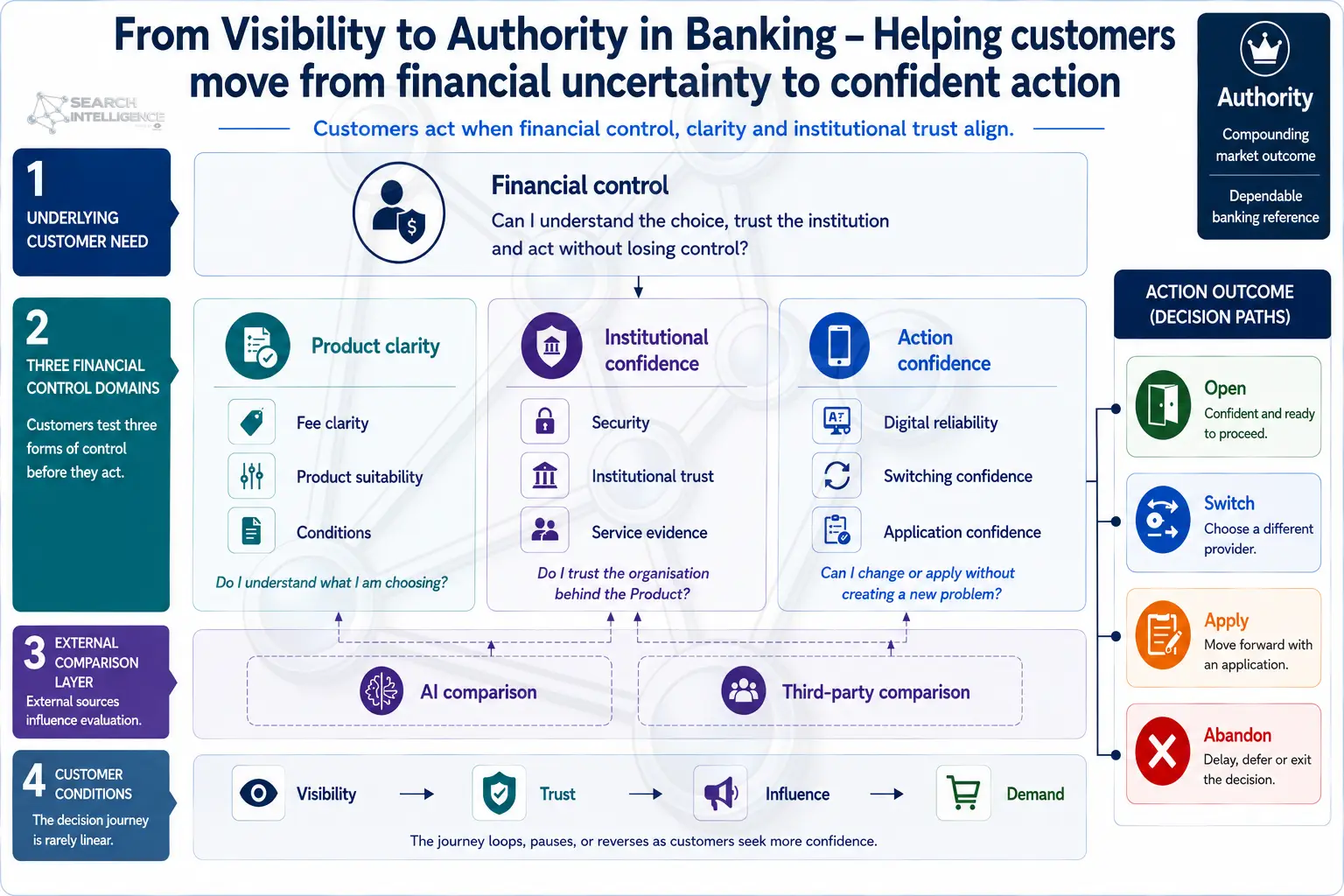
The customer's underlying question
The visible query may be "best bank account", "lowest bank fees" or "open a business account". The underlying question is closer to:
That question is answered through more than the Product page. It is influenced by fees, service reputation, app reliability, fraud information, eligibility, onboarding, switching, branch or human support, customer stories and the consistency of what search and AI systems say about the bank.
How the four customer-progression layers and the Authority outcome apply
| Condition | Banking question | A stronger condition may look like |
|---|---|---|
| Visibility | Can the customer find the right account, credit or service option for their situation? | The bank appears across relevant life-stage, Product and action-led journeys. |
| Trust | Are fees, suitability, security and service expectations clear enough to proceed? | Important financial uncertainty is reduced through consistent, accessible evidence. |
| Influence | Does the bank feel fair, capable and more suitable than the alternatives? | The bank earns preference through clarity, relevance, reliability and institutional credibility. |
| Demand | Can the customer open, switch, apply or enquire without avoidable friction? | Commercial intent reaches a viable onboarding, application or service route. |
| Authority | Is the bank becoming a dependable reference for selected financial needs? | Customers and the wider market repeatedly treat the bank as credible in specific Product or life-stage spaces. |
The value the model can reveal
Value created
A bank may create value by becoming discoverable for unowned life-stage and customer-job questions, improving Product education, strengthening digital onboarding and making suitable Products easier to understand before the customer reaches an application.
Value protected
Existing account and credit demand; fee and Product trust; digital-channel confidence; Brand credibility during outages or public issues; high-value business and personal banking positions; and customer confidence in switching and onboarding.
Value recovered
Where challengers or publishers have become the default answer for a profitable Product, where unclear fees have weakened trust, where an app or onboarding reputation continues to shape search after remediation, or where technically weak pages prevent the bank from appearing for high-intent needs.
Waste avoided
Avoid building large volumes of Content that do not resolve a material customer question, and reduce paid dependence, duplicated agency work and repeated Product explanations when the underlying source, journey or governance issue has not been fixed.
What progress may look like over time
Short term, make uncertainty visible
The first stage may establish the priority account, credit and service portfolio; fee, eligibility and switching questions; customer decision friction; competitor and publisher occupation; app and service reputation themes; AI representation and source use; technical and onboarding weaknesses; and ownership across Product, Digital, Technology, Marketing and Conduct functions.
Medium term, improve clarity and conversion readiness
The bank may then strengthen Product and life-stage coverage; make fees and qualification rules easier to interpret; improve switching and onboarding guidance; align public information with the current digital experience; strengthen Product source consistency; reduce repeated customer confusion; protect or reclaim selected competitive positions; and create a clearer governance route for material digital and search findings.
Long term, compound institutional confidence
Sustained improvement may contribute to stronger Product adoption; greater branded demand; increased relevance during switching and life-stage decisions; better resilience to new challengers and platform change; a more coherent public source environment; and Authority in selected banking needs.
No time horizon should be treated as a guarantee. Banking outcomes depend on Product competitiveness, conduct requirements, operating capacity, technical delivery and the wider market.
AI changes how Products are compared
AI can combine fees, benefits, eligibility, app reviews and switching guidance into one answer. That can reduce effort for the customer. It can also create new exposure: the wrong account may be associated with a need, an outdated fee may continue to circulate, a limitation may disappear from the summary, an app complaint may be generalised across the institution, business and personal Products may be confused, or a publisher may become the primary source of Product truth.
The bank should govern the source environment rather than chase every answer individually: which approved source should an AI system be able to find, is the Product entity clearly defined, are fees and dates current, are limitations visible in the source itself, and who owns correction and re-observation.
A Banking Brand is a promise of control, fairness and reliability, weakened when Product information is fragmented, fee explanations differ across pages, digital journeys fail after a reassuring campaign, service reputation contradicts the stated experience, security concerns are difficult to resolve, or the customer cannot understand what happens after applying.
Brand confidence is strengthened when the institution behaves coherently across the entire decision environment.
This does not mean every source must sound identical. It means the underlying Product truth, customer expectation and next step should not fight each other.
Marketing and Media, SEO and Content, Product and Pricing, Digital and Experience Design, Technology, Data and AI, Customer Service and branch operations, Risk, Legal, Compliance and Conduct owners, Corporate Affairs and Reputation, and specialist agencies. Search Intelligence establishes what is happening and why it may matter. Authorised banking functions retain Product, conduct, legal and risk judgement.
Evidence and responsible outcome language
Useful evidence may include priority Product and life-stage visibility; fee and eligibility consistency; AI answer captures; technical and onboarding tests; customer and contact-centre questions; app and service reputation themes; competitor movement; application progression; and ownership and implementation records.
A movement may be Observed without its financial contribution being Validated. The distinction must remain visible.
Questions Banking teams should be able to answer
Where to begin.
A Banking assessment can start with one Product family, one life-stage journey or one high-value customer need. The aim is to create a defensible baseline and decision path before the organisation commits to broader mobilisation or ongoing Governance.