
From Visibility to Authority through Agency Collaboration: Helping good recommendations become implemented value
8 min read
An agency presents the same technical recommendation for the fourth month.
The issue is valid. The evidence is clear. The Development team has competing priorities. Product has not approved the related Content changes. Legal has questions. The client has not assigned one accountable owner. The report records the recommendation again. Nothing changes.
When performance remains flat, the agency is asked why the work has not produced an outcome. This is not always an execution failure. It is often a decision-system failure. Agencies can identify, recommend and implement within their mandate. They cannot force the client to prioritise, fund, approve or coordinate work across internal functions.
This article applies the From Visibility to Authority framework to Agency Collaboration. It explains how SI can improve the conditions around specialist execution without replacing the agency or turning Governance into agency policing.
The model at a glance
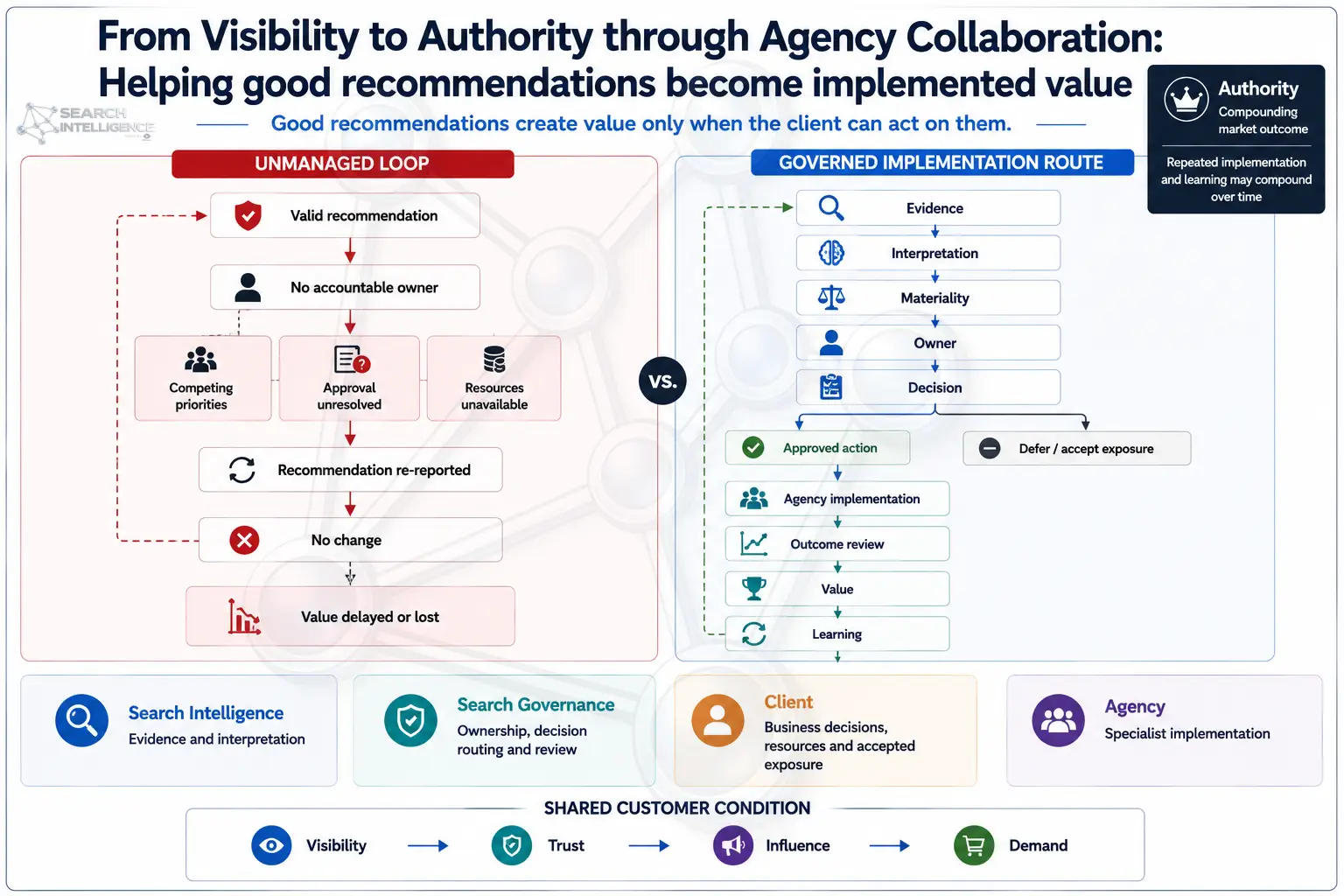
How the four customer-progression layers and the Authority outcome apply to agency work
| Condition | Collaboration question | A stronger condition may look like |
|---|---|---|
| Visibility | Is agency work improving materially relevant presence? | Scope and reporting focus on the customer and commercial portfolio that matters. |
| Trust | Are Content, technical and public-evidence recommendations supported by Product and service truth? | The agency is not expected to solve client-side Product or operational issues through optimisation alone. |
| Influence | Is execution helping the organisation earn preference? | Brand, Content, PR, Product and search work reinforce a clear comparison position. |
| Demand | Can the implemented work support a viable commercial next step? | Agency recommendations connect to functioning journeys and client-side owners. |
| Authority | Is the combined system building durable category strength? | Repeated implementation, learning and credible evidence compound over time. |
The value Agency Collaboration can create
Value created
Focus the client and agency on higher-value work, create better business cases and coordinate several disciplines around one customer outcome.
Value protected
Agency investment, specialist relationships, technical and Content recommendations, continuity during staff or supplier change, trust between internal and external teams, and the value of accumulated market and customer knowledge.
Value recovered
From recommendations left open, findings repeatedly reported without a decision, technical work blocked by unclear ownership, or agency scopes that became reactive because the client never established the strategic priority.
Waste avoided
Reduce repeated audits, duplicate recommendations from several suppliers, tactical work that compensates for unresolved root causes, meetings without decisions, agency effort spent defending issues outside its control, and client-side blame that damages a productive relationship.
What progress may look like over time
Short term, create shared clarity
The material customer and commercial scope, existing agencies and specialist roles, current recommendations and evidence, client-side blockers, decision rights, implementation dependencies, issues that should be closed, deferred or monitored, and a Collaboration Charter with a practical RACI.
Medium term, improve recommendation-to-action flow
A Recommendation-to-Decision Log, a Blocker Register, clearer prioritisation, agreed evidence standards, named client owners, escalation routes, outcome review, and a governance forum proportionate to the engagement.
The aim is not more meetings, it is making existing work more likely to move.
Long term, build a more mature delivery ecosystem
Better recommendation closure, faster client decisions, stronger agency contribution evidence, less repeated work, clearer scope boundaries, better renewal and supplier confidence, retained learning across agency or staff changes, and more durable customer and category outcomes.
AI creates new shared responsibilities
AI representation rarely belongs to one team. An SEO agency may observe an answer. A Content team may improve the source. Product may own the underlying fact. Technology may affect accessibility. Corporate Affairs or Compliance may need to review the response. The client must decide whether the issue is material. A mature collaboration model asks:
This prevents AI work from becoming an unowned experiment or an artificial new agency scope with no decision system behind it.
Clear accountability protects everyone
SI is accountable for
Independent observation and interpretation, materiality recommendations, governance artefacts, ownership and escalation visibility, and outcome and Evidence Trail discipline.
Agencies are accountable for
Work within their agreed specialist scope, transparent recommendations, implementation quality, delivery evidence, and raising dependencies and constraints early.
The client is accountable for
Priorities and budgets, Product, Brand, risk and legal decisions, access and internal coordination, acceptance, deferral or rejection of recommendations, implementation by internal teams, and accepted residual exposure.
The Brand impact
Agencies often see Brand inconsistency before leadership does: different Product claims across pages, campaigns promising an experience the journey does not support, reviews contradicting the Brand message, competitor narratives gaining strength, Content approvals removing the evidence customers need, or technical releases weakening carefully built visibility.
The agency can surface the condition. The client must retain the authority to decide what changes. SI helps make that boundary explicit.
Evidence that improves the relationship
A useful collaboration Evidence Trail may include the original finding and source; the agency recommendation; materiality and business consequence; the client owner; decision date and status; blocker and dependency; implementation evidence; outcome observation; contribution and limitation notes; and learning for future work.
This protects the agency from being judged only on deliverables and protects the client from paying for activity without a decision path.
Questions clients and agencies should answer together
Where to begin.
Agency Collaboration can begin with a review of one active workstream, one recurring blocker or one material customer journey. The purpose is not to audit the agency, it is to understand why the current system does or does not turn good evidence into implemented value.