
Executive Governance, Finance and Organisational Value: Governing the complete customer-decision system
10 min read
Marketing reports stronger reach.
SEO reports improved visibility. Product has addressed several customer questions. Technology has completed a release. Sales reports a mixed pipeline. Finance sees rising acquisition costs. The agency says important recommendations are still waiting for approval.
Every function may be telling the truth. The organisation can still lack one governed view of whether customer confidence, commercially valuable demand and category position are becoming stronger or weaker. That is the executive and financial role in the From Visibility to Authority framework:
Leadership does not execute the complete strategic stack. Finance does not validate every customer interpretation. The governance responsibility is to ensure that material conditions crossing several functions become visible, owned, decided, implemented and reviewed.
The model at a glance
No single dashboard explains the whole decision.
Functional reporting is necessary. Marketing needs media performance. SEO needs search data. Product needs customer and Product evidence. Technology needs platform controls. Sales needs pipeline information. Finance needs commercial and cost records.
The problem begins when leadership assumes one of those reports represents the complete customer and commercial environment. Search Governance exists because these conditions cross normal functional boundaries.
HOW
Governance connects the four customer-progression layers.
Visibility. Decide where presence is commercially material
Leadership should not govern individual keyword movements. It should understand which Product, service, market or audience portfolios matter, whether first-page presence is strengthening or weakening, which competitor movement is structural, where paid and organic investment interact, whether the correct Brand and Product entities are represented, and which loss would be material if the trend continued. The governing decision may be to invest, protect, monitor, accept or take no action.
Trust. Assign ownership beyond Marketing
Trust conditions may belong to Product, Customer Experience, Technology, reputation, Legal or Compliance, service operations, source governance, or Content and Brand. Leadership's role is to prevent the issue from remaining everyone's concern and nobody's responsibility.
Influence. Understand who is shaping preference
Competitors, publishers, reviewers, retailers, advisers and AI systems may shape how the customer understands the choice.
Demand. See value before and after the pipeline boundary
Search Governance expands the view to include high-intent presence, customer confidence, demand creation, capture, leakage, journey reliability, lead relevance, Sales readiness, paid dependency and value lost before CRM entry. The purpose is not to invent revenue attribution. It is to make commercially relevant conditions inspectable.
Authority. Govern long-term category position
Leadership should be able to see whether the organisation is gaining or losing category association, becoming easier to trust, earning credible references, building branded demand, strengthening its source position, and becoming more or less difficult to displace. Authority should be externally evidenced and reviewed over time. It should never be reduced to a self-declared leadership claim.
WHAT
A governance system for ownership, value and learning.
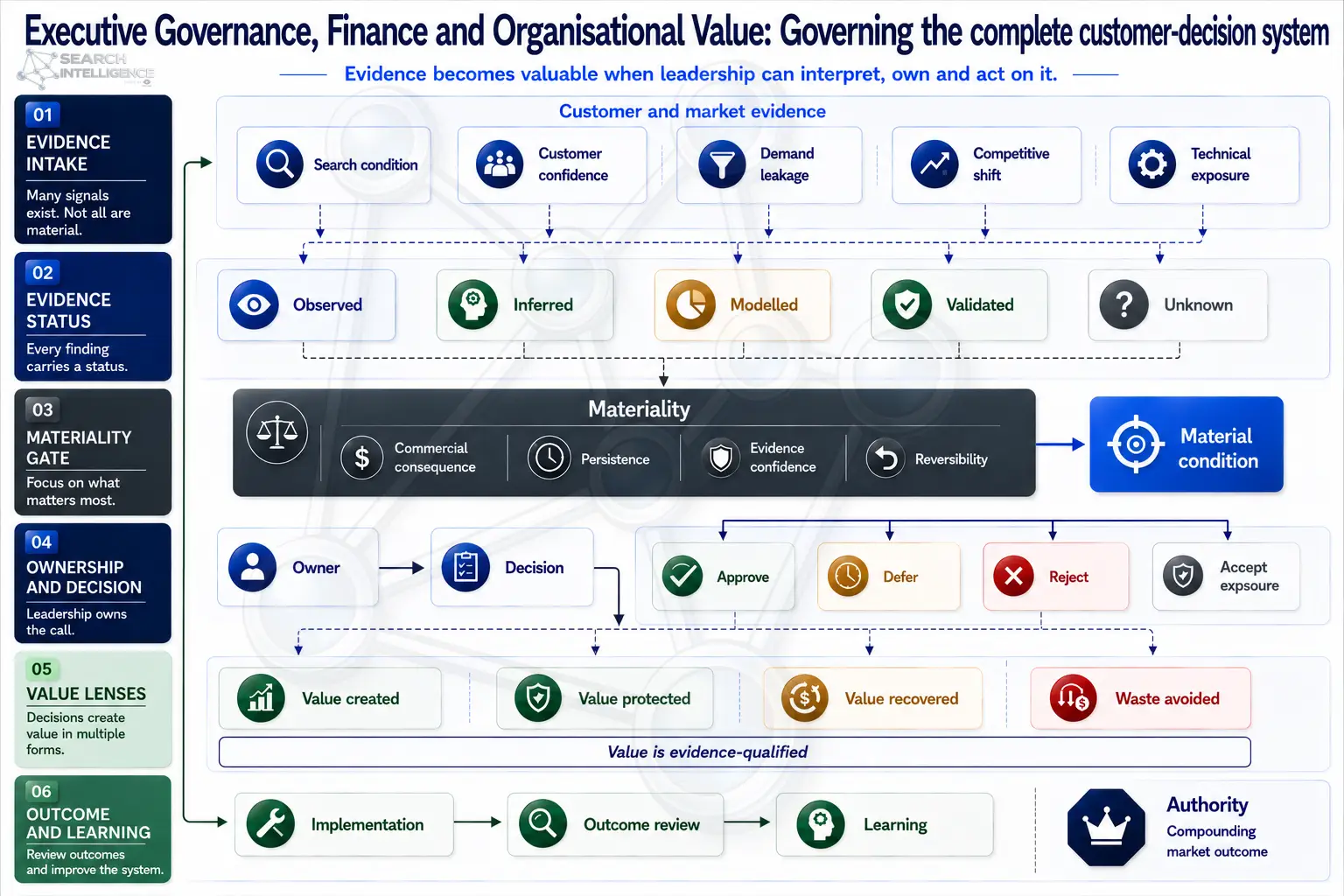
A material condition should move through: evidence interpretation materiality accountable owner decision specialist implementation completion evidence outcome review value classification learning.
Insight without action
The organisation receives a strong report, but no one owns the decision.
Action without evidence
A team completes work, but the changed condition is not re-observed.
Claimed value without an attribution boundary
A performance movement is presented as financial value without considering timing, market conditions, other interventions or competitor behaviour.
The financial value framework
SI classifies value through several controlled categories.
Value created
A stronger customer, commercial or organisational condition is established.
Value protected
An existing ranking position, demand pathway, reputation asset, Product launch or technical capability is defended.
Value recovered
A weakened or lost condition is restored.
Waste avoided
The organisation prevents low-value activity, repeated work, unnecessary spend or a poor decision.
Investment redirected
Resources move from a weak priority to a more material condition.
Decision accelerated
The organisation reaches a defensible decision earlier because the evidence and ownership are clearer.
Capability strengthened
Teams become better able to observe, interpret, decide and learn across the environment.
Some value can be directly observed. Some must be inferred or modelled. A Finance-approved method is required before a modelled contribution is presented as validated financial value.
An issue is not material because it sounds alarming or appears on a technical severity list. Materiality may consider Product or service value, customer intent, proximity to commercial action, scale and affected audience, persistence, competitive consequence, likelihood, reversibility, regulatory or reputation sensitivity, cost and feasibility of response, evidence confidence and cost of inaction.
A small technical defect close to a high-value application may be more material than a large group of low-impact issues. A trust concern affecting one important customer segment may matter more than broad traffic growth elsewhere.
Avoided loss requires restraint. The organisation should record the exposed condition, plausible loss mechanism, affected value, baseline evidence, probability or confidence, approved response, observed change, residual exposure, assumptions, alternative explanations and whether the value is modelled or validated.
The correct conclusion may be exposure reduced, value protected, intervention contribution supported, financial value modelled, or outcome still Unknown. That is more credible than presenting every prevented decline as money "saved."
The executive scorecard
| Field | Executive purpose |
|---|---|
| Material condition | What is strengthening, weakening or exposed? |
| Affected Product, market or customer | Where does it matter? |
| Stage | Visibility, Trust, Influence, Demand or Authority. |
| Evidence status | Observed, Inferred, Modelled, Validated or Unknown. |
| Materiality | Why does the organisation care? |
| Owner | Who has decision authority? |
| Decision required | Invest, protect, reclaim, displace, establish, monitor, accept or take no action. |
| Implementation | Who performs the approved work? |
| Outcome | Improved, unchanged, variable, worsened, unresolved or Unknown. |
| Value | Created, protected, recovered, avoided, redirected or clarified. |
| Residual exposure | What remains after the decision? |
The scorecard should not become another operational data dump. Its purpose is to support decisions and retain the Evidence Trail.
| Stage | Functional work | Governance responsibility |
|---|---|---|
| Visibility | SEO, Media, Content, Digital and Technology improve presence. | Approve priority portfolios and material response. |
| Trust | Product, Brand, Customer Experience, reputation and assurance improve evidence. | Assign ownership and decide whether the promise or underlying condition must change. |
| Influence | Brand, Content, Product, PR and agencies shape differentiation and comparison support. | Decide which decision space is worth protecting or pursuing. |
| Demand | Sales, Ecommerce, Digital, Product and Operations support progression. | See leakage, prioritise journey improvement and retain attribution boundaries. |
| Authority | All functions contribute to durable category strength. | Govern long-term position, evidence and value realisation. |
Common objections
"Does leadership need another framework?"
Only if the framework changes decisions. The From Visibility to Authority framework is useful when it helps leadership see conditions that cross functional reports, assign ownership and review outcomes.
"Is this a Marketing governance system?"
No. Marketing is one contributor. The model also includes Product, service, Technology, Sales, reputation, Data, AI, Finance and organisational decision rights.
"Can SI prove revenue causation?"
SI can support contribution evidence and Value Realisation. It should not claim sole causation where the evidence does not support it.
"Does governance slow execution?"
Poor governance can. The intended model clarifies the material condition, owner and decision so specialist teams spend less time on repeated, unprioritised work.
"What happens when the evidence says no action is required?"
No action is a valid governed decision when the evidence, materiality and residual exposure are recorded. SI should not manufacture further work.
What leadership and Finance should do on Monday morning
Select one strategic Product, service or market. Ask each function to identify what it sees at each customer-progression layer and the Authority outcome where relevant, what value it believes is strengthening, what loss may be hidden, what it cannot decide alone, which evidence supports the conclusion and what remains Unknown.
The differences between those answers often reveal the real governance gap.
The organisation does not need one team to own everything.
It needs one system through which important conditions become visible, owned and reviewed.
Visibility makes the organisation available. Trust makes it credible. Influence makes it preferable. Demand turns preference into action. Authority makes the organisation a repeated category reference.
Search Governance ensures the organisation can see what is happening between those conditions, and decide what to do while the decision can still be changed.
Next step.
Explore Search Intelligence Growth and Value, or return to the full From Visibility to Authority framework.