
Marketing and Media: What happens after the customer sees the campaign?
10 min read
The campaign works.
Reach rises. Search interest follows. The Brand becomes more visible.
Then the customer does what interested customers often do: they investigate. They search the Product, read a review, compare the main alternatives, check the detail behind the promise and ask an AI assistant whether the option is right for someone like them.
Marketing created attention. What happens next determines whether that attention becomes confidence, preference and commercially viable demand, or becomes demand another organisation captures. That is why the From Visibility to Authority framework matters to Marketing and Media teams.
Marketing contributes across the progression, but it does not control every condition. The value of the framework is that it helps Marketing see where its investment is being strengthened, weakened or redirected after the first exposure.
The model at a glance
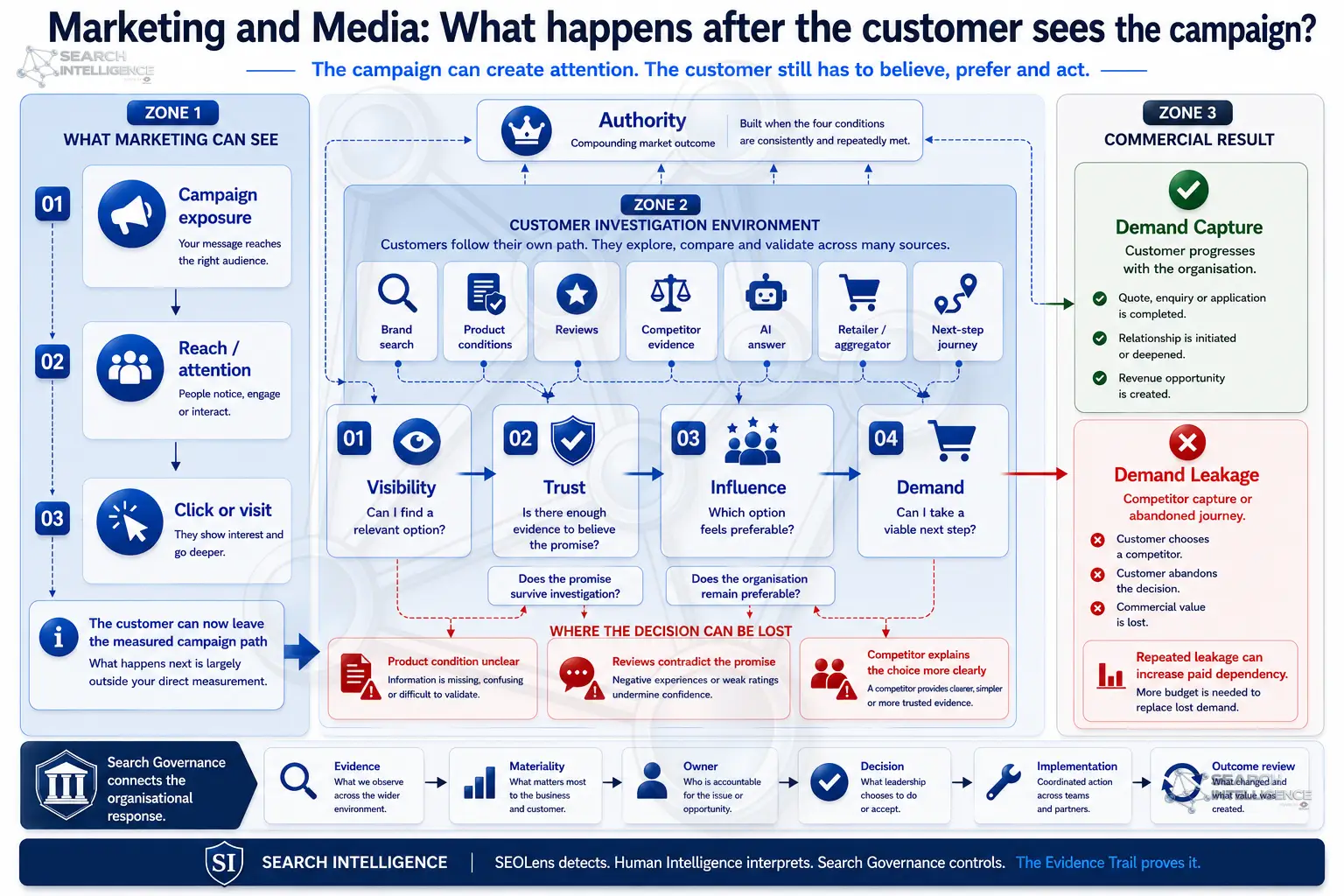
The campaign does not end when the impression is delivered.
Media reporting can explain who was reached, what was clicked, how much attention was generated, what the campaign cost, which audience or creative performed and what conversion occurred inside the measured path. It cannot fully explain what the customer found when they stepped outside that path.
The Marketing investment may have created real interest. The commercial outcome may still be lost elsewhere.
HOW
Marketing contributes to four stages directly, and helps build the fifth.
Visibility. Create relevant presence, not noise
Marketing and Media introduce the organisation to potential customers. The quality of that visibility depends on whether it reaches a meaningful need, audience and context. A large reach number can still hide weak customer fit or poor post-exposure validation.
Trust. Help the promise survive investigation
The advert cannot carry the full burden of proof. Trust may depend on Product facts, service expectations, fees and conditions, customer reviews, claims and supporting evidence, technical reliability, public-source consistency and an understandable next step.
Influence. Shape the comparison, not only the message
Customers rarely evaluate a Brand in isolation. They compare it with competitors, publishers, retailer pages, reviews, AI answers and previous experience. Influence grows when the organisation explains the choice clearly, provides credible proof, answers the decisive objection, frames meaningful differentiation, appears consistently across trusted environments and gives the customer useful criteria for comparing alternatives.
A campaign can create a Search Exposure. Influence determines whether the customer's evaluation becomes a Search Moment that changes preference or intended action.
Demand. Connect interest to a viable route
Demand has three conditions: creation (Marketing generates interest), capture (the organisation becomes the selected route) and leakage (intent exists but fails to reach or progress through the organisation).
Marketing should be able to see more than campaign conversions: high-intent search behaviour after exposure, Product and service questions, quote/application/booking/purchase readiness, where customers leave, competitor capture, paid dependency caused by weak organic infrastructure, and lead relevance and Sales readiness.
Authority. Build a position that reduces future friction
Marketing contributes to Authority through consistent category framing, credible public evidence, distinctive Product language and sustained presence. Authority is not campaign fame. It is the market repeatedly treating the organisation as a credible reference for a specific decision.
When Authority strengthens, Marketing may benefit from stronger branded demand, easier trust formation, greater campaign validation, improved category association, less dependence on discounts or repeated explanation, and more durable customer consideration.
WHAT
The decisions Marketing should make differently.
A campaign designed for Visibility should not be judged as though it alone must create immediate revenue. A trust campaign should not be evaluated only through reach. A Product launch intended to establish Authority needs a longer evidence horizon than a tactical demand campaign. Before approving the work, define the customer condition, the intended stage, the expected movement, supporting functions, the evidence required and the attribution boundary.
For every major campaign, ask what the customer will search next, which reviews or third parties they will encounter, what AI systems will say, which Product facts must be consistent, which comparison will matter, what objection could stop the next step, and which page or journey must work. This planning protects the campaign from creating curiosity the wider organisation is not ready to convert.
Paid media and Organic Search do different jobs, but the customer moves between them freely. The organisation should inspect paid search terms that reveal organic gaps, branded searches created by campaigns, campaign landing pages and supporting evidence, competitor presence during validation, and persistent paid spend compensating for unresolved organic weakness.
The From Visibility to Authority framework also asks what may have been lost: interest that moved to a competitor, demand that failed trust validation, a Product segment with weak first-page presence, repeated spend into a poor journey, customer questions that remain unanswered, and content created without a material decision purpose. Loss should not be exaggerated. It should be observed, classified and investigated with the same discipline as claimed growth.
A practical Marketing scorecard
| Stage | Marketing question | Useful evidence |
|---|---|---|
| Visibility | Did the right audience encounter us for the right need? | Reach quality, search lift, priority presence, audience and market coverage. |
| Trust | Did the promise survive investigation? | Review themes, Product clarity, proof access, source consistency, technical confidence. |
| Influence | Did we become more preferable? | Comparison framing, Search Moments, competitor references, preference and consideration evidence. |
| Demand | Did qualified intent reach a viable next step? | High-intent progression, lead relevance, journey completion, demand leakage. |
| Authority | Are we becoming a repeated category reference? | Branded demand, credible references, category association, durable search and AI representation. |
Common objections
"Is this just a new attribution model?"
No. The From Visibility to Authority framework does not claim that Marketing alone caused the commercial result. It helps the organisation understand contribution, customer conditions and the handoffs where value may be gained or lost.
"Does this make Marketing responsible for Product and service problems?"
No. It gives Marketing evidence that a campaign or customer question may expose a Product, service or operational condition. The responsible function owns the decision and implementation.
"Does SEO not already support trust and conversion?"
Responsible SEO contributes to relevance, usefulness, technical quality and discoverability. The From Visibility to Authority framework places that contribution inside a wider system that includes Brand, Product, reputation, Technology, Sales and customer experience.
"Can the complete strategic stack be measured perfectly?"
No. Some movement will be directly observed. Some will be inferred or modelled. The evidence status and limitation should remain visible.
What Marketing should do on Monday morning
Choose one major campaign or Product priority and map:
The exercise often reveals whether the organisation is funding attention while underfunding the conditions needed to turn that attention into confidence and action.
Marketing should not stop at being seen.
The commercial value of Marketing grows when the organisation can connect attention to credible evidence, preference, viable demand and a stronger category position.
That requires more than a larger media plan. It requires a coordinated customer-decision system.
Next step.
Take the Decision Confidence Diagnostic to see where Marketing-created demand may be leaking, or return to the full From Visibility to Authority framework.