
Demand leakage before the CRM: The customers Sales never sees
Sales can explain why a known opportunity was lost. It cannot explain the customer who never became an opportunity.
That customer may have seen the campaign, searched the Product, compared the Brand and left because the reassurance, proof or next step was not strong enough.
The model at a glance
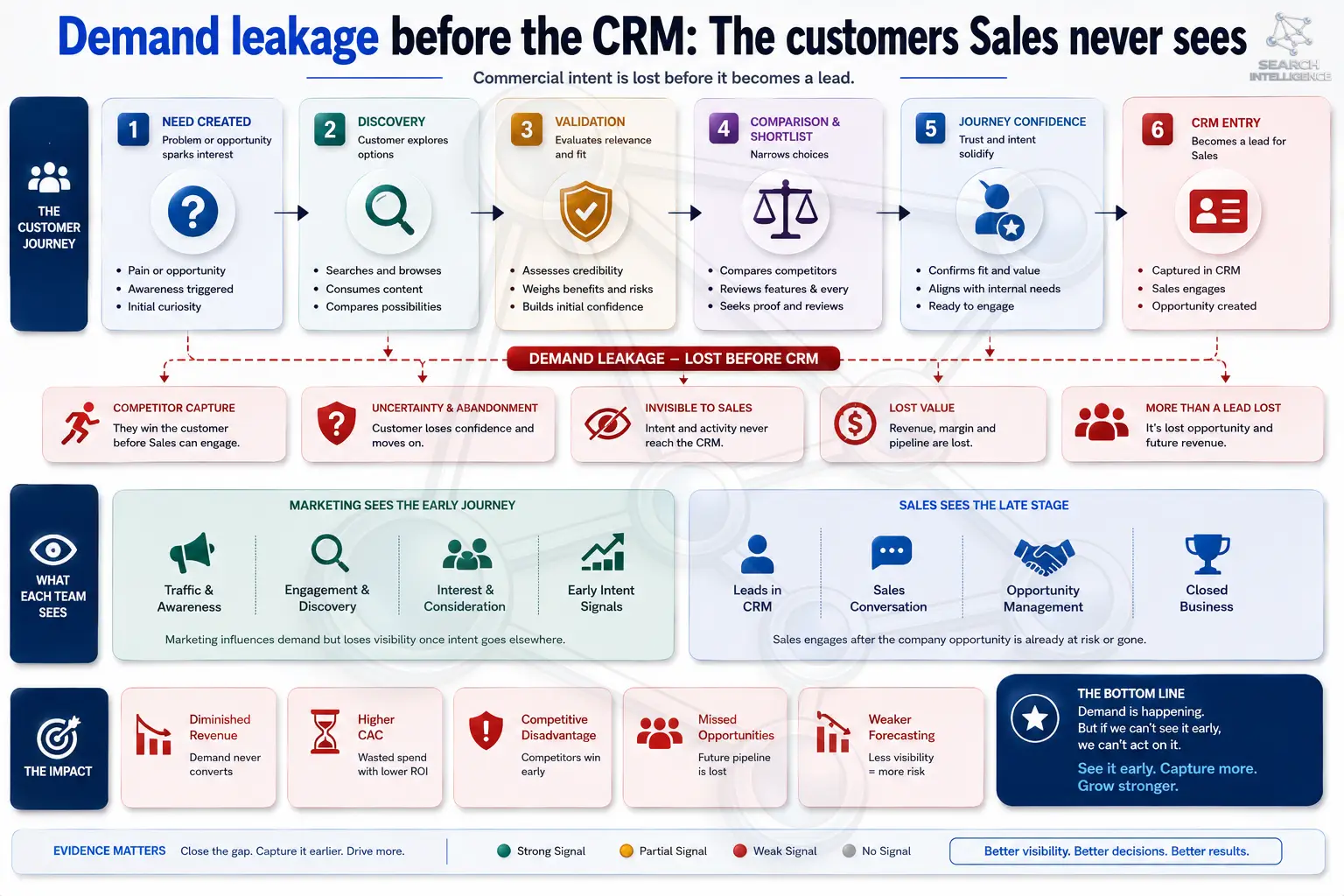
Where demand leaks
Each of these happens before the CRM has a record to lose.
The practical response
The organisation should connect pre-pipeline evidence to Marketing investment, Product truth, Sales feedback, journey design, technical remediation, reputation and review response, and competitor strategy. Demand leakage is rarely owned by one team \u2014 that is why it requires governance rather than a channel-only fix.
A pre-pipeline decision map
Marketing sees awareness, visits and engagement. Sales sees leads and opportunities. The missing section sits between the two: the customer's private validation and comparison work. Search Intelligence helps reconstruct that environment through query evidence, competitor content, reviews, AI outputs, journeys, Product information and Sales objection themes.
Marketing can see the beginning. Sales can see the customers who reach the end. Search Intelligence examines the middle.
These support contribution analysis. They do not prove one source caused every outcome.
What Marketing should do differently
Before increasing campaign spend, ask what customers will find when they investigate the promise, whether the Product page answers the likely concern, which third-party sources shape reassurance, whether the next step is technically reliable, and which competitor owns the comparison language.
Demand leakage is rarely owned by one team. Sales and Business Development hold valuable evidence about questions, objections and hesitation that should not remain in call notes, it can identify where Trust and Influence are weakening before the enquiry.
A stronger system does not merely create more leads. It helps customers reach the organisation with clearer expectations, stronger confidence and a more suitable next step — improving both acquisition quality and the experience after contact.
Protect the demand already being created.
Explore Commercial Intent, or return to the cornerstone framework.