Diagnostic
Good reporting deserves a fair assessment of its limits. · 5 min read

What search reporting can, and cannot, tell you

A report should not be criticised for failing to answer a question it was never designed to answer. Rankings reports are useful for ranking questions. Analytics is useful for recorded behaviour. Agency reports are useful for scope, delivery and performance conversations.

Confusion begins when those reports are treated as a complete account of the customer and market environment.

Explore Decision Confidence

The model at a glance

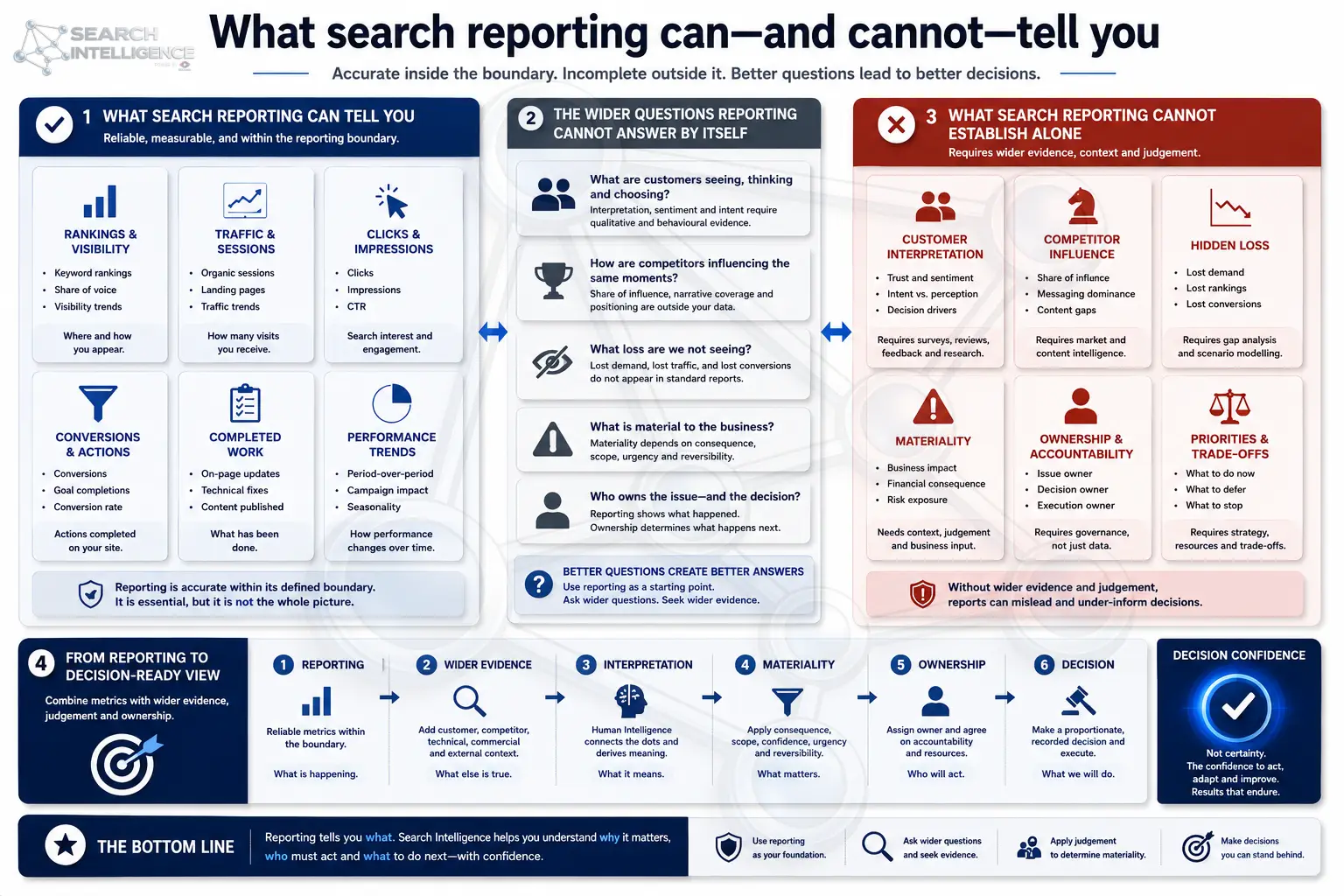
What search reporting can and cannot tell you: reliable metrics within the boundary, the wider questions reporting cannot answer alone, and the path to a decision-ready view.
What reporting does well

Seven things a good report shows reliably

Movement Across Agreed Measures Performance Over Time Completed Work Changes In Tracked Queries And Pages Recorded Traffic And Conversion Behaviour Technical Conditions Within Tool Coverage Performance Against A Defined Competitor Set
These are necessary inputs. Search Intelligence does not replace them.
Where the frame becomes narrow

Conditions that sit outside its scope

Demand Lost Before CRM Entry Confidence Shaped By Reviews Or AI A Competitor Outside The Tracked Set A Product Problem Misread As Content Implementation Blocked By Client-Side Ownership Technical Exposure Not Yet In The Headline Measure An Intervention Without Outcome Validation

The questions that widen the frame

Five questions for every important performance review.

01 What customer decision may sit behind the metric?
02 What is happening outside the owned website?
03 What alternative explanations remain plausible?
04 Which valuable loss or opportunity is absent from the report?
05 What action, owner and review date follow from the finding?
The purpose is not heavier reporting. It is to stop a narrow report from creating broad confidence it cannot support.

What changes in practice

Five layers, five different jobs.

A healthy reporting ecosystem separates them.

01 Operational reporting for teams
02 Analytical reporting for performance and diagnosis
03 Search Intelligence for material interpretation
04 Search Governance for ownership and decisions
05 Outcome review for learning and value
The system works when the organisation stops expecting one dashboard to perform all five.

A practical reporting architecture

A mature organisation does not replace one report with a larger report. It creates a clear reporting hierarchy.

Operational layer

Rankings, crawl findings, Content performance, campaign data, journey events and implementation status.

Performance layer

Trends, portfolio movement, commercial segments, conversion behaviour, exceptions.

Intelligence layer

What the combined evidence may mean for customers, Products, markets, competitors and value.

Governance layer

Decisions, owners, dependencies, escalation, accepted exposure.

Outcome layer

Re-observes whether the condition improved, was unchanged, worsened or stayed Unknown.

Executives do not receive every operational detail, and specialists do not lose the evidence required to do serious work.
A useful test for any report

Eight questions before a material decision

What was it designed to observe?
What does it exclude by design?
Which customer behaviour is invisible?
Which competitor set is assumed?
Which time horizon does it favour?
Does it show the condition or only a result of it?
What decision follows from it?
Is there an outcome review after action?
A report becomes dangerous only when its limitations are forgotten.
The customer perspective

Customers experience the combined result

They do not distinguish between an SEO issue, a Product issue and a technical issue. One journey can go wrong in five places:

Finds the page Misunderstands the offer Distrusts the proof Hits a failed journey Chooses another organisation
Every internal report can stay correct while the whole customer experience fails.

Use reporting for what it does best.

Explore Decision Confidence, or return to the cornerstone framework.