Diagnostic
The answer can only be as coherent as the source environment behind it. · 7 min read

Source-of-truth architecture for AI-mediated search

The website shows one Product condition. A PDF shows another. A retailer feed is older. A support page uses legacy wording. A third-party publisher copied the original version.

Which source should the customer, or an AI system, trust?

Explore Trust Architecture See Technical Integrity

The model at a glance

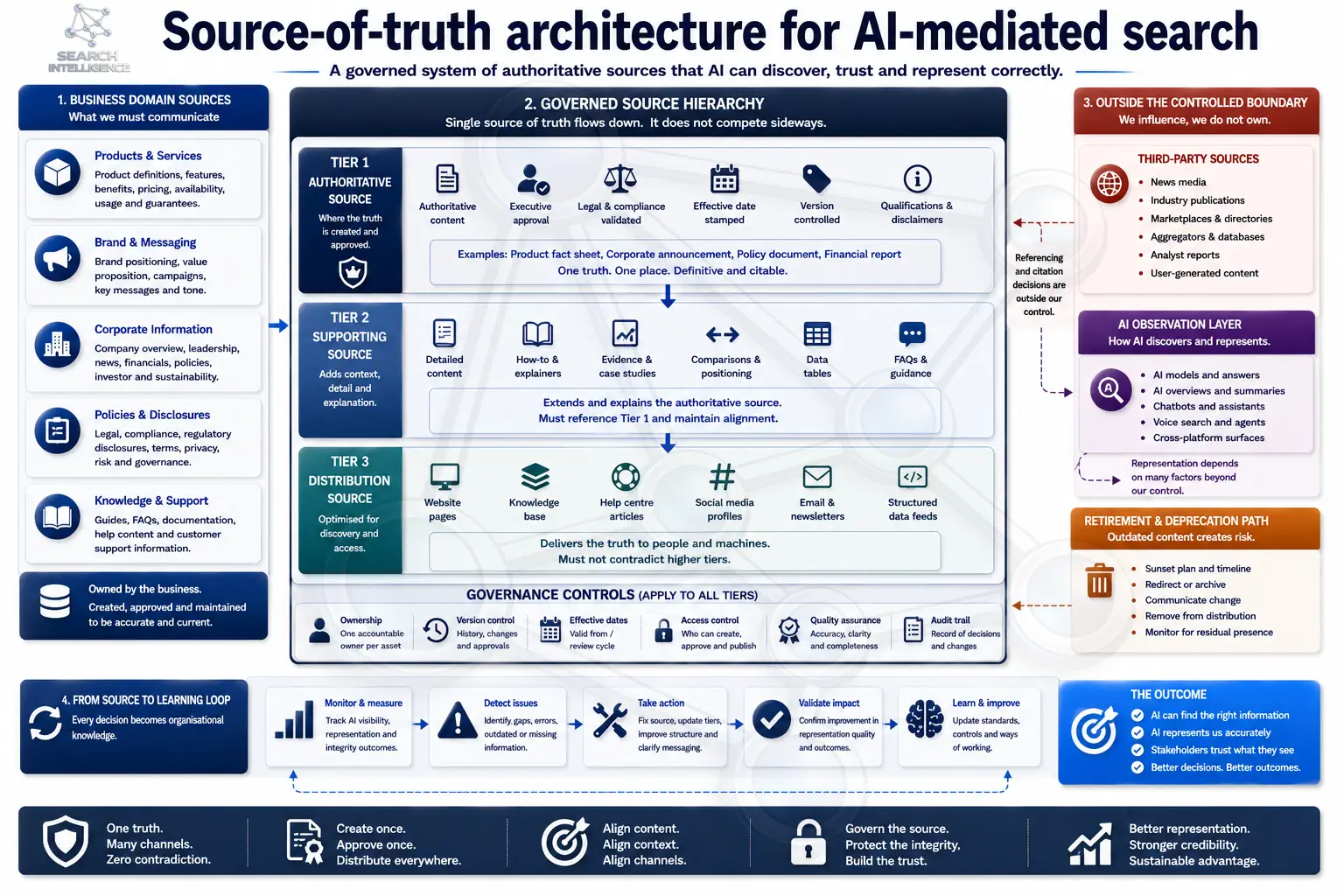
Source-of-truth architecture for AI-mediated search: business domain sources, the governed three-tier source hierarchy, what sits outside the controlled boundary, and the source-to-learning loop.
A source-of-truth system is organisational

Ten decisions the organisation has to make

Authoritative Source By Fact Or Product Product Ownership Approval And Publication Version And Effective Date Supersession Downstream Channels External Partners Correction And Retirement Technical Access Review Cadence
The practical source hierarchy

The chain from approved record to archive

Approved Product or policy record
Canonical public explanation
Supporting evidence and disclosures
Structured feeds and partner data
Approved third-party references
Archived or superseded material

The hierarchy differs by organisation and sector.

Important facts need an owner and an authoritative current source.
Consistency is not copying the same paragraph everywhere

Language can change. Material truth cannot.

These must never change accidentally because the format changed:

Product Detail Fee Qualification Claim Eligibility Condition Next Step
How Search Governance helps

It connects the conflict to an owner

Identifies Material Source Conflict Assigns Correction Records The Decision Tracks Partner Dependencies Re-Observes The External Environment
It does not replace Product, Legal, Compliance or Data authority.

A source-of-truth example

Five sources describe one claim differently.

A pharmaceutical organisation cannot solve this by editing one page.

What exists today
An Approved Patient-Information Page A Newer Regulatory Document An Old Campaign Page Still Indexed Distributor Pages Using Previous Wording A Support Article That Paraphrases Too Broadly
What has to be decided
Which Source Is Authoritative Per Fact Which Sources Are Updated Or Retired How Partners Receive The Current Version Who Approves Public Wording How Supersession Is Signalled How The Environment Is Re-Observed

Why source hierarchy helps teams

Every team gets one unambiguous answer.

Content

Knows where to obtain approved information.

SEO

Knows which source should be discoverable.

Technology

Understands which page or feed must remain stable.

Product

Can see where changes propagate.

Corporate Affairs and assurance

Can trace the public statement.

The minimum governance fields

Ten fields per governed fact

Fact Or Claim Identifier Authoritative Source Product Or Information Owner Approval Authority Effective And Review Date Affected Channels Dependencies Superseded Sources Technical Access Status Correction Status
Third-party sources

Influence is not ownership

The organisation does not control publishers, retailers, reviews or AI systems. It can:

Identify Material Inconsistency Provide Current Source Evidence Use Available Correction Processes Strengthen The Approved Public Source Document Unresolved External Exposure Monitor The Decision Consequence
The distinction between ownership and influence must stay clear.

A source should have a retirement path

Publishing the current version is only half the job.

Old PDFs, campaign pages, partner feeds and cached explanations keep influencing customers and external systems.

Every obsolete source needs one of these
Redirected Marked Archived Corrected Monitored

Without that discipline the organisation keeps adding truth without reducing contradiction.

Make the approved truth findable and governable.

Explore Trust Architecture, or return to the cornerstone framework.