Diagnostic
Insight has no commercial value until the condition changes. · 4 min read

Implementation loss: When the right recommendation never changes the condition

The issue is known. The recommendation is accepted. The work still does not happen. Or it happens, the ticket closes and nobody checks whether the customer or commercial condition improved.

Both situations create implementation loss.

Explore Mobilisation See Governance Implementation

The model at a glance

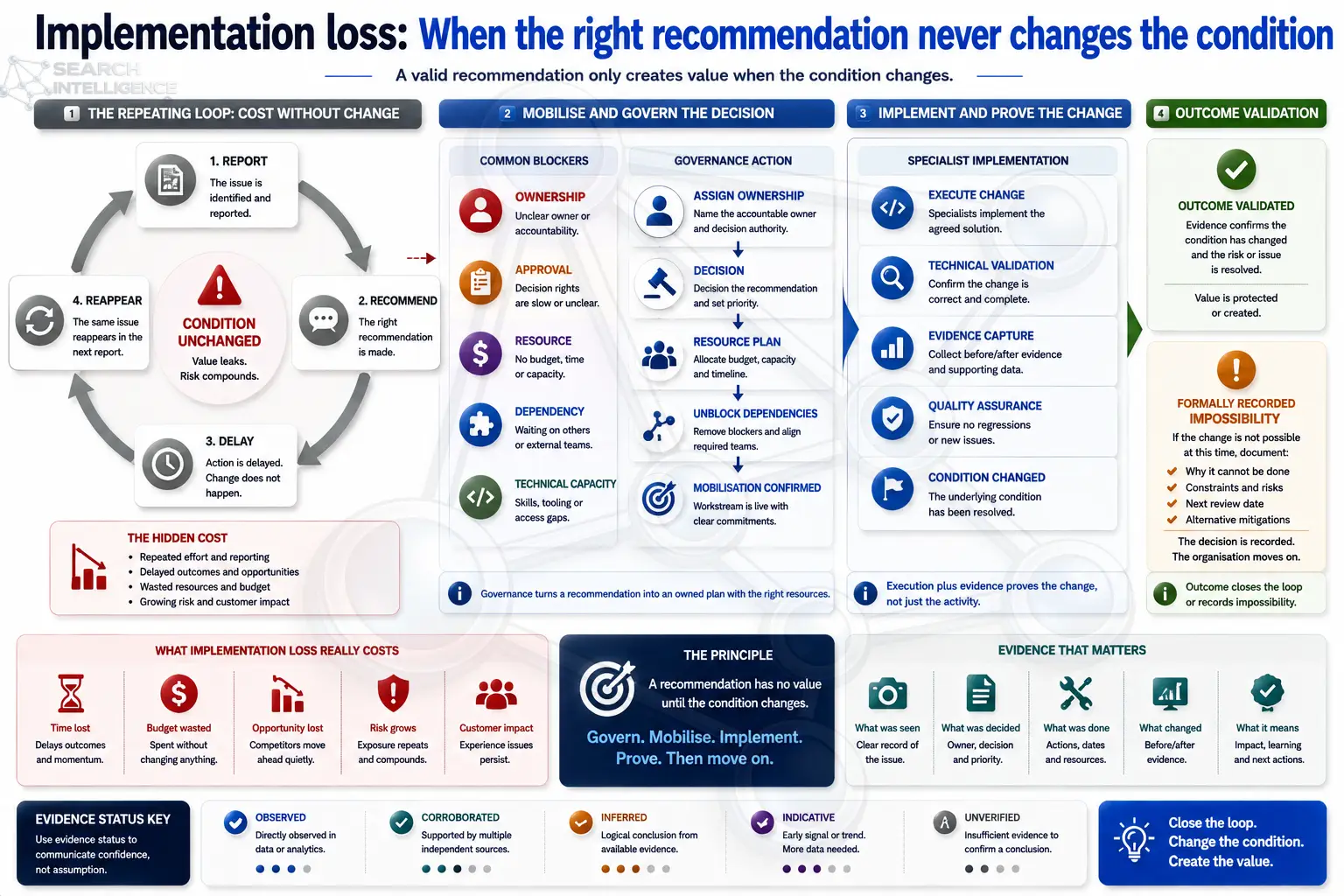
Implementation loss: when the right recommendation never changes the condition, the repeating loop, mobilising and governing the decision, implementing and proving the change, and outcome validation.

The hidden cost of repeated recommendations

Each repetition consumes
Agency Time Internal Review Time Executive Attention Reporting Space Credibility Opportunity

The waste is not only the delayed outcome. It is the repeated effort around a decision system that never closes the loop.

Why good work gets trapped

No Accountable Business Owner Product or Legal Approval Technology Capacity Unclear Commercial Consequence Competing Priorities Incomplete Evidence Cross-Agency Dependencies No Agreed Completion Test No Escalation Route

The implementation-loss cycle

Finding appears
Recommendation is accepted
Ownership is unclear
Work is delayed
Recommendation returns
Confidence in reporting falls
The underlying condition persists
and the finding appears again next reporting cycle

Over time, the organisation may normalise the open issue. The recommendation remains visible, but the exposure becomes part of the background.

Govern the implementation condition

A Mobilisation record should define

The intended changed condition
Owner and specialist
Dependencies
Priority and decision authority
Completion evidence
Review period
Residual exposure if delayed
Validate the outcome

Implementation must be followed by re-observation

Condition Improved Unchanged Another Issue Emerged Assumption Was Wrong Unknown
A failed intervention is still useful when the organisation records the learning and avoids repeating the same assumption.

The cost categories

Implementation loss is paid in eight places at once.

None of them appear as a line item, which is why the cost is rarely challenged.

01 Customer and commercial opportunity lost while the issue remains
02 Repeated agency and internal analysis
03 Duplicated tickets and meetings
04 Paid media compensating for unresolved weakness
05 Staff frustration
06 Reduced confidence in specialist advice
07 A more expensive later remediation
08 Lost learning when no outcome is reviewed

A practical mobilisation sequence

01 Restate the finding as a customer and business condition.
02 Confirm evidence and materiality.
03 Name the accountable business owner.
04 Identify specialist implementers.
05 Record dependencies and approval routes.
06 Define completion evidence.
07 Set a review date.
08 Escalate blocked work according to materiality.
09 Re-observe the environment.
When implementation is genuinely impossible

The organisation may face legal constraints, platform limitations, vendor dependency or insufficient capacity.

Governance should still record
Why Implementation Is Not Possible What Interim Control Exists Who Accepts The Residual Exposure What Would Reopen The Decision Whether Another Route Reduces The Consequence

The client-facing advantage

Transparency about what did not move is worth more than a roadmap.

This approach does not promise that every recommendation will be implemented. It gives the client a clear account of what moved, what did not, why and what exposure remains — more valuable than a plan that assumes unlimited authority and capacity.

Questions to test implementation readiness

01 Is the business owner named?
02 Has the decision actually been approved?
03 Are the specialist dependencies understood?
04 Does the executing team have capacity and authority?
05 What evidence will prove completion?
06 When will the customer and commercial condition be reviewed?
07 What exposure remains if the work is delayed?

These questions should be answered before the organisation treats the recommendation as an active implementation commitment.

Turn approved work into changed conditions.

Explore Mobilisation, or return to the cornerstone framework.