
From finding to owned decision: Why recommendations stall
A recommendation appears in the report for the fourth month. The agency believes Technology owns it. Technology is waiting for Product approval. Product says the business case is unclear. Marketing assumes the agency is handling it.
Nobody is refusing the work. The system simply has no owner for the complete decision.
The model at a glance
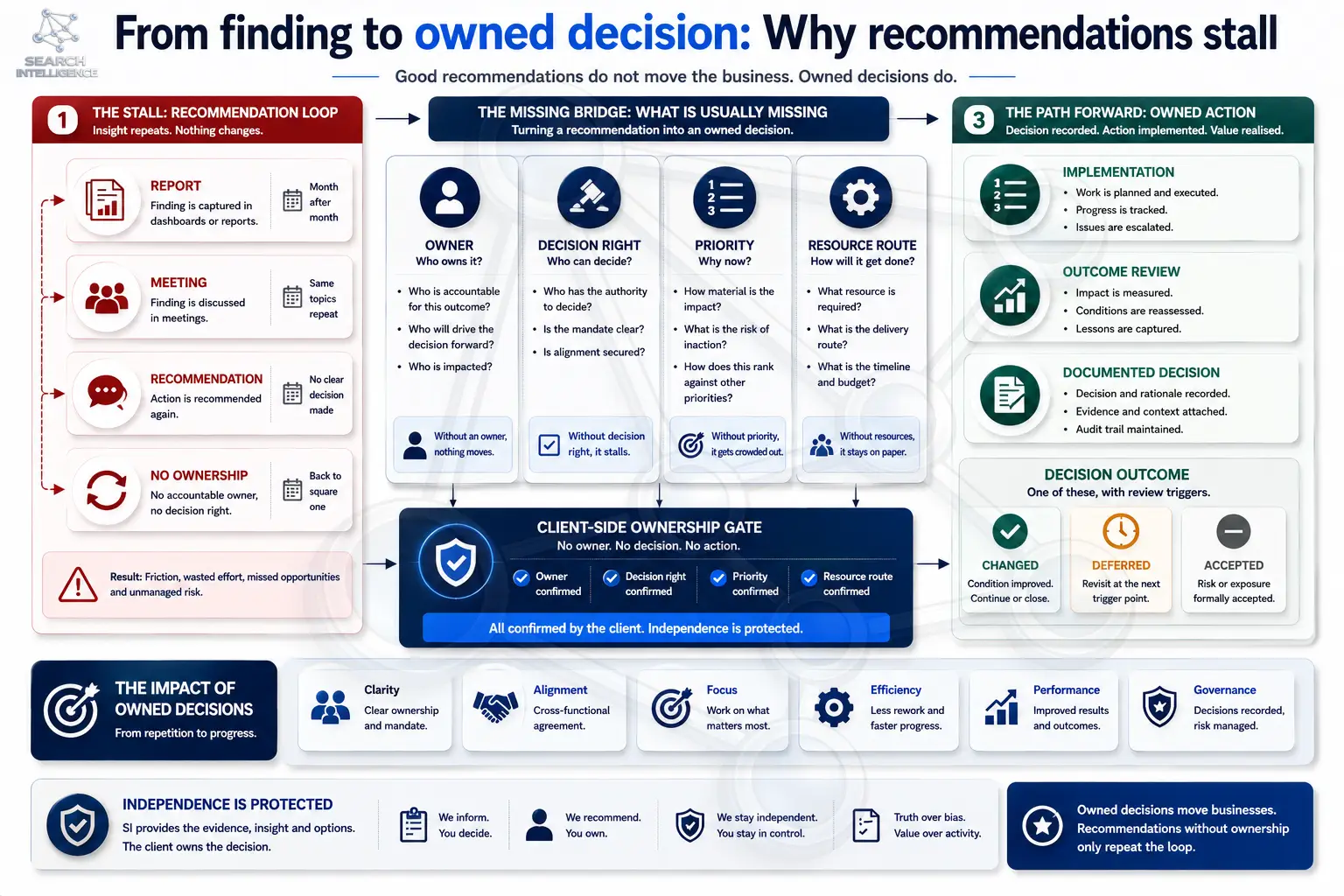
Why recommendations repeat
The executor is rarely the decision-maker.
Recommendations stall because they cross organisational boundaries.
Instead of
"Fix the page and improve the form."
Use
"Decide whether to protect a commercially important Product segment by improving the customer evidence and removing the mobile journey failure."
The minimum decision record
What this changes for agencies and teams
The four reasons a recommendation stalls
Four reasons a good recommendation goes nowhere.
Specialist language
"Improve internal links" does not tell Product or leadership what condition is exposed.
Missing business owner
The SEO agency can propose the work. It cannot approve Product truth or accept business exposure.
Invisible dependencies
A task may depend on Legal review, data feeds, a platform release or Brand approval.
Undefined completion
The ticket can close without evidence that the original condition improved.
A better implementation brief
Why this is better for the customer
Internal teams understand why the work matters. Agencies understand the limits of their accountability. Leadership can see whether the blocker is capacity, authority, evidence or unwillingness to accept the trade-off.
The human side of ownership
Repeated recommendations often create defensiveness. A well-run governance process treats the blocker as a system condition to be understood, not proof that one function is failing, that makes honest escalation easier, and implementation more likely.
Give the finding somewhere to go.
Explore Implementation Mobilisation, or return to the cornerstone framework.