
Accepted risk, residual exposure and organisational learning
4 min read
The organisation may decide that a finding is real and material, but still choose not to act. Budget, capacity, timing, legal constraints or strategic priorities may justify that choice.
Governance does not eliminate the trade-off. It makes the trade-off visible.
The model at a glance
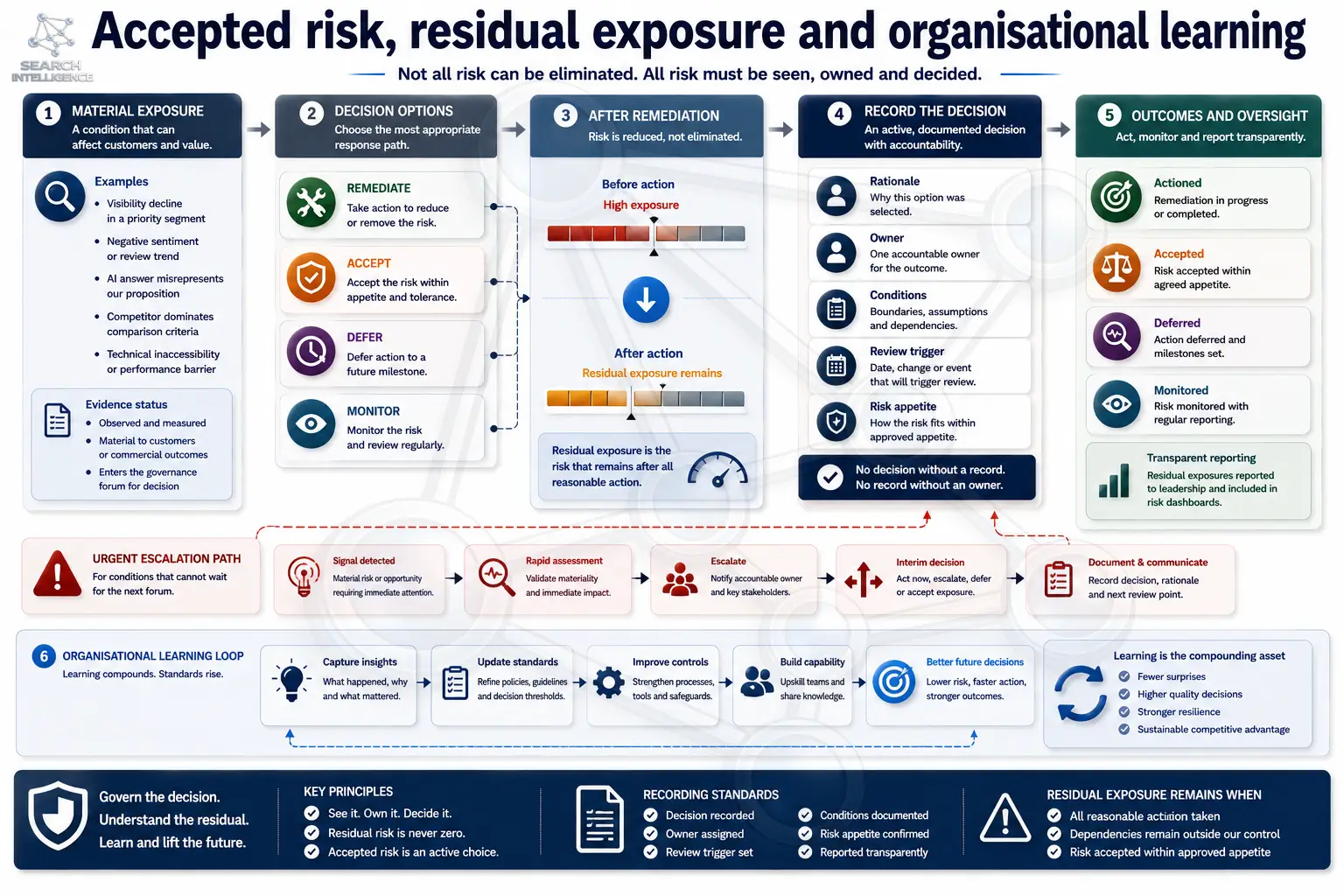
The record should show the condition and evidence, likely consequence, reason for acceptance or deferral, accountable owner, duration, trigger for review, residual exposure, and affected Product, customer or market.
A journey improves but one device issue remains. Product truth is corrected on owned sources but a third-party page remains outdated. A competitor is displaced on some queries but still owns a strong external reference. The Evidence Trail should preserve what remains.
Learning is the compounding asset
Over time, governance should improve detection, evidence quality, materiality judgement, decision speed, cross-functional ownership, implementation closure, value measurement, and response to external change. That capability can be more durable than one successful ranking movement.
Close, supersede or reopen
Every record should eventually be closed, superseded by stronger evidence, reopened after a trigger, retained as accepted exposure, or classified as Unknown where the evidence remains insufficient. Nothing material should disappear because the meeting ended.
A practical accepted-risk record
"The organisation accepts the current weakness in regional availability information until the Product-data migration is completed. The condition may continue to create customer uncertainty and third-party inconsistency. Product owns the source migration. Digital owns the interim public explanation. The exposure will be reviewed on migration completion or if complaint and search evidence increases."
This is materially different from leaving the issue open without explanation.
Residual exposure after a successful intervention
Suppose the owned Product pages are corrected and technically accessible, but several retailer pages remain outdated. The organisation has improved the condition. It has not removed the exposure.
The record should show what is controlled, what remains external, which partners are being addressed, whether the residual exposure is material, and the next review trigger.
Learning should change the system
A weak learning statement
"Improve communication between teams."
A useful learning statement
"Product changes must now trigger an update checklist covering owned pages, support Content, structured feeds, retailer data and AI re-observation."
The first changes a control. The second expresses a hope. Staff, agencies, platforms and market conditions change, retained evidence and learning reduce dependency on individual memory and create a more stable operating capability.
Questions for the owner
Record the trade-off and keep learning.
Explore the Evidence Trail, or return to the cornerstone framework.