
Decision rights across Marketing, Product, Technology and agencies
7 min read
The team that sees the issue may not own the decision. The team that owns the decision may not implement the work.
The specialist who implements the work may not be allowed to approve the Product, claim or risk.
The model at a glance
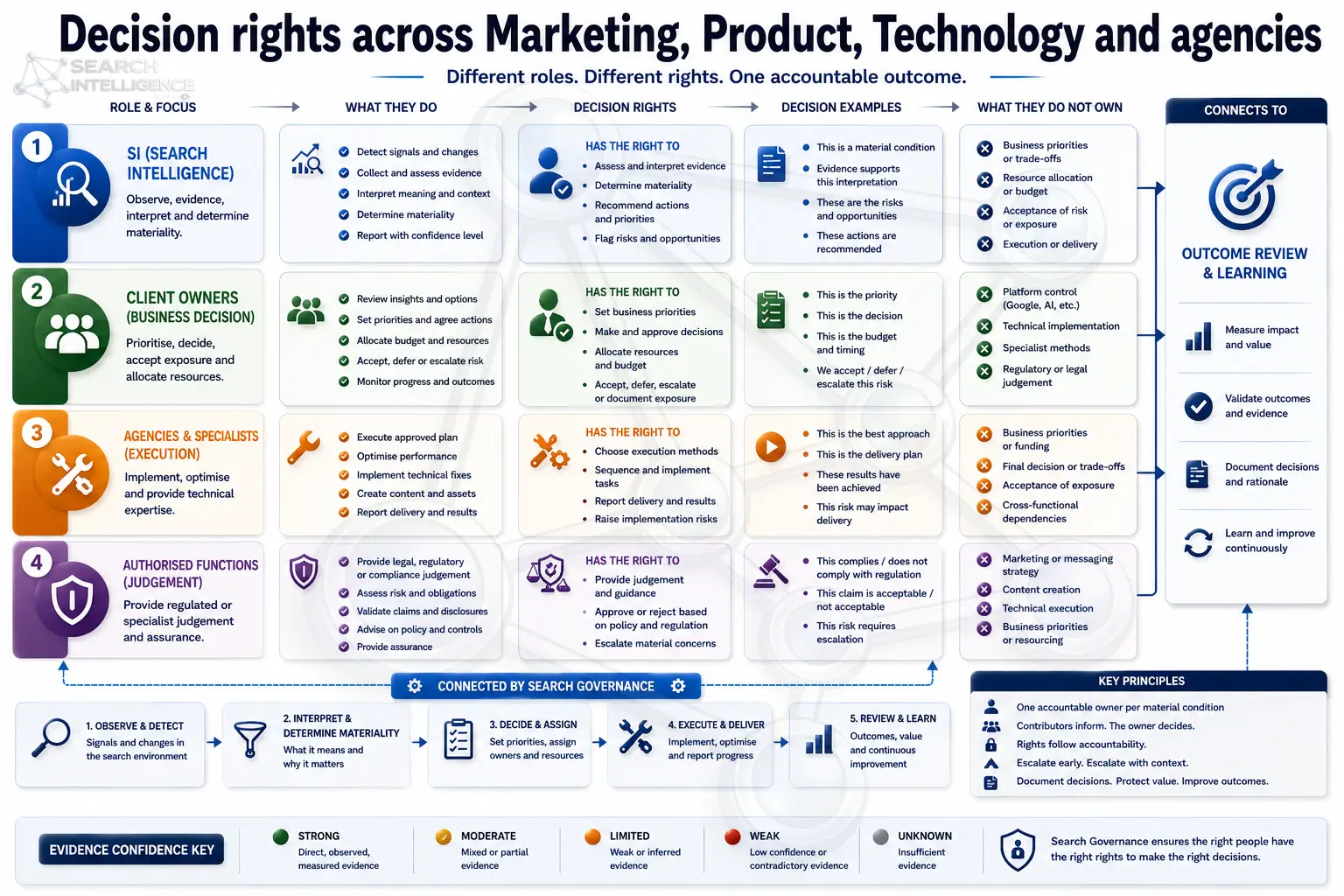
Four roles to separate
Business owner
Carries the customer or commercial condition.
Decision authority
Can approve, defer, reject or escalate the response.
Specialist implementer
Performs the approved technical, Content, Product, UX, reputation or assurance work.
Evidence and governance owner
Preserves the finding, decision, status, outcome and review.
Without this separation, agencies are blamed for client-side delays, Technology receives tasks without business context, Product is asked to approve wording without seeing customer evidence, Marketing assumes execution means the outcome is solved, and leadership cannot see where the real blocker sits.
A useful decision-rights table
| Decision | Likely authority | Likely implementers |
|---|---|---|
| Change approved Product information | Product / authorised specialist | Content, SEO, Development |
| Prioritise platform remediation | Digital / Technology leadership | Development, platform, vendors |
| Respond to reputation evidence | Corporate Affairs / CX | PR, service, Content, agency |
| Validate financial contribution | Finance | SI, Analytics, commercial teams |
| Accept residual exposure | Accountable business sponsor | Governance record retained |
SI interprets and governs the decision system. It should not take authority that belongs to the organisation, the client decides what to fund, accept, publish and what business risk to carry. That boundary protects accountability.
A decision-rights example
An AI answer incorrectly summarises a Product condition. SEO can capture the answer and improve source discoverability. Product must confirm the approved condition. Compliance may need to approve the interpretation. Content can revise the public explanation. Technology can improve source access and entity structure. Corporate Affairs may decide whether external correction is necessary. The business sponsor decides urgency and accepted exposure.
No single team should inherit the complete accountability.
Decision rights by stage
Evidence, interpretation, materiality, approval, implementation, risk acceptance and publication each need a named authority, who may collect evidence, determine meaning, weigh consequence, approve the truth, perform the work, accept exposure and authorise external use.
Avoiding two extremes
Centralising every decision with one sponsor creates delay and weak specialist ownership. Distributing decisions too widely means nobody can resolve a cross-functional conflict. A good model delegates routine authority and preserves clear escalation for material conditions.
What Procurement should understand
SI is not procured to replace all these functions. It is procured to create a defensible decision and evidence layer across them. That distinction should appear in scope, RACI, deliverables and evaluation criteria.
A decision-rights checklist
Before mobilisation, confirm who may approve the truth, who may fund the response, who may implement it, who validates completion and who accepts the remaining exposure. Where one person cannot answer all five, the decision should be routed rather than informally assigned. Clear decision rights also protect specialists from being asked to make business, legal or Product judgements beyond their authority.
Clarify who decides before asking who delivers.
See Agency Collaboration, or return to the cornerstone framework.