
The competitor who grows quietly: Decision-space loss before market-share decline
4 min read
A competitor enters a few commercially important searches. Its explanations improve. Reviews become more reassuring. AI systems cite its pages more often.
No single movement appears decisive. Together, they change who the customer treats as the stronger option.
The model at a glance
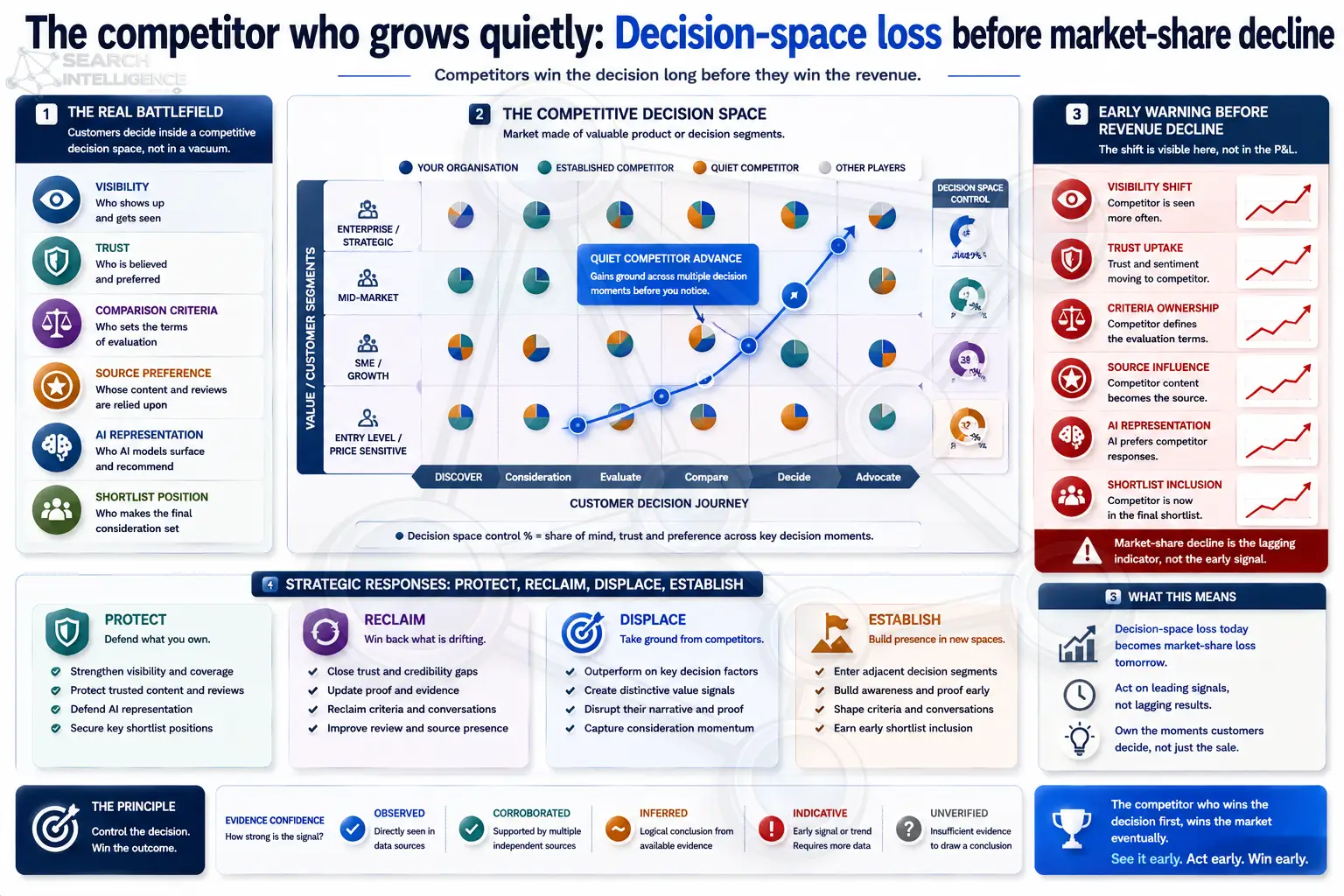
Decision space is more than ranking position
Decision space includes the sources, comparisons, explanations and trust signals that shape customer preference. A competitor may gain ground through first-page consistency, stronger Product truth, better external references, clearer comparisons, more credible reviews, faster implementation, stronger technical access, and repeated AI inclusion.
When movement becomes structural
SI looks for persistence, portfolio breadth, customer relevance and reinforcement across sources. One temporary ranking change may be noise. Repeated movement across connected high-intent queries, supporting Content and third-party evidence may indicate structural momentum.
The early stages of displacement
Competitive displacement often develops in layers: the competitor appears for a small set of relevant needs; its Product and comparison Content improves; external sources reference it more often; reviews strengthen; it gains first-page consistency; customers begin using it as the comparison reference; branded demand and commercial outcomes follow later.
Leadership may notice only the last two stages. SI is designed to observe the earlier pattern.
The earlier signal may not prove future market-share loss. It can still give the organisation time to understand the customer condition, strengthen the Product or evidence, fix the journey and assign ownership before recovery becomes expensive.
Not every visible competitor deserves attention. A material competitor is more likely to serve the same customer need, compete for the same Product or decision space, gain repeated presence across connected queries, provide stronger trust or comparison evidence, offer a viable next step, sustain movement over time, and create a realistic commercial transfer.
Choosing the response
Protect
Strengthen a valuable position before it weakens.
Reclaim
Restore lost presence where the organisation still has a credible right to compete.
Displace
Outperform weaker competitor evidence in a defined decision space.
Establish
Build a credible position where no organisation currently serves the customer well.
Monitor / No action
Avoid spending against low-value or structurally unwinnable spaces.
Competitive strategy should not be reduced to beating another website. The better outcome is a market where customers can find clearer, more useful and more reliable evidence. SI should help the organisation compete by improving the decision environment, not by manufacturing empty visibility.
Follow the competitor movement that matters.
Explore Competitive Displacement, or return to the cornerstone framework.