
Why Organic Search Performance Requires Governance
6 min read
Organic Search performance begins as a specialist concern.
A page cannot be indexed. A competitor is gaining. A Product category is underrepresented. A template is creating duplication. A content gap is weakening relevance.
The issue becomes a governance concern when the organisation must decide what matters, who owns the response and what happens when the work crosses functions.
That point arrives sooner than many teams expect.
Why Organic Search Performance Requires Governance
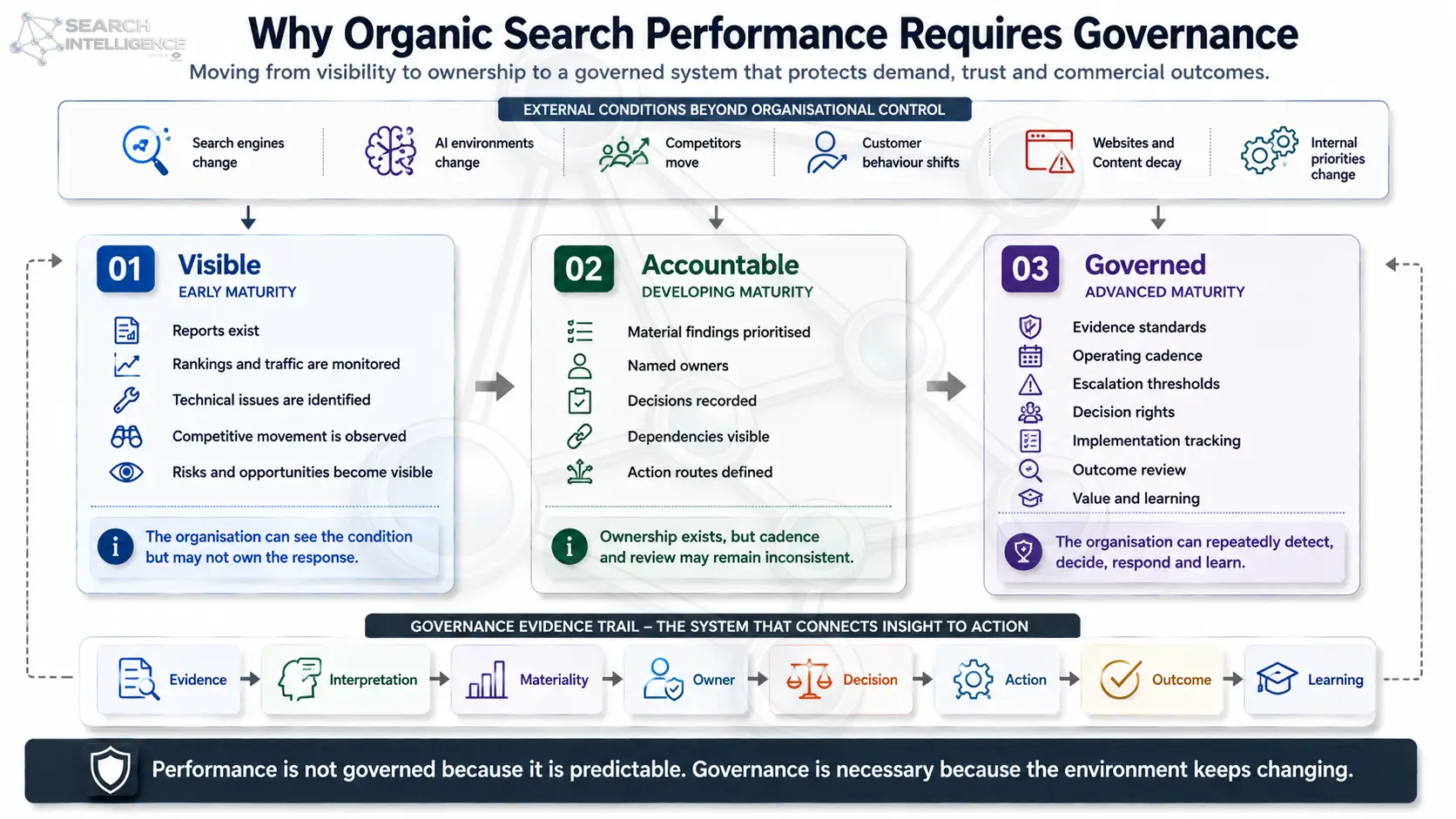
Performance depends on distributed control
Organic Search outcomes depend on decisions made across the organisation.
No single team controls the complete system.
Distributed control is normal. Unmanaged distributed control is the problem.
Reporting does not create ownership
A report can identify a material condition and still leave the organisation unchanged.
The finding may be accurate. The recommendation may be sensible. The responsible team may agree.
Nothing happens, for seven recurring reasons.
Data does not reduce exposure. Decisions and action do.
When governance is required
Formal Search Governance becomes necessary when one or more of the following conditions exist.
The issue is material
It affects important demand, customer confidence, reputation, technical resilience, Product truth or competitive position.
Several functions control the response
The work cannot be completed within one team's authority.
The issue repeats
Recommendations remain open, are reversed or reappear after implementation.
Evidence is disputed
Teams or suppliers rely on different data and interpretations.
Leadership must accept exposure
The organisation may choose not to act, but the decision should be conscious and recorded.
The outcome needs proof
The organisation needs to know what changed and what value was created or protected.
What Search Governance governs
Search Governance does not govern Google, customers or competitors.
It governs the organisation's own response.
This boundary is important. Governance creates control over organisational behaviour, not external certainty.
The operating chain
A governed response follows a traceable chain:
The chain prevents common failures.
Evidence cannot remain an unowned observation.
A recommendation cannot be treated as implementation.
Ticket closure cannot be treated as proof of outcome.
A ranking change cannot be treated as proof of commercial value without supporting evidence.
Governance protects the decision not to act
Governance is often mistaken for a requirement to fix everything.
A mature system protects restraint.
The difference is that the decision is explicit, owned and reviewable.
Governance improves specialist execution
SEO teams and agencies benefit when the client has a stronger decision system.
Material work is more likely to be understood, prioritised, approved, implemented, validated and connected to value.
Search Governance does not reduce the importance of specialist expertise. It creates better conditions for that expertise to produce a result.
Governance creates organisational memory
Without a record, the organisation repeatedly asks the same five questions.
The Evidence Trail turns individual decisions into institutional learning.
Over time, the organisation becomes better at recognising material patterns, allocating resources and avoiding repeated loss.
The complete operating relationship
Organic Search Optimisation manages continuous improvement.
SEO and related specialists implement within their authority.
Search Intelligence establishes what is happening and what is materially important.
Search Governance controls the organisational response.
Leadership owns business decisions and accepted exposure.