
Where SEO Ends and Search Intelligence Begins
5 min read
SEO and Search Intelligence are connected.
They are not interchangeable.
The distinction matters because organisations often ask SEO reporting to answer questions it was not designed to answer.
SEO can show how managed assets are performing and where they can be improved.
Search Intelligence establishes what is happening across the wider search-driven customer decision environment, why it matters and what is materially important.
Where SEO Ends and Search Intelligence Begins
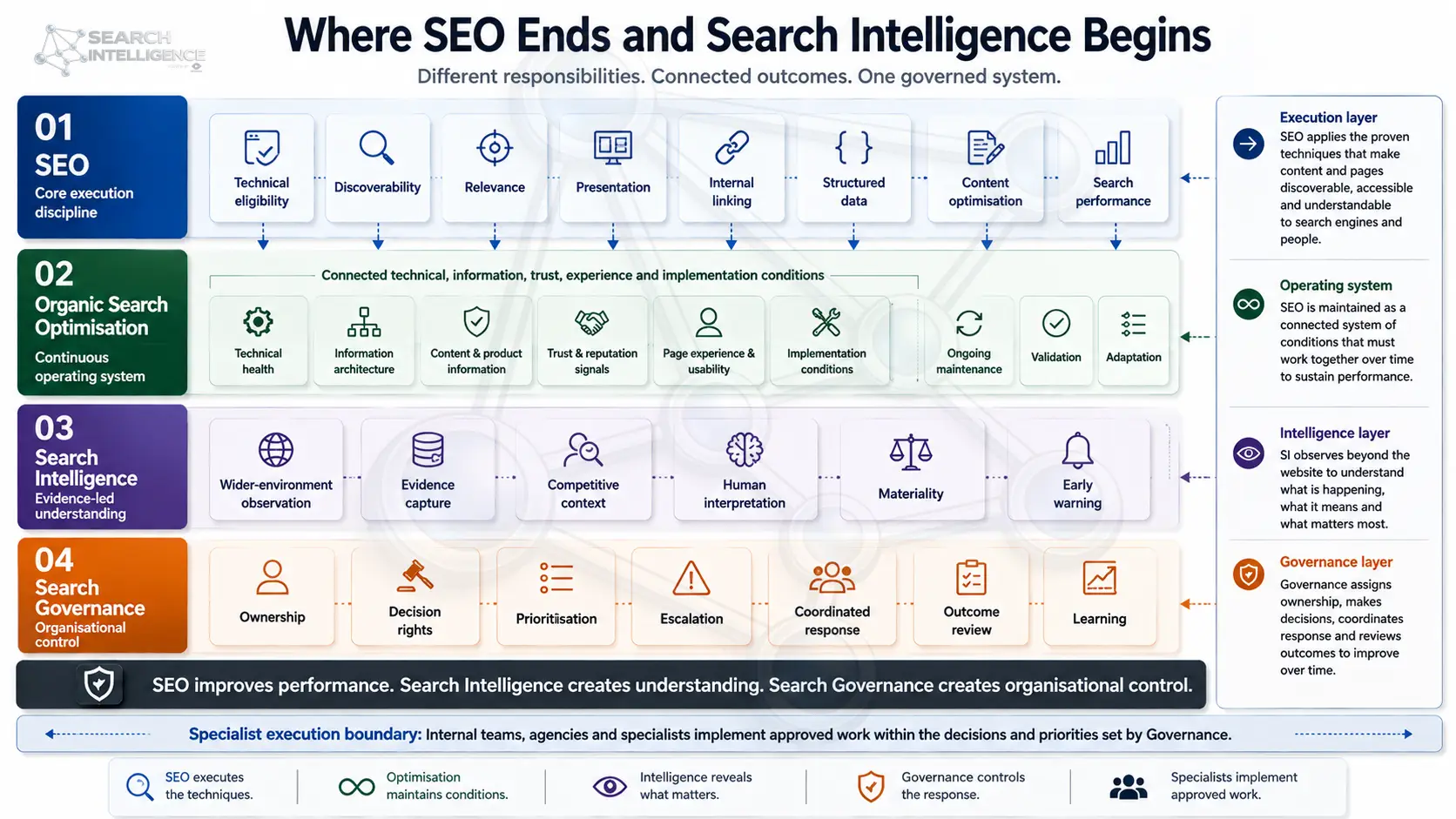
What SEO owns
SEO is the principal execution and optimisation discipline concerned with improving the eligibility, discoverability, interpretation, relevance, presentation and performance of managed digital assets within search experiences.
SEO remains necessary.
The problem is expecting it to provide the complete organisational model.
Questions SEO alone may not answer
A ranking decline can be observed through SEO data.
The wider questions sit outside what SEO data alone can settle.
These questions require wider evidence and interpretation.
Search Intelligence adds context
Search Intelligence observes and connects evidence across the whole decision environment.
The value is not more data. It is better interpretation.
Signal, noise and materiality
SEO tools can surface hundreds or thousands of issues.
Not every issue deserves the same response.
This Human Intelligence layer prevents dashboard volume from becoming organisational noise.
The boundary in practice
Consider an insurer losing presence for a high-value product segment.
SEO may identify weaker internal links, content gaps, indexation problems, and competitor pages outranking the insurer.
Search Intelligence may establish that one competitor has been gaining across the segment for several months, its content answers a new customer concern, review evidence reinforces its claims, AI answers increasingly reference its material, the movement affects commercially important demand, and the insurer's Product and service evidence is inconsistent.
The SEO response is now part of a larger business decision.
Search Intelligence does not replace SEO
Once the material condition is understood, specialist work is still required.
SEO, Content, Product, Technology, UX, Reputation or another function implements the approved response.
Search Intelligence should not become a vague strategic layer that diagnoses everything and owns nothing.
Its responsibility is disciplined observation, evidence, interpretation and materiality.
The handoff to Search Governance
Search Intelligence establishes what matters.
Search Governance determines how the organisation responds.
The complete relationship is:
The management principle
SEO ends where specialist optimisation no longer provides enough context to make a responsible organisational decision.
Search Intelligence begins where the organisation needs to understand the wider condition, consequence and materiality.