Diagnostic
Prevention creates value. It also creates a measurement problem. · 4 min read

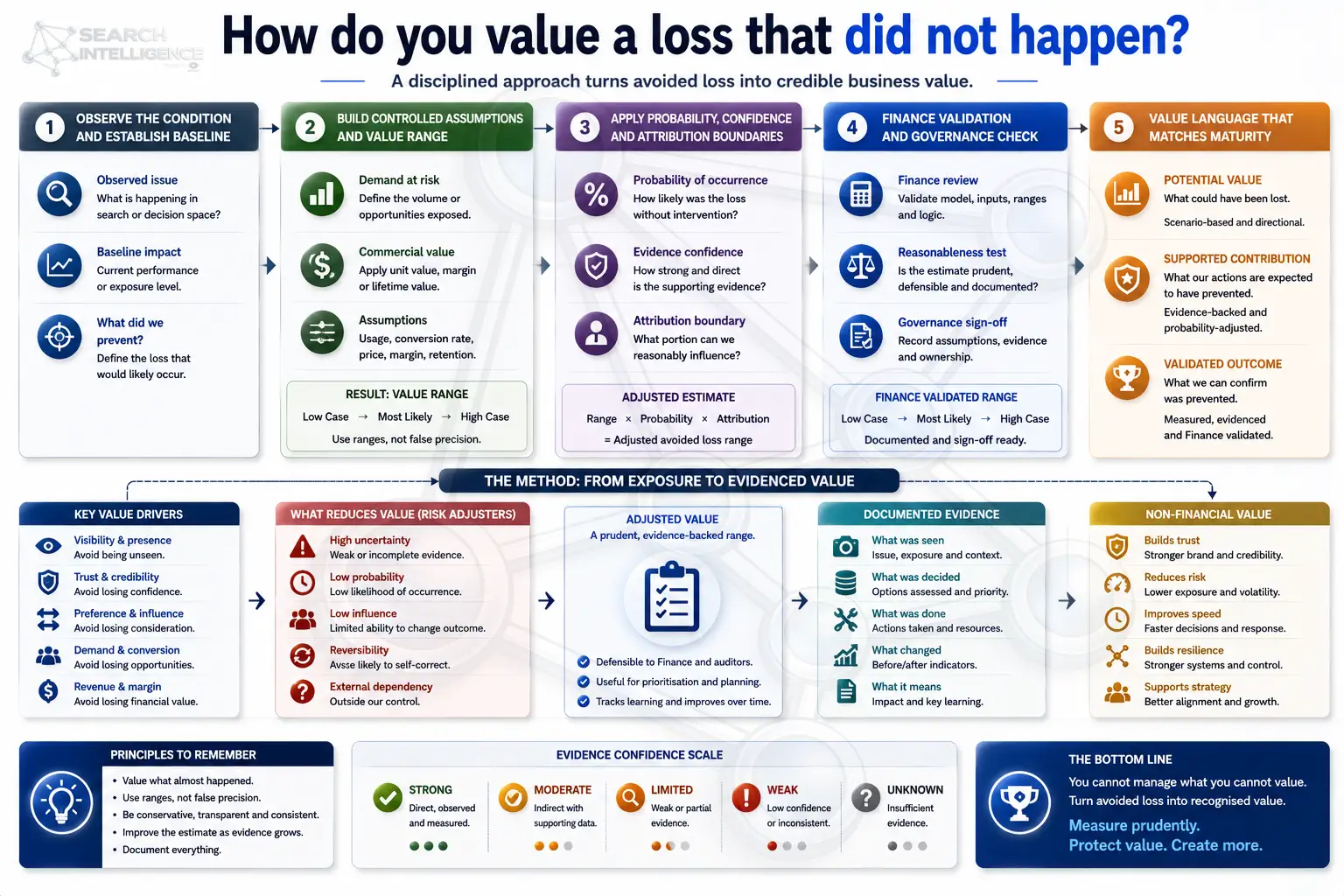
How do you value a loss that did not happen?

A technical failure is corrected before rankings decline. A Product explanation is clarified before a campaign sends more customers into the journey. A competitor's movement is identified early enough for the organisation to protect the segment.

What is that worth? The honest answer is rarely a single certain number.

Explore Growth and Value Review Results and Proof

The model at a glance

How do you value a loss that did not happen: observing the condition and baseline, building controlled assumptions, applying probability and attribution, finance validation and value language matched to maturity.
Start with the condition, not the claim

The record has to exist before the number does

What was exposed
The affected Product, customer or market
The loss mechanism
Baseline evidence
Likelihood and potential consequence
The approved intervention
The changed condition and residual exposure
Use a controlled estimate

The declared formula

Value exposed × Likelihood of loss × Influence factor × Period = Modelled avoided value
The inputs and assumptions must be declared. Sensitivity ranges are more honest than a single number.
Keep financial authority clear

SI establishes the evidence. Finance validates the number.

SI can establish the evidence, the loss mechanism and the contribution logic. Finance should validate the financial method and the use of the resulting figure.

Modelled Validated only once Finance signs the method
Value can be non-financial and still material

Not every useful outcome belongs in revenue

Protected Customer Confidence Preserved First-Page Presence Reduced Paid Dependency Avoided Rework Reduced Technical Exposure Faster Decision-Making Retained Category Position

A disciplined avoided-loss example

A high-value application journey fails intermittently on mobile.

What can be observed
The failure rate
Affected sessions
Product value
Historical completion behaviour
The period of exposure
What stays uncertain
Not every failed session would have completed
Customers may return through another channel
Seasonality may change demand

A responsible record uses a range, labels the assumptions and preserves alternative explanations.

Three levels of value language

The language should advance only as the evidence advances.

01 Level 01

Descriptive

"A commercially important journey failure was removed."

02 Level 02

Supported contribution

"Completion improved after the failure was corrected, while other material conditions were reviewed."

03 Level 03

Modelled financial value

"Based on the approved assumptions, the intervention may have protected value within a defined range."

Always report a range, never a point
Conservative Central Upper

A single precise figure implies a certainty the evidence does not support. The range makes uncertainty visible and lets Finance challenge the assumptions.

Removing a material failure, protecting Product truth or retaining a strong category position is valuable even when the financial amount cannot yet be validated.

Avoided cost is broader than revenue

Prevention also removes costs that never reach a revenue line.

Costs the organisation may avoid
Emergency Remediation Repeated Investigation Additional Paid Acquisition Customer-Support Demand Reputation Response Duplicated Supplier Effort Delayed Product Launch Future Migration Complexity

Governance questions for Finance

01 Which baseline is approved?
02 What counterfactual is being assumed?
03 Which period is reasonable?
04 What other factors could explain the result?
05 What confidence range is appropriate?
06 Who may use the estimate and for what purpose?
07 When can the claim be treated as Validated?

The goal is not to undervalue prevention. It is to value it in a way that survives challenge.

Value prevention with discipline.

Explore Growth and Value, or return to the cornerstone framework.