
Search Intelligence for Beauty and Cosmetics
7 min read
A customer may discover a serum in a creator's video, search the active ingredient, read two retailer reviews, compare the Brand's claim with a dermatologist's article, ask AI whether it suits their routine and buy from a marketplace the Brand does not control.
That journey can happen without the Brand website ever becoming the centre of the decision.
Beauty Search Intelligence focuses on the evidence around the Product: what is claimed, what is substantiated, how the Product is described across retailers and creators, which concerns create demand and where confidence transfers to an alternative.
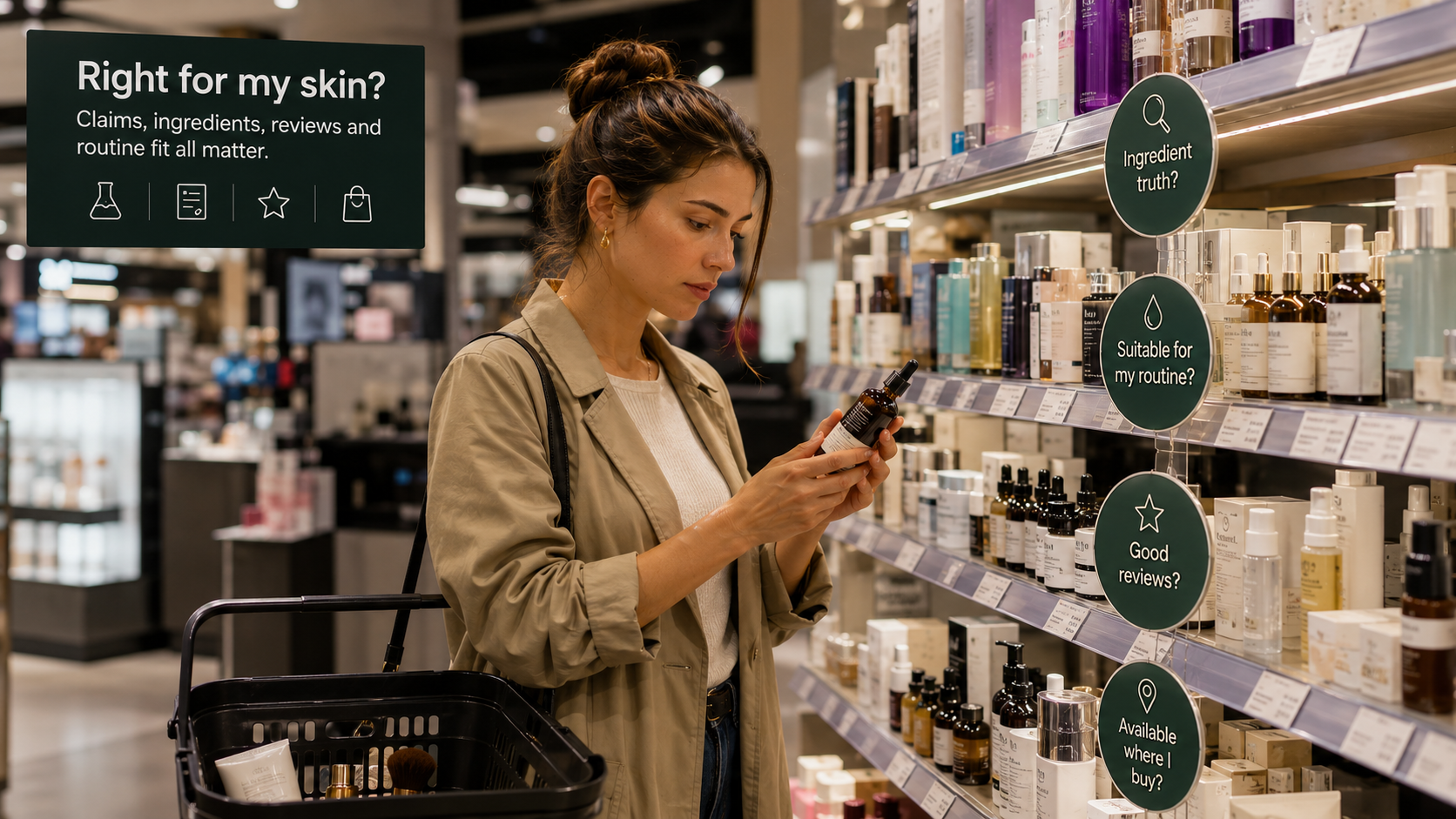
The sector truth
The Product may be desirable before the customer believes it. The real question is:
Search Intelligence examines the evidence surrounding that choice: concern-led searches, ingredient and Product information, retailer listings, reviews, creators, publishers, AI recommendations, availability and the ecommerce journey.
SEO helps approved Product information become discoverable. SI asks whether the Product truth, claims and customer evidence remain coherent once the shopper leaves the Brand page. Search Governance connects material issues to Brand, Product, Regulatory/Claims, Ecommerce, Retail and specialist owners rather than asking Content to repair every problem.
What conventional reporting may not show
The Brand may see strong reach and healthy ecommerce traffic while the customer is losing confidence elsewhere. A retailer may show an outdated ingredient list. A review theme may contradict the promise. A creator may overstate the Product. AI may collapse a cosmetic claim into language that sounds medicinal. A shade or variant may be difficult to find when the customer is ready to buy.
These are not all Content problems. They are Product truth, source, reputation, retail, technical and governance conditions.
What Search Intelligence should focus on
Eight governance priorities specific to beauty decisions.
Concern and need-state discovery
Map the beauty questions customers use before they know the Product or Brand name.
Product and ingredient truth
Compare approved Product, ingredient, use and variant information across owned, retailer and marketplace sources.
Claims integrity
Identify where public wording may exceed approved substantiation, lose context or drift across channels.
Shade, variant and suitability discovery
Assess whether customers can find the right Product form, shade, size or routine information without confusion.
Reviews, UGC and influencer evidence
Observe the public narratives shaping trust and distinguish customer experience from approved Product evidence.
Retailer and marketplace consistency
Find mismatches in names, claims, imagery, ingredients, availability and Product descriptions across sellers.
Availability and ecommerce journey
Test whether high-intent Product demand reaches a viable retailer, cart or checkout path.
AI Product and routine representation
Capture how AI systems describe Product claims, ingredients, suitability and comparisons, including source provenance and qualification.
How the From Visibility to Authority framework applies
The customer progression remains:
Authority is the compounding market outcome that may emerge when those conditions are repeatedly sustained. It is not an equivalent fifth customer-progression stage.
Where value can be created, protected or recovered
Value created
New concern-led discovery, stronger Product education, improved retailer conversion, better launch support and more commercially useful category presence.
Value protected
Brand trust, approved claims, retailer consistency, repeat-purchase confidence, Product reputation and the value of creator or media investment.
Value recovered
Lost retailer visibility, outdated Product information, weak category association, inaccurate AI representation and confidence damaged by old or unsupported public descriptions.
Waste avoided or investment redirected
Paid and influencer demand sent into inconsistent Product information, duplicate low-value Content, unresolved retailer feeds and acquisition activity that repeatedly compensates for Product truth problems.
The evidence status must travel with any value conclusion: Observed, Inferred, Modelled, Validated or Unknown. Contribution can be stated where the evidence supports it. Attribution requires a disclosed causal method.
AI can recommend routines, compare ingredients and summarise reviews in seconds. That makes source governance especially important. SI should identify whether the Product is represented accurately, whether claims remain within their approved cosmetic context and which external sources are becoming the default explanation.
AI Narrative Integrity therefore operates across the complete strategic stack. The organisation cannot control external AI systems. It can govern approved source accuracy, currency, provenance, entity coherence, technical accessibility, ownership, correction and re-observation.
Beauty Brands live in the tension between aspiration and proof. The Brand can create desire, but trust depends on whether Product truth, claims, retailer information and customer experience support the promise. Search Intelligence helps show where meaning is strengthening preference and where the public evidence is asking the Brand to change something more fundamental.
What an SI assessment could produce
A useful first scope might be one Product range, one concern category, one launch or one retailer/ecommerce decision journey. The assessment should be narrow enough to trace the approved claim, public evidence and commercial path without turning the exercise into a catalogue audit.
Boundaries and authorised judgement
SI does not substantiate cosmetic claims, provide dermatological or medical advice, determine Product safety or replace Regulatory, Legal, R&D or professional judgement. Claims remain subject to the organisation's approved substantiation and applicable advertising controls.
Questions leadership and functional teams should be able to answer
Start with the customer uncertainty closest to commercial or reputational consequence.
Establish what the customer can currently find, what evidence enters consideration, which condition appears material, who can change it and what would count as improvement.