
Govern the moments FMCG consumers choose what to trust.
FMCG customers do not only search to find products. They search to reduce small but decisive doubts about quality, safety, ingredients, claims, availability, value, family suitability, and reasons to choose.
Search Intelligence helps FMCG brands govern the search environments where product truth, claim confidence, retailer pathways, category preference, and repeat purchase confidence are formed.
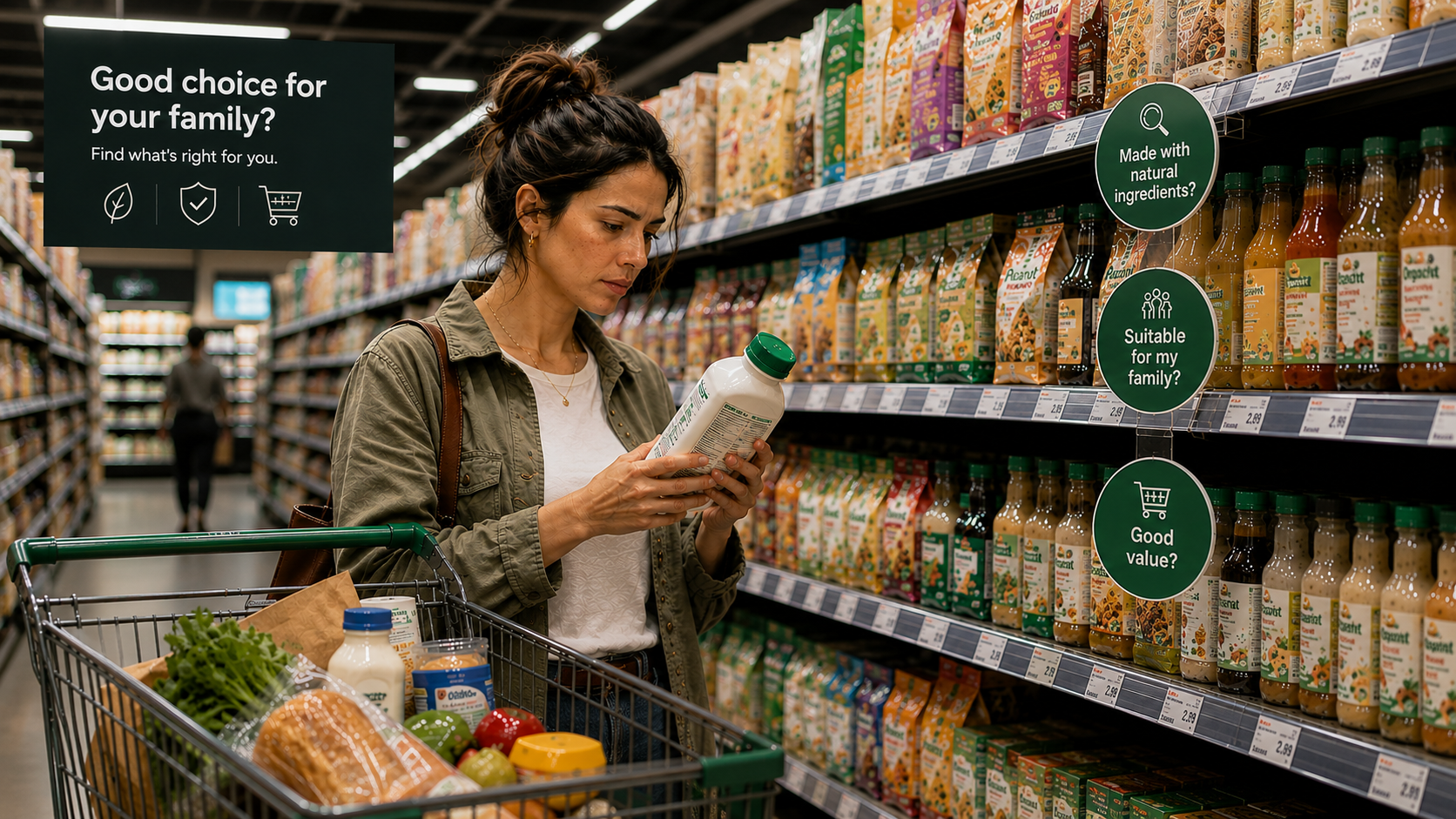
FMCG decisions look simple. The confidence layer is not.
From the outside, FMCG can look like fast choice: see product, recognise brand, check price, buy. But many purchase decisions include fast confidence checks: is this safe, is this right for my family, is this healthy enough, can I trust the claim, will I regret choosing this?
A consumer may not convert on the brand website, but search still influences shelf choice, ecommerce selection, retailer pathway completion, product substitution, claim credibility, and repeat purchase.
Product truth is now searchable.
FMCG brands can no longer rely only on advertising, shelf visibility, packaging, retailer distribution, or promotions. Consumers search ingredients, claims, reviews, health suitability, allergens, product availability, certifications, comparisons, and AI recommendations.
Retailers, competitors, influencers, publishers, AI systems, and user-generated content can shape product confidence before the consumer reaches the shelf. If the brand does not govern these signals, product truth may be defined by someone else.
Seven governance priorities specific to shopper decisions.
Whether product facts, ingredients, nutrition, benefits, allergens, and certifications are accurate, consistent, and visible.
Health, sustainability, quality, functional, safety, ethical, and performance claims across owned, earned, and retailer environments.
Whether customers can find where to buy, which retailers stock the product, and whether ecommerce pathways reinforce confidence.
Where search shapes preference through comparison content, reviews, recipe moments, and product education.
How reviews, ratings, testimonials, UGC, complaints, and third-party proof affect confidence.
How AI systems describe, compare, recommend, or omit the brand and its products.
Where competitors or private-label alternatives appear more available, affordable, credible, or better explained.
FMCG consumers search to resolve small doubts that change choice.
The FMCG consumer is often asking: is this product safe, suitable, believable, available, and worth choosing? Search Intelligence maps that tension into a governable model.
Common FMCG search governance risks.
| Risk | What it means |
|---|---|
| Product Truth Gap | Product facts are unclear, inconsistent, outdated, or hard to find |
| Claim Confidence Risk | Claims lack visible proof or responsible framing |
| Retailer Pathway Weakness | Search interest does not connect clearly to purchase options |
| Ingredient or Nutrition Confusion | Consumers cannot validate suitability quickly |
| Safety or Allergen Concern | Search-facing information does not resolve concern |
| Review and Social Proof Weakness | External proof does not support confidence |
| Substitution Risk | Competitors or private label appear easier to choose |
| Availability Signal Gap | Consumers cannot confirm where to buy |
| AI Product Narrative Risk | AI systems misstate, omit, or weakly represent products |
| Occasion Relevance Gap | Brand content does not connect product to real use moments |
What the FMCG Diagnostic produces.
- Product Truth Review
- Claim Confidence Snapshot
- Retailer Pathway and Availability Review
- Category Preference Search Map
- Review and Social Proof Signal Review
- AI Product Narrative Integrity Snapshot
- Substitution and Private-Label Exposure Map
- Search Risk Register
- FMCG Decision Confidence Score
- Commercial Priority Roadmap
Why this matters to leadership.
Find where consumers may be losing confidence before shelf, basket, or repeat purchase.
Take the FMCG Decision Confidence Diagnostic to identify where product truth, claim confidence, and category preference signals may be exposed.